
Alerts
-
4 minutes, 52 seconds
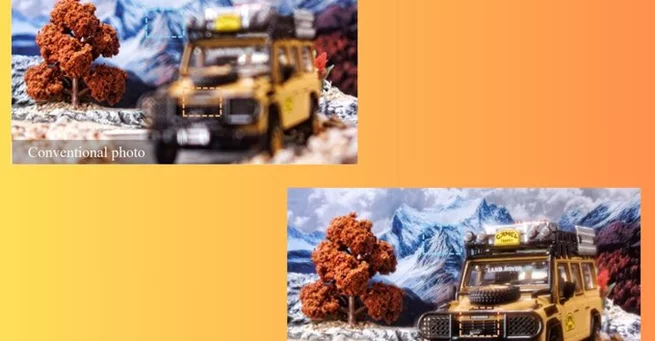
Experimental focal lens camera research is changing how cameras see the world, answering a long-standing question many photographers ask: why can’t everything be in focus at once? Researchers at Carnegie Mellon University say that limitation may soon disappear. Their new system allows a camera to focus on multiple objects at different distances simultaneously. Unlike traditional lenses, this design does not rely on a single focal plane. Instead, it distributes focus control across the entire image. That means near and far details appear sharp in a single shot. For everyday users, it could eliminate the need for complex manual adjustments. For professionals, it opens entirely new creative possibilities.
Conventional cameras are built around a simple optical rule that mirrors human vision. At any moment, only one distance can be perfectly sharp. Objects closer or farther away naturally blur, creating depth but also hiding detail. Photographers often compensate by stacking multiple images shot at different focus distances. While effective, that process is time-consuming and impractical for moving scenes. Smartphones and modern cameras try to simulate full focus using software tricks. However, these methods still rely on multiple exposures. The experimental focal lens camera challenges this approach at the hardware level.
At the heart of this breakthrough is what researchers call a computational lens. The system blends a Lohmann lens with a phase-only spatial light modulator. Together, these components can bend and adjust light at a pixel-by-pixel level. Instead of one fixed focus point, each region of the image can be tuned independently. Associate professor Matthew O’Toole describes it as giving every pixel its own adjustable lens. This allows the camera to decide which areas should remain sharp. The result is a single exposure with depth-defying clarity. It is a fundamentally new way to think about optics.
One concern with all-in-focus images is that they might look flat or artificial. The CMU team addressed this by preserving natural depth cues. Their system keeps fine textures visible while maintaining realistic spatial separation. Unlike heavy software sharpening, this method works directly with incoming light. That reduces artifacts and preserves image integrity. Early demonstrations show crisp foregrounds and backgrounds coexisting naturally. For scientific imaging, this clarity can reveal details normally missed. For creative photography, it offers more control without sacrificing realism.
The experimental focal lens camera is not just about better photos for social media. Researchers see strong applications in robotics, medicine, and autonomous vehicles. Robots could analyze complex environments without refocusing. Medical imaging could capture layered biological structures more clearly. Self-driving systems might better detect obstacles at varying distances. Even augmented reality could benefit from sharper environmental mapping. Because the system reduces the need for multiple exposures, it also speeds up image capture. That efficiency matters in time-sensitive scenarios.
While the technology is still experimental, its implications are significant. Integrating computational lenses into consumer devices will take time. Manufacturing costs and hardware complexity remain challenges. However, similar obstacles existed before smartphone cameras adopted advanced sensors and AI processing. Experts believe hybrid optical-computational systems are the future of imaging. As research progresses, the experimental focal lens camera could move from labs to real-world products. If that happens, the way we think about focus may change forever. Cameras may finally see everything, all at once.










Comment