Alerts

-
4 minutes, 19 seconds
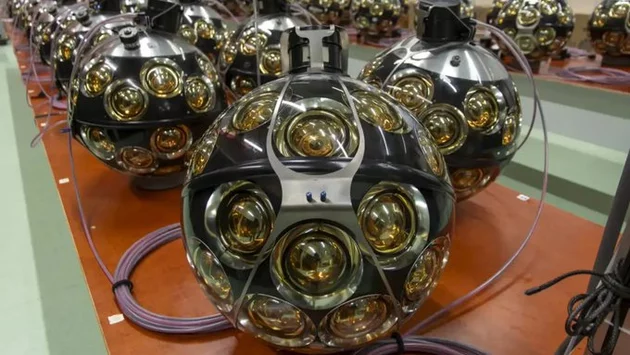
A single particle detected deep beneath the Mediterranean Sea may change how we understand the universe. In 2023, scientists using the KM3NeT neutrino detector recorded an ultra-powerful neutrino carrying energy roughly 25 times higher than anything produced in the Large Hadron Collider. Such a discovery has left physicists puzzled and excited, as it challenges long-standing theories in cosmology and particle physics.
The event was so extraordinary that researchers initially struggled to find an explanation. Now, a new study in Physical Review Letters suggests that this cosmic visitor might have originated from a primordial black hole — a type of black hole formed in the earliest moments of the universe.
Primordial black holes, or PBHs, differ significantly from the stellar black holes formed by collapsing stars. Proposed by Stephen Hawking, these tiny singularities emerged directly from the Big Bang. Unlike typical black holes, PBHs could vary dramatically in size, some being much smaller than the mass of our sun.
Size is more than a number in black hole physics. It directly influences Hawking radiation, a phenomenon Stephen Hawking theorized decades ago. Smaller black holes are predicted to emit more Hawking radiation, potentially leading to detectable cosmic signals — like the high-energy neutrino observed by KM3NeT.
The detected neutrino might not just point to a primordial black hole but also offer clues about one of physics’ greatest mysteries: dark matter. Some researchers theorize that PBHs could account for a fraction of the universe’s missing mass. If a tiny black hole explodes, it could release bursts of energy detectable as neutrinos or other high-energy particles.
Detecting such a particle provides scientists with a rare chance to test these theories in real-world conditions. It could confirm that PBHs exist and even offer a new method to probe the invisible dark matter shaping the cosmos.
KM3NeT, located in the depths of the Mediterranean Sea, uses thousands of light sensors embedded in the water to detect tiny flashes caused by passing neutrinos. These detectors allow scientists to observe cosmic events that are otherwise invisible, acting like a telescope for particles rather than light.
This neutrino’s energy was unprecedented. By studying it, physicists can explore questions previously confined to theoretical models. Each detection pushes the boundary of what we know about high-energy physics, cosmic explosions, and the formation of the universe itself.
While one neutrino cannot rewrite textbooks alone, it opens the door to exciting possibilities. Future detections by KM3NeT and other neutrino observatories could provide more evidence of primordial black holes and deepen our understanding of dark matter.
Every cosmic particle carries a story from the universe’s earliest moments. By listening closely, scientists hope to answer some of the biggest questions in physics: How did the universe evolve? What is dark matter? And could a single, tiny particle really challenge everything we thought we knew about black holes?










Comment