Alerts

-
3 minutes, 8 seconds
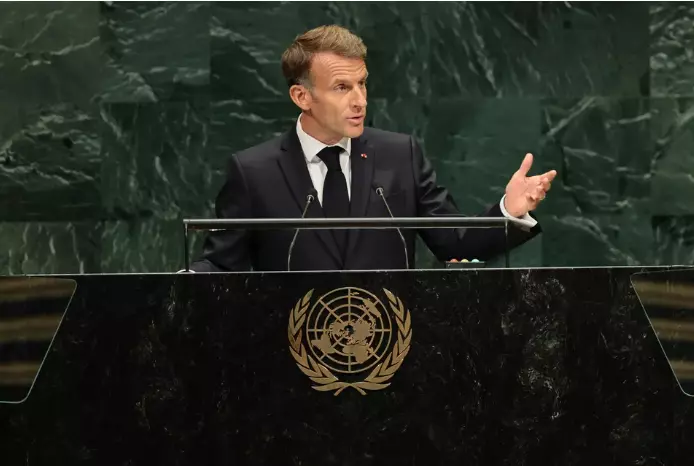
It was Tuesday in Manhattan during UNGA week, when the city that never sleeps becomes a traffic jam that never ends, boxed in by barricaded streets and constant motorcades. Amid the endless speeches, panels, and meetings, two words cut through the rest, delivered by French President Emmanuel Macron in his final address to the General Assembly: "Stand firm."
Macron was speaking specifically about standing firm against the abuse of power by empires. It's a simple, compelling idea, and far easier said than done. But what struck a chord was that it has little to do with geopolitics specifically. It's a test that applies just as much in a team meeting or client pitch as it does at a podium at the UN: do you actually hold your values when holding them costs you something, or only when it's free?
It's tempting to label the bending of values as a character flaw. It isn't. It's wired into the human condition. Behavioral economists have long shown that we discount future rewards in favor of immediate ones. The payoff for bending arrives today; the cost shows up later, often borne by others far removed from us. Short-term incentives don't just tempt us to compromise — they make it easy to relabel that compromise as prudence.
Today's climate of division, amplified by algorithms built to reward engagement over accuracy, only adds to the pressure. The 2026 Edelman Trust Barometer found that seven in ten people are unwilling or hesitant to trust someone with different values, backgrounds, or sources of information.
Most of us recognize this pull. It shows up when we stay quiet in a meeting about something we know isn't right. When we let a client, a boss, or a family member cross a line we said mattered to us, because naming it in the moment felt like more trouble than it was worth. None of it feels like a compromise when it's happening. It feels wholly reasonable. That's the trap.
The real cost of failing to stand firm rarely shows up on the day we fold. It compounds. Wells Fargo's sales-goal scandal is one of the clearer public examples: years of pressure on employees to hit unrealistic targets ended with millions of accounts opened for customers who never asked for them, and a cost to the bank's reputation, and its customers' trust, far greater than whatever short-term numbers those goals were designed to hit.
As I explored in The Courage Gap, when we trade what's expedient now for what would secure a stronger future, we make ourselves more vulnerable to greater dangers later. That trade often buries itself in the noise and emerges much later.
Macron may have been speaking to world leaders, but his invitation to stand firm holds a siren call for this time for each of us. Standing firm isn't the same as digging in. Digging in is about winning an argument; standing firm is about refusing to abandon what you know, at a deep level, is right and true. A value only holds real potency when it's tested by what we will refuse to do, not when it's stated from a stage or printed on a wall.
You don't need a podium at the UN to test that in yourself this week. You just need one moment where staying quiet would be easier — when a client, a boss, or a family member crosses a line you said mattered to you — and the willingness to not take it.










Comment