
-
4 minutes, 46 seconds
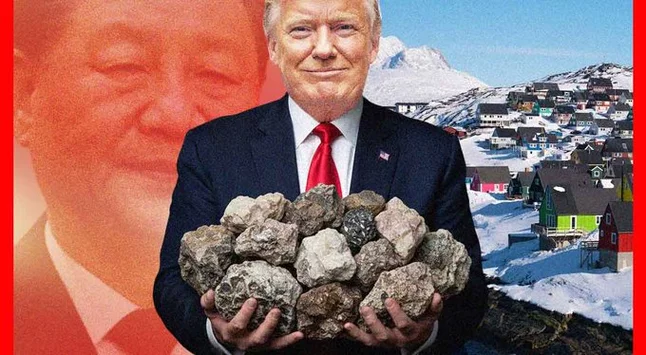
The icy expanse of Greenland might hold the key to the next technological revolution. With 1.5 million tons of rare earth minerals buried beneath glaciers, this Arctic territory has become a focal point in the escalating AI competition between the US and China. These minerals, critical for semiconductors, microchips, and batteries, are essential for powering artificial intelligence systems—making Greenland more than just a remote island.
As both nations race to dominate AI, securing reliable mineral supplies has emerged as a strategic necessity, blending national security with economic power. But Greenland’s frozen terrain presents serious challenges that could slow or even stall exploitation.
Greenland’s mineral deposits include Cerium, used in smartphone screens, and Germanium, essential for fiber-optic cables. These elements are not just useful—they are vital for AI infrastructure. Without them, producing advanced semiconductors or high-performance batteries becomes nearly impossible.
The United States and China, leaders in AI development, both face a bottleneck: controlling these rare earths. Currently, China dominates 60% of global Germanium production and has strict export restrictions, requiring special approvals for products containing its rare earths. This control creates a direct obstacle for manufacturers aiming to produce AI-enabled devices outside of China.
The strategic importance of Greenland extends far beyond its ice and snow. For the US, gaining access to these minerals could reduce reliance on Chinese exports and strengthen domestic AI production. China, meanwhile, seeks to maintain its grip on global rare earth markets, creating tension over Arctic resources.
Yet, mining Greenland is far from simple. Extraction costs are high, and environmental protections are strong. Political resistance is widespread: 85% of Greenlanders oppose large-scale mining, and 75% of Americans share concerns about environmental and diplomatic fallout. This makes Greenland a potential flashpoint in international tech and trade policy.
Outside the US and China, Europe and other Asian countries are investing in AI, but their efforts remain far behind. No single European AI initiative matches the scale of investment by US tech giants. For both China and the US, the ability to secure and control rare earth minerals directly affects their competitiveness.
Greenland represents a rare opportunity—and a rare challenge. While the US aims to diversify its supply chains, China’s established control over global minerals gives it leverage. Whoever manages Greenland’s resources effectively could gain a significant edge in AI development.
Even with Greenland’s potential, extraction is not guaranteed. Harsh climate conditions, glacial coverage, and community opposition make mining a delicate issue. Any initiative must balance economic interests, environmental protection, and indigenous rights—factors that could stall projects for years.
The intersection of geopolitics, technology, and natural resources makes Greenland a crucial but complicated piece of the AI puzzle. How the US and China navigate this challenge could shape global AI dominance for decades to come.
AI may be a battle of algorithms and talent, but minerals like those in Greenland are the backbone. Without access to these rare earths, even the most sophisticated AI programs are limited by the hardware they run on. For now, Greenland remains frozen, both literally and strategically, but its hidden resources could decide the next chapter of AI leadership.

2.5K articles

1.4K articles

34 articles

28 articles














Comment