Alerts

-
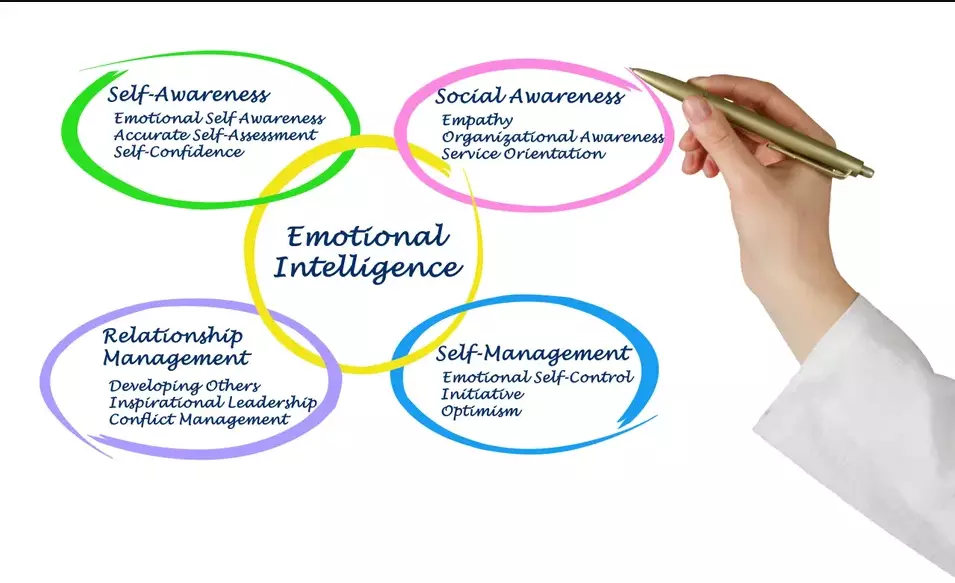
Emotional intelligence (EI) is your ability to recognize and understand emotions in yourself and others, and to use that awareness to manage your behavior and your relationships toward effective and desired outcomes.
To understand EI better, let’s talk about three things that EI is not. First, despite how it’s often framed, EI isn’t about being nice. EI is about being effective. In fact, many of the most emotionally intelligent leaders find themselves delivering the news nobody else wants to deliver.
Second, EI isn’t your personality. Personality is stable and largely fixed from a young age, while EI is a set of skills you can measurably improve with practice.
Lastly, EI isn't a proxy for IQ. The two are essentially unrelated, which is why so many brilliant people say and do the stupidest things and why the smartest person in the room is so often not the one running it.
To understand why this matters now more than ever, it helps to look at the structural shift that is redefining how careers are built. According to PwC's 2026 Global AI Jobs Barometer, which analyzed more than a billion job ads across six continents, entry-level roles most exposed to AI are now seven times more likely to require traditionally senior-level skills, like judgment and leadership. Seven times as likely to require senior-level skills for entry-level work.
Something deep has changed, and on a structural level. For decades, the unwritten rule of career progression was that “technical expertise gets you through the door and emotional intelligence gets you promoted.” That rule has been flipped on its head because of the way AI is shifting the modern landscape of work. When the technical, knowledge-based component of a job can be augmented or automated, the human skills then become an entry requirement.
So, while the question of "what is emotional intelligence" has been answered numerous times, the definition has shifted in some important ways, evolving to fit the demands of 2026, which are quite different from those of 2006. The data from the AI Jobs Barometer makes it clear that the old career playbook no longer applies. The most underreported and underrated statistic in this year’s labor data is that the boundary between entry-level and senior-level work is dissolving, not because technical requirements have been lowered, but because the baseline for human capabilities has been raised. In this new environment, the ability to exercise judgment, demonstrate leadership, and navigate complex interpersonal dynamics is no longer a bonus for the C-suite; it is the price of admission for the front door.
Embarking on a journey to enhance your emotional intelligence (EQ) can feel overwhelming if you treat it as a single, monolithic trait. To make the process more manageable and measurable, psychologists and leadership experts often break the concept down into four distinct core skills. This framework, sometimes referred to as the Four-Box Model, provides a clear roadmap for personal development. Before you begin working on these areas, it is highly recommended that you establish a baseline by taking a validated emotional intelligence assessment. This initial step helps you identify your natural strengths and the specific areas that require the most attention.
The first pillar of the model is self-awareness, which serves as the bedrock for all other emotional skills. This is your ability to accurately recognize your own emotions as they arise in real-time and to understand the underlying drivers behind them. It is about knowing what truly makes you tick. This includes identifying your specific triggers, understanding your behavioral tendencies when you are under pressure, and recognizing the gap between how you think you present yourself to the world and how you are actually perceived by others. Without a solid grasp of your internal state, the other components of emotional intelligence have little to build upon.
Self-management is essentially what you do with the insights gained from self-awareness. It is the ability to remain flexible and consciously direct your behavior in a productive manner, particularly in moments when you would rather react impulsively. It is crucial to clarify that self-management is not about suppressing or bottling up your emotions. Extensive research has demonstrated that suppression is an ineffective long-term strategy. Instead, true self-management involves working with your emotions, acknowledging their presence, and channeling that energy toward a more constructive and positive outcome.
The third component, social awareness, is the outward-facing counterpart to self-awareness. This skill involves your capacity to accurately read the emotions of others and to understand what is genuinely happening with them on a deeper level. While empathy is a central element of social awareness, this competency extends further. It encompasses your ability to pick up on the subtle emotional cues, tendencies, and unspoken dynamics of the people around you. Developing strong social awareness allows you to navigate group settings with greater sensitivity and insight.
The final piece of the model is relationship management. This is the skill that most heavily depends on the previous three, as it requires you to draw upon your self-awareness, self-management, and social awareness simultaneously to build and maintain effective interactions. Your proficiency in this area directly impacts your ability to handle conflict resolution, navigate critical conversations, deliver and receive feedback, exert positive influence, and build lasting trust. In essence, relationship management is the practical application of your entire emotional intelligence toolkit, determining the overall health and effectiveness of your personal and professional connections.
The business case for emotional intelligence was compelling long before artificial intelligence entered the mainstream. Drawing on data from more than 500,000 assessments, EI expert Travis Bradberry found that emotional intelligence accounts for 58% of performance across all job types, and that 90% of top performers score high in it. His research also indicates that EI is roughly twice as predictive of success as IQ, and that your compensation follows your EI. High-EI professionals earn an average of $29,000 more per year than their low-EI counterparts.
Now add AI to the equation, and the calculus becomes even more interesting. AI is delivering real productivity gains. PwC finds productivity growth running 40% higher at the companies most exposed to AI than at the least exposed. But productivity is not the same as return. The gap between what AI produces and what an organization actually realizes in return is bridged almost entirely by human skills. That bridge—EI—is where ROI is won and lost.
The market has noticed. The new types of skills being added to AI-exposed roles are 2.5 times more likely to depend on capabilities like empathy, judgment, and creativity. Any specific technical capability has a shortening shelf life, and what holds value is the layer underneath. These are the roles PwC calls “professionalized,” where AI absorbs your routine work and human interaction, and human judgment becomes increasingly important.
Employers say the same thing when you ask them directly. The World Economic Forum’s Future of Jobs Report 2025 ranks EI skills like resilience, flexibility, agility, leadership, social influence, motivation, and self-awareness as among the top ten most desirable skills.
AI supplies the leverage, and EI helps you exercise the judgment you need to turn your increased productivity and efficiency into realized profit.
The rise of artificial intelligence is reshaping the workplace, but it doesn’t spell the end of human advantage. In fact, it elevates the importance of the one skill set that machines cannot easily replicate: emotional intelligence. What makes EI so unique is that, unlike cognitive ability or inherent personality traits, these competencies are not fixed. While IQ and temperament tend to stabilize by early adulthood, the four core skills of emotional intelligence—self-awareness, self-management, social awareness, and relationship management—can be developed and strengthened at any stage of life.
This capacity for growth is rooted in neuroscience. Emotional responses travel through the limbic system before reaching the rational, thinking brain. However, the neural pathway between these two regions is plastic, or malleable. This means you can actively practice and rewire your brain’s reactions to stimuli. By consistently rehearsing a new, positive response, you create a new default path. Over time, this conscious effort becomes an automatic habit, effectively raising your baseline emotional intelligence.
The old adage that “technical expertise gets you through the door, but emotional intelligence gets you promoted” still holds weight, but the timeline has shifted. In today’s landscape, AI is rapidly automating the technical tasks that once served as your entry ticket. These hard skills are quickly becoming the table stakes—the minimum requirement just to compete. As AI handles more of the analytical and logistical work, the premium placed on human-centric skills rises. The abilities that previously distinguished senior leaders are now becoming essential expectations for entry-level employees.
This shift creates a significant opportunity for those willing to adapt. Whether you are a seasoned executive, a fresh graduate entering the workforce for the first time, or a professional somewhere in between, the conclusion is the same: social-emotional skills are now more critical than ever. Investing in these skills is not just a personal development goal; it is a strategic career imperative for thriving in an AI-driven world.
Kevin Kruse is the Founder and CEO of LEADx, a company specializing in emotional intelligence training. He is also a New York Times bestselling author. You can take his free, psychologically validated EI Assessment, which provides a score breakdown across each of the four core skills.










Comment