
-
5 minutes, 49 seconds
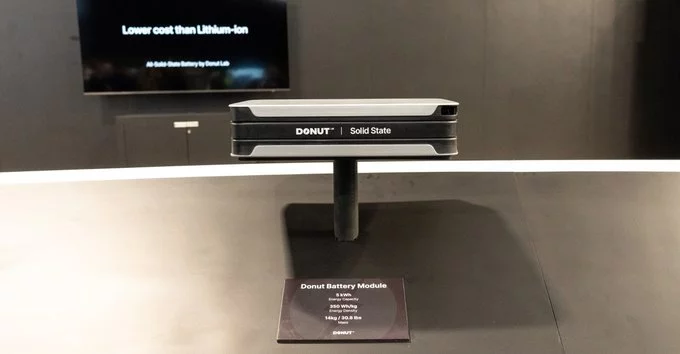
Questions about whether the Donut Lab solid-state battery is a real battery or simply a disguised supercapacitor have circulated since the technology was first announced. Now, new independent test results appear to settle the debate. The Finnish startup says recent testing proves its battery can retain energy over long periods—something supercapacitors typically cannot do. The findings could strengthen confidence in the company’s breakthrough claims and potentially reshape the future of electric vehicle energy storage.
When Donut Lab introduced its solid-state battery earlier this year, the announcement quickly captured attention across the electric mobility industry. The company claimed its battery could charge and discharge energy extremely quickly while maintaining high efficiency.
However, those performance claims raised eyebrows among battery experts and engineers. Some critics suggested the technology might actually be a supercapacitor, a device known for rapid charging and discharging but limited in long-term energy storage.
Supercapacitors and batteries serve very different purposes. Supercapacitors deliver quick bursts of energy but lose stored power quickly when idle. Batteries, on the other hand, are designed to store energy for longer periods while maintaining stable voltage. That difference became the central issue behind the skepticism surrounding Donut Lab’s claims.
To address the speculation, Donut Lab commissioned independent testing through VTT Technical Research Centre of Finland, a well-known state research organization specializing in advanced technologies.
The goal of the latest experiment was simple: determine whether the device behaves like a true battery when left idle. If the technology were a supercapacitor, it would lose a significant portion of its stored energy within a relatively short time.
Researchers connected the battery cell to testing equipment and left it unused for ten days. During that time, the system measured voltage levels every ten seconds to monitor how well the battery retained energy.
This experiment formed the third phase of independent testing ordered by Donut Lab to validate its technology.
The results were encouraging for the startup. According to the test data, the battery retained 97.7 percent of its stored energy during the 10-day idle period.
There was an initial drop in voltage during the first hour, decreasing from about 3861 millivolts to 3722 millivolts. Researchers attributed that early fluctuation to chemical stabilization inside the battery cell—a normal phenomenon during testing.
After that early adjustment, the battery maintained a remarkably stable energy level for the remainder of the test period.
For comparison, supercapacitors typically lose a substantial amount of stored energy due to self-discharge when left unused for extended periods. The stability shown in the test suggests the device functions as a genuine battery rather than a capacitor-like storage system.
Marko Lehtimäki, the CEO of Donut Lab, addressed the speculation directly following the release of the results.
According to Lehtimäki, many critics believed the company’s performance specifications could only be achieved with supercapacitor technology. The latest test results were designed specifically to challenge that assumption.
By demonstrating strong charge retention over an extended idle period, the company hopes to reinforce confidence among investors, partners, and industry observers.
Lehtimäki emphasized that independent validation is a key step in proving the reliability of new battery technologies.
Solid-state batteries are widely viewed as one of the most promising advancements in energy storage. Unlike traditional lithium-ion batteries, they replace liquid electrolytes with solid materials, potentially improving safety, energy density, and charging speed.
If Donut Lab’s technology continues to pass independent testing, it could play a role in accelerating the development of next-generation electric vehicles. Faster charging and improved efficiency remain major goals for automakers and battery researchers worldwide.
While further testing and large-scale production challenges still lie ahead, the latest results offer a strong signal that the technology may be more than just an ambitious concept.
For now, the Donut Lab solid-state battery appears to have cleared one of the biggest doubts surrounding its design—proving it behaves like a true battery, not a supercapacitor.

2.5K articles

1.4K articles

34 articles

28 articles













Comment