
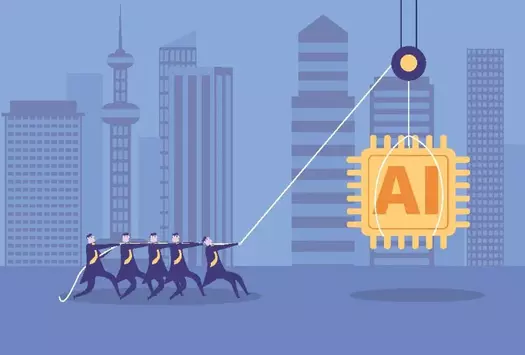
Many leaders search for answers to a growing gap: Why are so many enterprise AI projects failing, and what are top companies doing differently? As organizations enter their third year of mainstream AI adoption, the results show a clear pattern. Research from Google, MIT Media Lab and McKinsey reveals that only a small fraction of companies are generating real, measurable value from their AI initiatives. Most are running pilots, experimenting with tools and layering new technologies onto outdated workflows. Meanwhile, a small “front-runner” group is turning AI into lasting business impact—proving that the real challenge is execution, not enthusiasm.
Industry studies continue to highlight the same trend: technology is advancing, but organizations are not structurally prepared to support it. Google’s “Beyond AI Optimism” report shows only 3% of companies have reached true AI-enabled transformation. MIT Media Lab found that 95% of generative AI pilots fail to show clear ROI. McKinsey’s latest AI survey echoes this gap, emphasizing that front-runners capture most of the impact while others struggle to scale. The disconnect is now impossible to ignore: leaders believe AI is delivering value, while employees say they lack clarity, confidence and support in using it.
The organizations seeing real results do not treat AI as a project or a phase. They operate with a living strategy—one that evolves as capabilities advance and business needs shift. These companies define what success looks like early, set measurable proof points and continually adjust direction. Their AI plans are integrated with broader business goals rather than siloed in IT. This long-game strategic approach ensures alignment as teams move from experimentation to scaling. For the top performers, strategy is not a document—it's a discipline.
In the top 3% of companies, AI is not an add-on. It becomes part of the daily language, training and rhythm of work. These organizations invest in building confidence and curiosity, not just teaching tools. Managers talk openly about what AI changes, what it doesn’t and how it can free employees for higher-value work. This transparency reduces fear and increases trust—two ingredients essential for productivity gains to stick. When people understand both the “how” and the “why,” AI shifts from intimidating to empowering.
The companies benefiting most from enterprise AI do not simply automate around the edges. They take the time to map out which tasks AI should handle, where human expertise is essential and how the two interact. Jobs evolve, responsibilities shift and friction disappears when processes reflect the new balance of human and machine work. This redesign ensures that employees move toward higher-impact tasks while AI absorbs repetitive or analytical load. The result is not just efficiency—it’s a more meaningful flow of work.
Successful organizations avoid centralizing AI knowledge in one team. Instead, they empower early adopters across departments to experiment, teach and influence peers. These “AI champions” become catalysts who spark fast, horizontal learning. Ideas travel quickly, adoption spreads organically and employees feel ownership rather than pressure. This networked approach helps maintain momentum long after initial excitement fades.
The top-performing companies select tools that integrate directly into existing work rather than creating separate systems. AI lives inside email, documents, messaging, meetings and shared workspaces. This reduces switching costs and makes AI a natural part of everyday decision-making. When people use AI without leaving their workflow, adoption surges—and measurable productivity gains follow. True enterprise AI success happens when the technology becomes invisible.
The research points to one undeniable truth: the front-runners succeed because they connect technology to purpose, workflows to value and people to the process of change. They do not assume AI will deliver results automatically. They build foundations that allow transformation to scale sustainably. These choices create a multiplier effect—leading to faster development cycles, stronger innovation and more meaningful work.
The organizations that treat AI as a leadership decision—not a software upgrade—are already outpacing their peers. Those that rely on tools without reshaping culture, workflows and strategy will continue to fall behind. Enterprise AI success now depends on intentional, human-centered transformation. Companies that embrace these five behaviors will move into the top 3% sooner than they expect.

𝗦𝗲𝗺𝗮𝘀𝗼𝗰𝗶𝗮𝗹 𝗶𝘀 𝘄𝗵𝗲𝗿𝗲 𝗽𝗲𝗼𝗽𝗹𝗲 𝗰𝗼𝗻𝗻𝗲𝗰𝘁, 𝗴𝗿𝗼𝘄, 𝗮𝗻𝗱 𝗳𝗶𝗻𝗱 𝗼𝗽𝗽𝗼𝗿𝘁𝘂𝗻𝗶𝘁𝗶𝗲𝘀.
From jobs and gigs to communities, events, and real conversations — we bring people and ideas together in one simple, meaningful space.


Comments