Alerts

-
4 minutes, 8 seconds
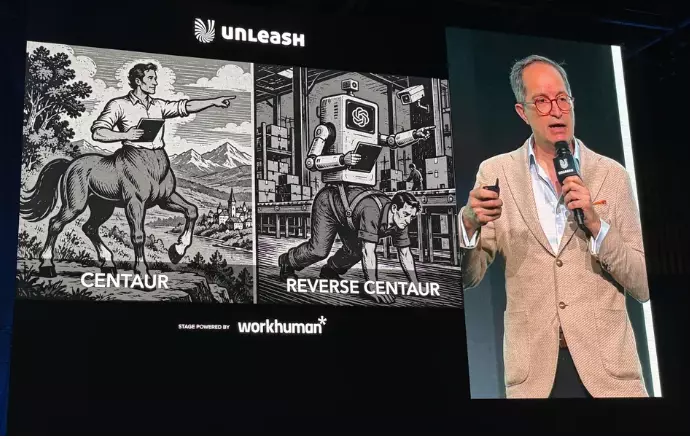
How organizations combine human judgment and artificial intelligence will shape whether AI expands people’s capabilities or turns them into executors of algorithmic decisions. At UNLEASH 2026 in Paris, Peter Hinssen, co-founder and partner at nexxworks, urged HR leaders to consider what kind of future they are building.
Hinssen drew on Cory Doctorow’s reverse-centaur metaphor. A traditional centaur has a human head directing a powerful horse’s body. In a reverse centaur, the relationship is flipped: AI supplies the direction, while people carry out its instructions. The distinction is not simply whether a workplace uses AI, but whether people retain meaningful control over goals and decisions.
If an organization values workers mainly for completing assigned tasks, technology may replace much of that work. Hinssen illustrated this with warehouse labor: an algorithm determines what to do, and a person repeatedly performs the prescribed action. In knowledge work, the same dynamic can be less obvious. A worker may review and approve a recommendation while contributing less of the thinking behind it.
Wharton researchers Steven Shaw and Gideon Nave call uncritical acceptance of AI-generated answers “cognitive surrender.” Their 2026 working paper reports three experiments involving more than 1,300 participants who answered reasoning questions with or without AI assistance. Participants sometimes followed incorrect AI advice and became more confident in their answers. A person can therefore remain accountable for a decision while signing off on a recommendation without examining it closely.
Human judgment can also be lost when employees do not speak up. At UNLEASH, University of Bath Professor of Practice Margaret Heffernan described “organizational silence”: people withhold ideas or concerns because they fear consequences or think nothing will change. They may see a better direction but no longer believe proposing it is worthwhile.
Cognitive surrender and organizational silence differ, but both limit human contribution. People may stop forming independent judgments, or stop sharing the judgments they have. In either case, an organization employs people’s minds without making full use of them. That is how a reverse centaur can emerge even when a process is described as human-led.
When an AI transformation begins with the technology, organizations naturally ask what it can automate, how quickly it can produce, which activities it can absorb and how much money it can save. These questions reveal the technology’s capabilities, but they can also restrict ambition to doing existing work faster and with fewer resources.
Starting with human creativity points to different possibilities. People may identify an unmet need, imagine an experience that does not yet exist or question an accepted outcome. AI can then help extend the reach of that intention. For example, a company might use AI to handle more customer complaints, or use what it learns from those complaints to rethink the service and address the underlying problem. AI can support either approach; people must decide which goal matters.
The human “head” of the centaur represents that responsibility: choosing what deserves effort and defining what a better outcome means.
Automating tasks does not automatically prepare employees for more creative or meaningful work. Organizations need to develop creativity and judgment alongside people’s ability to use AI tools. Heffernan argues that creativity is a capacity people already have, but that organizations must support and cultivate it.
She points to artists who observe the world closely and collect ideas before knowing what they will become. They do not always begin with a complete plan; direction develops through engagement, choices and revisions. Similar skills help employees recognize possibilities before a task has been defined. A new service, a more humane system or a different strategy may begin with someone noticing an issue worth pursuing.
Organizations can make room for people to notice, investigate and create, then give their discoveries a route into decisions. An employee’s observation might become a team experiment and later influence a broader direction. AI can help turn an idea into something others can examine and use, but leadership determines whether the idea can advance.
Efficiency matters. Removing unnecessary effort can improve work, make services more accessible and make new possibilities affordable. But efficiency alone does not prove that an organization has built a better future. A reverse centaur could perform very well by that measure.
A fuller definition of progress considers not only what AI produces, but what it enables: more people pursuing ideas, solving problems they care about, contributing their experience or changing systems that are not working. That opportunity should extend beyond senior leaders. Employees throughout an organization encounter needs and possibilities that strategists may not see.
The centaur offers a way to think about technology’s power guided by human intention. Building that future requires investment in both AI and human imagination—and giving people across the organization the chance to help choose the direction.










Comment