Alerts

-
6 minutes, 21 seconds

Short Summary:
Entrepreneurship Through Acquisition (ETA) is a business ownership model where entrepreneurs acquire an existing company instead of starting one from scratch. It combines acquisition, leadership, due diligence, financing, and post-acquisition growth.
Entrepreneurship Through Acquisition, commonly known as ETA, is a pathway to entrepreneurship that involves finding, acquiring, and operating an existing business. Instead of developing a new product, building a customer base, and establishing operations from zero, an entrepreneur becomes the owner of an established company.
The model can be attractive to professionals who want to become business owners but do not have a startup idea or prefer an existing revenue-generating operation. Harvard Business School describes ETA as a path where individuals can acquire an existing business, become its CEO, and work toward building a larger and more successful enterprise.
ETA can involve different acquisition structures, including self-funded searches, traditional search funds, and other sponsored approaches. A searcher typically establishes acquisition criteria, identifies potential businesses, evaluates opportunities, raises or arranges capital, and eventually takes an operating leadership role.
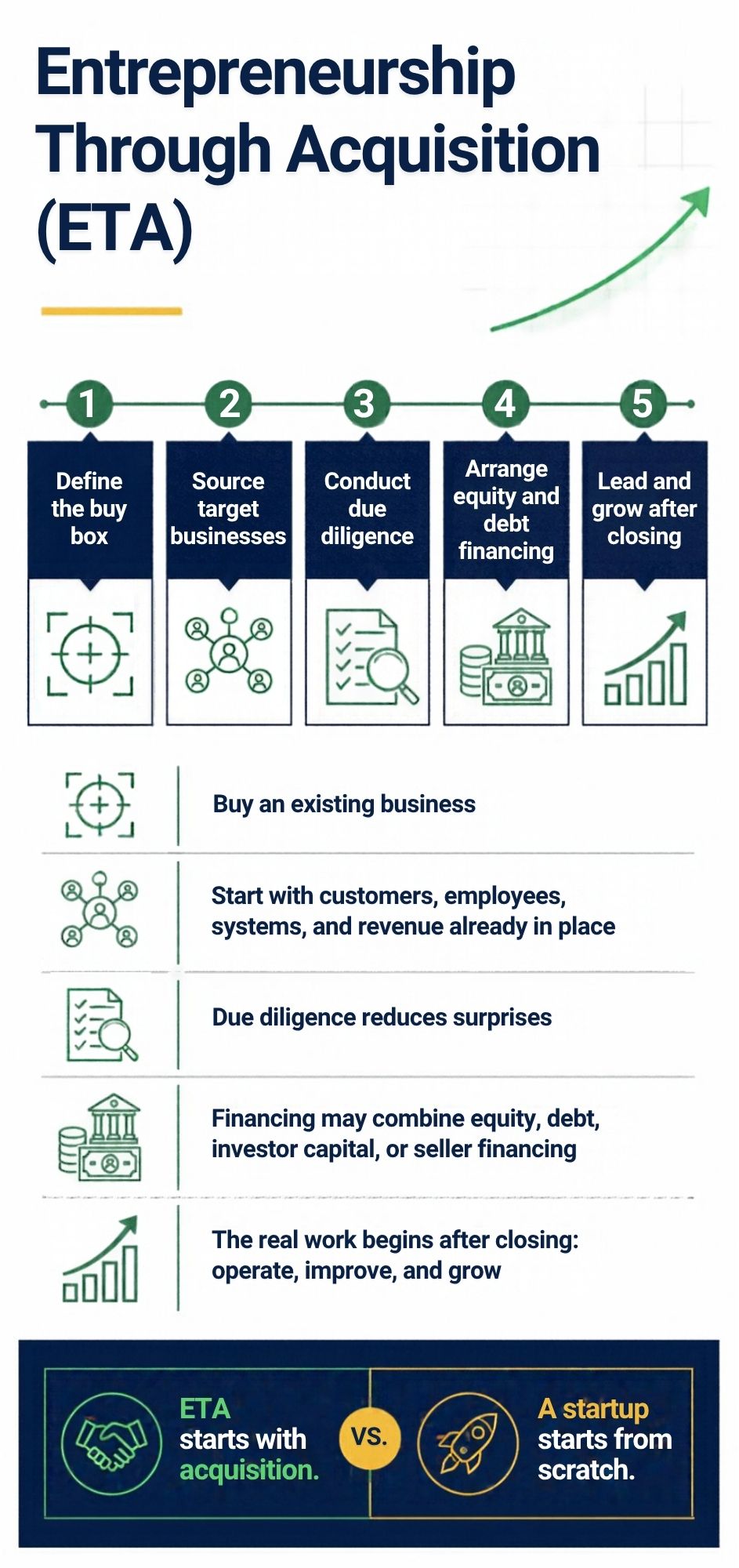
Starting a business requires developing an idea, validating the market, attracting initial customers, building a team, and establishing operational systems. An acquisition entrepreneur starts with many of these elements already in place.
An existing business may have established customers, employees, suppliers, processes, brand recognition, and historical financial information. This does not eliminate risk, but it can give the entrepreneur a foundation from which to operate and grow.
The difference is therefore less about whether someone wants to be an entrepreneur and more about how they enter business ownership. ETA uses acquisition as the entry point, while traditional entrepreneurship usually starts with creating a new company.
Finding the right acquisition target is one of the most important parts of the ETA process. Searchers usually begin by defining a buy box, which can include preferred industries, company size, geography, revenue, profitability, customer characteristics, and other criteria.
Once the criteria are established, potential targets can be identified through databases, business owners, professional networks, intermediaries, referrals, and direct outreach.
For entrepreneurs pursuing proprietary opportunities, off-market deal sourcing can also be valuable. Caprae Capital, for example, provides acquisition support that includes direct owner outreach through cold calling, email, LinkedIn, and direct mail.
Searchers can also learn about the broader search-fund model through Search Fund resources, which explain how entrepreneurs can raise capital to search for, acquire, and personally operate an existing privately held company.
Finding a promising business is only the beginning. Before completing an acquisition, buyers need to understand the company's financial position, operations, customers, employees, market, technology, and potential risks.
Due diligence helps test whether the information provided about a target business matches the underlying reality. Areas may include financial performance, customer concentration, revenue quality, contracts, technology systems, market conditions, and operational processes.
A buyer should also work with appropriate legal, accounting, tax, and other professional advisers because acquisition decisions can involve significant financial and legal considerations.
Understanding due diligence is particularly important because the findings can influence valuation, transaction terms, financing requirements, and whether the buyer ultimately proceeds with the deal.
Acquisition financing depends on the buyer, target business, transaction structure, and available capital. Some entrepreneurs use personal funds or investor capital, while others use a combination of equity and debt financing.
Traditional search funds may raise capital specifically to support the search and subsequent acquisition. Self-funded searchers may initially finance the search themselves before arranging acquisition financing.
The financing structure should match the economics and risk profile of the target. Buyers generally need to understand how purchase price, cash flow, debt payments, working capital, and future investment requirements affect the overall transaction.
Closing the transaction is not the end of ETA. It is the beginning of the operating phase.
New owners need to understand the team, customers, financial performance, processes, and existing priorities. The first few months can be particularly important because major changes made too quickly may create unnecessary disruption.
A structured post-acquisition plan can help establish priorities, assign responsibilities, monitor key performance indicators, and identify opportunities for improvement.
Caprae Capital's post-acquisition strategy service, for example, focuses on 100-day planning, value creation, operational support, and fractional executive resources for new owners.
Growth after acquisition can come from improving existing operations as well as pursuing new opportunities. Owners may focus on increasing sales, improving customer retention, strengthening marketing, reducing inefficient processes, upgrading technology, or expanding the team.
Some owners also pursue a buy-and-build strategy, where additional businesses are acquired and integrated with the original company. The right growth strategy depends on the company's industry, resources, management capabilities, and acquisition thesis.
Technology and AI can also become part of the value-creation strategy. Assessing existing systems and identifying practical automation opportunities can help an acquired business improve efficiency without introducing unnecessary complexity.
ETA offers opportunities, but it also comes with challenges. Finding a suitable business can take significant time, and attractive targets may face competition from other buyers.
Other challenges include accurately evaluating financial performance, negotiating a transaction, arranging financing, managing employees after the ownership transition, and meeting growth expectations.
Entrepreneurs also need to balance their acquisition thesis with the realities of operating the business. A strong target on paper may require substantial operational improvement after closing.
ETA can provide a practical route for professionals who want to become business owners through acquisition rather than startup creation. The entrepreneur can take control of an established operation while applying leadership, strategic planning, and operational improvements to create additional value.
For searchers, having the right acquisition criteria, sourcing process, diligence support, financing strategy, and post-close plan can make the process more structured.
Stanford Graduate School of Business has also examined different ETA models, including traditional, self-funded, and sponsored searches, demonstrating the range of approaches entrepreneurs can consider. Models of Entrepreneurship Through Acquisition provides additional background on these models.
Entrepreneurship Through Acquisition provides an alternative route into business ownership by combining entrepreneurship with the acquisition of an existing company. Instead of starting with a blank page, entrepreneurs begin with an established operation and focus on evaluating, acquiring, leading, and growing it.
Success in ETA requires more than finding a business for sale. Searchers need a clear acquisition strategy, disciplined sourcing, thorough due diligence, appropriate financing, and a practical post-acquisition growth plan. With the right preparation and support, acquisition can become a structured pathway to entrepreneurship and long-term business ownership.
Entrepreneurship Through Acquisition means becoming an entrepreneur by acquiring and operating an existing business rather than starting a company from scratch.
A startup begins with creating a new company, product, or service. ETA begins with acquiring an existing business that may already have customers, employees, revenue, and established operations.
Searchers can use business databases, intermediaries, professional networks, referrals, direct owner outreach, and off-market sourcing campaigns to identify potential acquisition targets.
Buyers should evaluate financial performance, customers, operations, employees, market conditions, technology, contracts, liabilities, and other relevant risks as part of a comprehensive diligence process.
ETA acquisitions can be financed through combinations of personal capital, investor equity, search-fund capital, acquisition debt, seller financing, or other transaction-specific funding arrangements.



?)
?)
Comment