
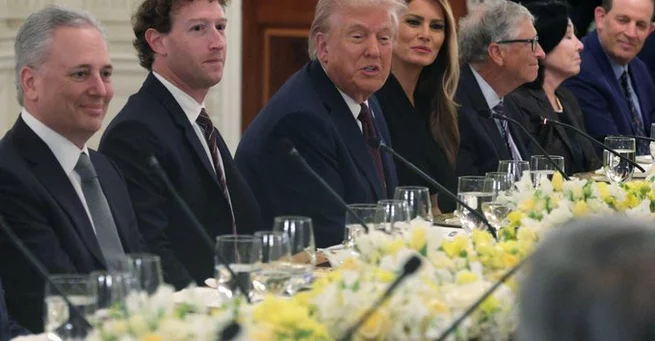
2025 was expected to be the year Donald Trump and the populist right challenged Big Tech’s dominance—but events took an unexpected turn. Instead of humbling Silicon Valley, Trump found himself increasingly entwined with the tech industry he once criticized. From lobbying battles to AI regulations, the former president’s approach now mirrors the very networks of influence he vowed to disrupt.
Public appearances and media commentary reveal a subtle shift: Trump has begun adopting the language, tactics, and strategies of tech moguls, blurring lines between political populism and Silicon Valley-style corporate power. Observers note this pivot as a defining moment in the evolving relationship between politics and technology.
A recent radio appearance highlighted Trump’s push to limit state-level AI regulations. “Digital twins,” generative AI models designed to mimic human behavior, have become central to corporate strategies, replacing traditional human roles at scale. While Congress debates nationwide AI frameworks, Trump’s administration attempted to preempt states from crafting their own rules, signaling a close alignment with industry interests.
Listeners expressed concern about how these policies affect everyday workers. The debate underscores a broader tension between innovation and oversight, raising questions about who benefits—and who bears the risk—when AI reshapes labor markets.
Trump’s alignment with Silicon Valley reflects a growing trend: populist figures increasingly collaborate with the tech industry rather than oppose it. Lobbying efforts, campaign partnerships, and media endorsements demonstrate that corporate influence remains a powerful tool for shaping political narratives. Analysts suggest this strategy may secure political leverage while simultaneously smoothing the regulatory path for tech companies.
This convergence has implications for voters, policymakers, and tech executives alike, illustrating that political messaging and corporate interests often intersect in unexpected ways.
Trump’s media strategy now mirrors tech playbooks. Long-form interviews, podcast appearances, and radio call-ins allow for nuanced messaging, bypassing traditional news soundbites. These platforms enable him to engage directly with audiences while reinforcing key talking points that resonate with Silicon Valley allies.
Observers note that these tactics, long used by tech executives to shape public perception, are now central to political communication, blurring the lines between corporate branding and political identity.
Tech lobbying in 2025 surged as AI, data privacy, and platform regulation dominated headlines. Trump’s administration, once critical of Big Tech, now champions legislation favorable to industry giants. This shift benefits companies working on digital twins, AI-assisted customer service, and automated workplace tools, reinforcing Silicon Valley’s influence over policy.
Experts warn that this alignment may limit regulatory oversight, giving corporations unprecedented latitude in shaping market rules while also consolidating political influence.
Not everyone is embracing Trump’s pivot. Critics argue that the populist narrative has been co-opted by corporate interests, leaving ordinary voters sidelined. Social media discussions reveal frustration over the perceived erosion of accountability, particularly in emerging tech sectors like generative AI and autonomous systems.
Despite pushback, Trump’s approach signals a strategic blending of political messaging and corporate collaboration that is likely to influence 2026 campaigns and beyond.
As 2025 closes, Trump’s transformation from populist challenger to quasi-tech insider raises key questions: How will AI regulation evolve? Will voters accept the merging of corporate and political power? And what does this mean for the balance between innovation, accountability, and democratic oversight?
One thing is clear: the intersection of Silicon Valley and political strategy is only deepening, redefining how power operates in both the tech and political arenas.

𝗦𝗲𝗺𝗮𝘀𝗼𝗰𝗶𝗮𝗹 𝗶𝘀 𝘄𝗵𝗲𝗿𝗲 𝗽𝗲𝗼𝗽𝗹𝗲 𝗰𝗼𝗻𝗻𝗲𝗰𝘁, 𝗴𝗿𝗼𝘄, 𝗮𝗻𝗱 𝗳𝗶𝗻𝗱 𝗼𝗽𝗽𝗼𝗿𝘁𝘂𝗻𝗶𝘁𝗶𝗲𝘀.
From jobs and gigs to communities, events, and real conversations — we bring people and ideas together in one simple, meaningful space.




Comments