Alerts

-
4 minutes, 33 seconds
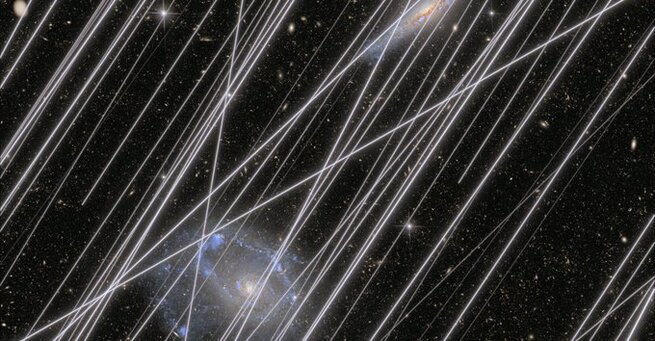
The Hubble Space Telescope, long celebrated for capturing breathtaking cosmic images, is increasingly under siege—not by cosmic phenomena, but by satellites. A surge in artificial satellites orbiting Earth is creating streaks of light that photobomb telescope images, making it harder for scientists to study space. According to a new NASA study published in Nature, nearly 40% of Hubble’s images could be affected, and other telescopes might see up to 96% contamination within the next decade. The consequences extend beyond aesthetic interference, potentially hindering discoveries of new planets and the detection of hazardous asteroids.
The problem stems from an explosion of satellite launches. In 2019, about 5,000 satellites circled the planet. Today, that number has more than tripled to over 15,800. If current plans proceed, space could host as many as 560,000 satellites in the next ten years. Alejandro Borlaff, a NASA research scientist leading the study, warns that cheaper launch costs and large telecommunications constellations like Starlink have created unprecedented challenges for space observation. “For the first time, we found something that may actually be worse in the future,” Borlaff notes.
NASA researchers ran simulations to estimate how telescope images will be affected by the growing satellite swarm. Hubble, with its narrower field of view, could capture an average of 2.14 satellites per exposure. Other upcoming telescopes, such as China’s Xuntian Space Telescope, may see as many as 92 satellites per shot. The sheer density of objects in low Earth orbit threatens to make clean, detailed observations increasingly rare.
The intrusion of satellite trails doesn’t just ruin photos—it risks scientific progress. Identifying near-Earth objects, mapping distant galaxies, and discovering new exoplanets all rely on clear, unobstructed images. As light pollution worsens, astronomers may miss faint but crucial signals from space. “Our ability to see the universe clearly is at stake,” says Borlaff. Without coordinated efforts to reduce light pollution, space observation could face decades of interference.
Some companies are exploring ways to make satellites less reflective. For instance, SpaceX has experimented with darker coatings and sunshades on Starlink satellites to reduce glare. Scientists are also advocating for international guidelines to limit light pollution in orbit, but regulation is complex. Unlike terrestrial light pollution, orbital contamination requires cooperation between private companies, governments, and global space agencies.
Hubble remains relatively protected thanks to its position and field of view, but other telescopes are more vulnerable. The James Webb Space Telescope orbits farther from Earth, avoiding most satellite trails, while Xuntian and other next-generation observatories may struggle. The study underscores the need to plan future telescopes with crowded orbits in mind, ensuring humanity can continue exploring the cosmos without interference.
Despite the challenges, researchers remain hopeful. Awareness of the issue is growing, and mitigation strategies are being tested. Satellite companies may adopt darker coatings or change orbital paths, and new software could help astronomers filter out unwanted streaks from images. As Borlaff emphasizes, proactive efforts now could prevent decades of compromised astronomical research. Space may be crowded, but with collaboration, the view doesn’t have to be lost.









Comment