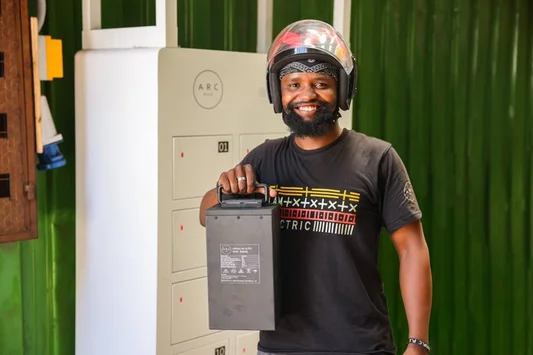
IFC investment in Arc Ride is sparking widespread interest across Africa’s electric mobility space. Many readers are asking: What does this funding mean for Kenya’s EV future? Is Arc Ride ready for scale? And will battery-swapping finally make electric motorbikes practical? The proposed $5 million investment suggests the electric two-wheeler market is moving beyond experimentation into real-world viability. But with institutional capital comes scrutiny, and Arc Ride’s next phase will be shaped by performance on the ground.
Investment headlines often sound optimistic, but timing reveals deeper signals. When institutional investors enter at the Series A stage, it usually means early traction has turned into measurable demand. In Arc Ride’s case, the funding reflects growing confidence in both the business model and the broader shift toward electrified transport. It’s no longer just about innovation—it’s about execution.
Institutional backing also changes expectations. Investors are not just betting on ideas; they’re looking for operational proof. That means consistent uptime, scalable infrastructure, and sustainable economics. For Arc Ride, success will depend less on announcements and more on daily performance in dense urban transport ecosystems.
Founded in 2020, Arc Ride operates in a sector where adoption barriers have historically been financial rather than technological. Electric motorbikes are not new to Kenya, but affordability has always been the missing link. The biggest cost isn’t the bike—it’s the battery.
Arc Ride tackles this challenge by separating battery ownership from vehicle ownership. Instead of buying a battery upfront, riders access energy through a battery-swapping network. Depleted batteries are exchanged for fully charged ones at fixed stations, allowing riders to pay for usage instead of capital investment. This approach lowers entry costs and accelerates adoption.
On paper, the model seems simple. In practice, it introduces operational complexity. Battery logistics, station density, and uptime reliability become critical variables. If the system works smoothly, riders benefit immediately. If it falters, confidence can erode quickly.
Electric mobility conversations often emphasize environmental impact. But for most motorcycle riders, sustainability messaging is secondary. Income stability drives decision-making, and fuel costs are a daily pressure point.
Riders calculate profitability based on end-of-day earnings. Lower operating costs can translate directly into higher take-home income. That’s where electric motorbikes hold a compelling advantage. Electricity is typically cheaper than petrol, and maintenance requirements are lower. However, those savings only matter if infrastructure supports uninterrupted operation.
This reality puts Arc Ride’s battery network at the center of its value proposition. Riders need predictable access to charged batteries, minimal downtime, and transparent pricing. Without those factors, environmental benefits alone won’t drive adoption.
The involvement of a global development finance institution carries symbolic and practical weight. Symbolically, it signals confidence in Africa’s electric mobility trajectory. Practically, it introduces new accountability layers around governance, scalability, and impact.
Development-backed investments often prioritize long-term sustainability over rapid expansion. That can influence how Arc Ride scales its operations, potentially favoring measured growth over aggressive rollout strategies. The focus may shift toward building resilient infrastructure rather than chasing headline expansion numbers.
For the broader ecosystem, this funding could unlock follow-on investments. Institutional participation often acts as validation, encouraging additional capital flows into adjacent sectors such as charging infrastructure, local manufacturing, and battery lifecycle management.
Growth in electric mobility rarely follows a straight path. Expanding a battery-swapping network requires capital-intensive infrastructure, strong logistics coordination, and localized demand insights. Urban density can accelerate adoption, but it also introduces congestion and operational friction.
Charging station placement will be one of Arc Ride’s biggest strategic decisions. Stations must be accessible without disrupting rider routes. Too few locations can create queues and delays, while over-expansion can strain finances. Striking the right balance will determine user satisfaction and long-term viability.
Another challenge lies in pricing stability. Riders rely on predictable operating costs to manage daily earnings. Fluctuations in swap pricing or hidden fees could undermine trust, especially in highly competitive transport markets.
With institutional capital comes a shift in narrative. Arc Ride is no longer just a startup experimenting with electrification—it’s becoming a test case for scalable clean transport in emerging markets. That transition brings both opportunity and pressure.
On one hand, the funding validates years of groundwork. On the other, it raises expectations for measurable impact. Investors will look beyond user growth metrics to evaluate real-world outcomes such as rider income improvements, emission reductions, and infrastructure utilization rates.
Ultimately, success will be determined far from boardrooms. It will be shaped by how smoothly riders navigate traffic, how quickly they swap batteries, and how reliably the network supports daily operations. These micro-level experiences will define macro-level perception.
The IFC investment in Arc Ride represents more than a funding milestone—it marks a maturity moment for Africa’s electric mobility ecosystem. The conversation is shifting from possibility to practicality, from pilots to performance.
Arc Ride now stands at a crossroads. Institutional support offers resources and credibility, but it also demands consistency. Delivering seamless rider experiences will be key to converting optimism into lasting adoption.
If the company can align infrastructure reliability with rider economics, it could accelerate the region’s transition to cleaner transport. If not, the gap between ambition and execution may widen. Either way, this moment signals that electric mobility in Africa is entering a new phase—one defined less by promises and more by proof.
IFC Investment in Arc Ride Signals a Turning ... 0 0 0 1 2
2 photos





Array