
Alerts
-
11 minutes, 17 seconds
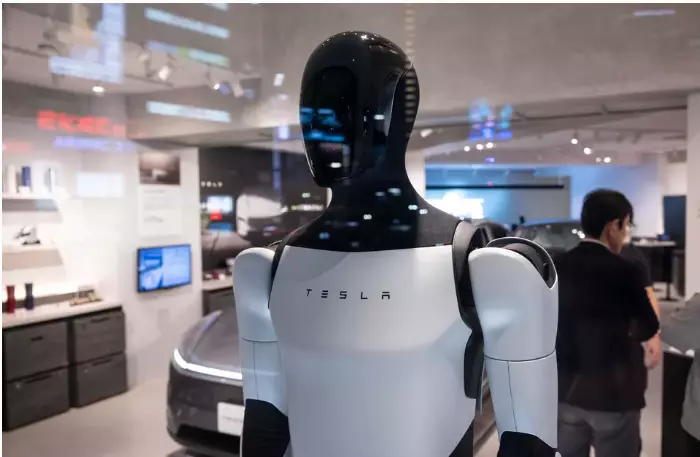
Robot makers sold about 7,000 full-size humanoids taller than 4 feet 7 inches for business use in 2025, according to the International Federation of Robotics. Factories installed that many ordinary industrial robots roughly every four days. Tesla has cleared out the Fremont lines that built its Model S and X to make room for its Optimus humanoid. Dozens of startups are racing too, because the potential prize is enormous: Morgan Stanley estimates the market could top $5 trillion by 2050. A handful of humanoids already do paid work, but those jobs are narrow, closely watched and still too few to prove the robots pay for themselves.
A humanoid robot, as the International Federation of Robotics defines it, is a machine designed to resemble a person and work in places built for people. Typically that means a torso, two arms and a head packed with cameras. Many can even walk. The shape is deliberate: it lets a machine fit into a world designed and sized for humans.
Stairs, doorknobs, shelves and hand tools are built around the human body, so, in principle, one humanoid could move from job to job without anyone rebuilding the site. Traditional factory robots, by contrast, are fixed in place and do one narrowly defined job. For a single repetitive task, that specialist is usually cheaper, which is why buyers should weigh the economics, not the anatomy. As for the hardware, dozens of electric motors called actuators move the joints. Cameras do the seeing, much as in self-driving cars, and AI decides what to do next.
The idea is half a century old. Japan’s Waseda University built its WABOT-1 robot in 1973, and Honda’s ASIMO made walking robots famous in 2000. Those early machines were research showpieces, built to prove a robot could walk and move like a person. Today’s humanoids are being pitched as workers. That shift, from showpiece to employee, is what’s new, and it’s why the industry is suddenly growing.
Three things changed: a new kind of AI, a flood of investor money and cheaper parts. Many of those parts, like the motors, batteries and sensors, are close cousins of electric-car components, so China’s EV supply chain can make them cheaply and in volume.
AI is the biggest change. Traditional robots are programmed step by step: an engineer writes code for every movement, and changing the task means rewriting it. The techniques behind chatbots now let robots learn from video and recordings of people doing the work. A robot can increasingly be told what to do in plain words, a shift I’ve called AI learning to move. Money followed. Humanoid startups raised $6.1 billion in 2025, roughly four times their 2024 total. Then came the warnings. In late 2025, China’s top economic planners said the industry risked a bubble, pointing to more than 150 companies making remarkably similar robots.
A few humanoid robots do paid work today, mostly moving bins and parts in warehouses and factories. Most don’t have jobs at all. IDC, which also counts smaller and research robots, says nearly 25,000 humanoids shipped in the first half of 2026, and 69% went to labs, classrooms, exhibitions or government data centers.
A humanoid’s path to a real job runs through five stages: a demo, a sale to a research lab, a pilot at a customer’s site, paid work every shift and, finally, the same job at many sites. The 69% sold to labs, classrooms and exhibitions are still in the first two stages, though that share is down from nearly 84% across 2025. The IFR also says most current uses still often need a person steering the robot remotely, known as human teleoperation.
This is where humanoids have climbed highest. Agility Robotics’ Digit lifts plastic bins, called totes, off small wheeled robots and onto conveyors, a repetitive job people usually do. By late 2025, it had moved more than 100,000 totes at a GXO warehouse near Atlanta.
Factories have logistics work too. At Schaeffler’s auto-parts plant in South Carolina, Digit carries baskets of parts to a conveyor inside a Plexiglas enclosure, while a worker with the job title “Agility contractor” watches it. Schaeffler puts Digit’s cost at $10 to $25 an hour, and the plant’s entry-level jobs start at $20. That isn’t a clean comparison, because the robot figure doesn’t say whether it covers the watcher, setup or repairs. For people on the floor, the direction is clear. “Efficiency is the name of the game and it’s relentless,” said Doug Thompson, a worker at the plant. “It’s not going to stop.”
Car plants are the other early target. China’s UBTech sold 1,079 full-size humanoids in 2025, up from three the year before, and it works with carmakers such as BYD and Geely.
Fixed robots already do the welding in car plants, so humanoids are being tried on the work around it. Figure AI’s Figure 02 spent 10 months at BMW’s plant in Spartanburg, South Carolina, placing more than 90,000 sheet-metal parts for welding. BMW vice president Ulrich Wiel and told visiting reporters in June that the robots are “still slower than humans,” though “they’re advancing fast.” Hyundai plans to start Boston Dynamics’ Atlas lining up parts at its Georgia plant in 2028, then add tasks one at a time as each proves its safety and quality.
Nuclear sites are where a human-shaped robot makes intuitive sense: it can use the same tools and corridors without risking a person. Capgemini and Orano began a four-month trial of a humanoid called Hoxo at a French nuclear training school in November 2025. It should have ended by March, but I found no published results.
It’s harder than it sounds. When Japan sent purpose-built robots into Fukushima’s wrecked reactors, several were knocked out or stranded, and as of 2017 they kept getting fried by radiation. A humanoid’s motors and chips would be just as exposed.
The largest store rollout I found belongs to a robot without legs. Chinese startup Galbot has opened around 200 robot retail stores in nearly 50 mainland cities. Its robots roll on wheels because walking robots are “noisy and have short battery life,” its founder, Wang He, has said.
Apptronik, for one, plans to expand into healthcare, but care robots have a cautionary history. Japan’s government spent more than $300 million developing them by 2018, yet researcher James Wright found some created more work for caregivers and left less time for residents. Staff who once chatted with residents while helping them out of bed had to cut those moments short to wheel the robot back to storage. Some simpler machines have helped.
A 2026 Stanford study of Japanese nursing homes found that care robots such as fall sensors and mobility aids raised care-worker employment by 28%. As of October, I found no well-documented, ongoing humanoid deployment in a hospital or care home.
The home is the most ambitious target and the furthest from reality. 1X has taken orders for its NEO at $20,000, or $499 a month, since its October 2025 launch. Deliveries are still only promised for 2026.
Today, people do their own housework, with help from single-job gadgets like robot vacuums. For chores NEO hasn’t learned, owners can book a “1X Expert,” a person who guides it remotely. Doing chores without that help is the hard part. Figure took its own robots into 30 Bay Area homes the robots had never seen to tidy living rooms, fold towels and make beds. They fully finished the job 56% of the time by Figure’s own scoring, up from 9% before the company trained them on its library of recorded human behavior. That’s a big jump, and still a long way from being a reliable and trusted housekeeper.
America leads in AI software, but China builds the robots. Humanoid sales came to about $740 million in the first half of 2026, by IDC’s count, and Chinese makers built more than 95% of the units.
Prospective buyers aren’t sold yet, though. In a late-2025 Morgan Stanley survey of Chinese executives, 62% said they were likely to adopt humanoids within three years. Just 23% were happy with today’s robots, and only about 1 in 10 was testing one.
Agility has the clearest paid work. In 2024, GXO signed what it called the industry’s first commercial deal to rent humanoids, and Toyota’s Canadian plant followed. Agility also counts Schaeffler and Amazon as customers, and its next model has more than $300 million in orders, conditional on meeting contract milestones.
UBTech has moved past pilots into real orders, more than $110 million worth by late 2025. Its Walker S2 swaps its own battery in about three minutes instead of stopping to recharge, so it can keep working around the clock.
Figure is still at the pilot stage, after its 10-month trial at BMW. It has built more than 350 of its latest model, Figure 03, and assigns them to internal research, data collection, housework training and developing commercial uses.
Boston Dynamics, owned by Hyundai, made its name with robot backflip videos and now wants Atlas to be boring: the same factory job, every shift. Its 2026 production was already spoken for, and Hyundai plans to put 25,000 Atlas robots in its car plants over the next few years.
Tesla pitches Optimus for dangerous, repetitive and boring work, but it hasn’t disclosed a paid deployment. In January, Elon Musk told investors that Optimus was “still in the R&D phase.” Its first factory-built robots will go to an “Optimus Academy” to collect training data. They go to school before they go to work.
Unitree sells humanoids the way electronics makers sell gadgets, cheaply and in bulk. Its G1 starts at $13,500, and it shipped more than 5,500 humanoids in 2025. In one analyst’s view, it’s among the strongest players in research, education and development.
Narrow, supervised work is already here. What’s still years away is a humanoid that switches between varied jobs, in places that weren’t designed for it, without someone watching. Morgan Stanley expects adoption to stay relatively slow until the mid-2030s. Before then, seven things have to get better:
The main task is rarely what breaks a deployment. It’s the odd case nobody scripted, like a bin that lands upside down, a box with a torn flap or a worker who steps into the robot’s path. Those are the moments that shut everything down, so ask a vendor how its robot handles them.
Humanoid robots are improving fast, and a few already do paid work, but most still live in labs and showrooms. Before buying one, ask for three numbers: cost per finished task, how often a person steps in and guaranteed daily running time. If a vendor can’t answer, the robot isn’t ready for your floor.










Comment