Alerts

-
5 minutes, 15 seconds
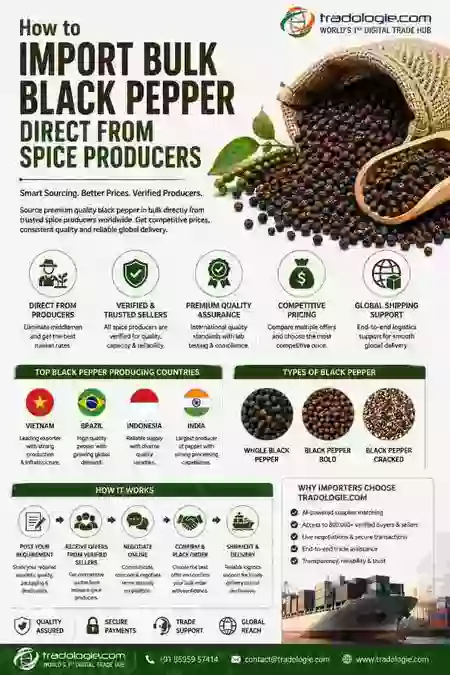
There is no other spice trade commodity like black pepper. Although it is a common ingredient found in kitchens, the sourcing of it involves complex business operations. Every year, thousands of businesses buy black pepper in commercial quantities, from food processors in Europe to spice blenders in the Middle East and spice wholesalers in Africa.
But for a bulk black pepper importer, the pressing challenge is that of finding the right, trusted supplier. The real challenge is to find the right producer, at the right specification and price, with enough capacity to deliver when a requirement arises.
That is why digital procurement is facilitating direct sourcing from spice producers, which is altering the global pepper trade.
A Global Product with Limited Availability
Black pepper is one of the most traded spices in the world. As of 2025, the global export value of black pepper was approximately 3.24 billion US dollars, with Vietnam accounting for approximately 45% of the global export value. Other big exporting origins were Brazil, Indonesia and India.
Vietnam’s role is especially significant. The country exported 247,482 tonnes of pepper in 2025, of which 212,279 tonnes were black pepper, earning a total of more than US$1.66 billion in export revenues from pepper. Its key markets included the US, UAE, China, India and Germany.
India is an important market for production, processing and exports. Pepper contributed around 3 per cent to the country’s total spice export earnings in FY2025-26 from an overall basket of spices valued at about US$4.43 billion.
The result is a truly global market for sourcing, but one where availability and pricing are strongly influenced by a relatively small group of producing countries.
Origin is important for an importer because production characteristics, quality profiles, processing capabilities and logistics vary considerably.
Vietnam is the logical place to begin high-volume commercial sourcing. The extensive export infrastructure makes it ideally suited for buyers with large requirements and standard specifications.
Brazil has also become a major international supplier, especially for those buyers looking for alternative origins. In fact, Vietnam itself imported more than 19,000 tonnes of Brazilian pepper in 2025 for processing and re-export, demonstrating the interdependence of the global supply chain.
Indonesia is an important source, and India has a mature spice processing ecosystem and availability of both whole and processed pepper products.
The smartest strategy for buyers is not necessarily to pick just one origin. Comparing multiple producing regions can increase bargaining power and improve supply resilience.
The usual process usually looks like this:
A buyer finds several exporters, makes individual enquiries, waits for price quotations, checks on the suppliers, bargains separately, compares different specifications and then tries to determine what a truly competitive market price is for the quotation.
That’s inconvenient for one shipment.
If a company imports black pepper on a consistent basis, then it becomes a recurring procurement expense.
There’s also a problem of visibility. A buyer may know ten suppliers, but not know whether there’s another producer elsewhere who could provide better pricing or more suitable commercial terms.
This process is reversed in modern B2B procurement.
The buyer begins with a requirement rather than with a supplier search.
The bulk importer can select the product, quantity, quality, packaging, destination and delivery schedule. The relevant suppliers can then submit commercial offers for the same requirement.
This creates a much cleaner environment for discovering the bulk black pepper price.
Instead of asking, “What price will this supplier give me?” the buyer can ask a more commercially useful question: “What are qualified suppliers willing to offer for this exact requirement?”
That distinction is fundamental to modern commodity procurement.
This is where Tradologie.com differentiates itself from traditional B2B marketplaces.
A traditional marketplace is mostly a digital catalogue: suppliers list products, buyers browse through listings and the two parties take the conversation further on their own.
Tradologie.com is built on transaction-oriented procurement.
A buyer looking for bulk black pepper imports can post a structured requirement with quantity, specifications, packaging, destination and commercial conditions. Relevant suppliers can then participate with competitive quotes.
The result is a procurement environment designed around real buying demand, not just supplier visibility.
AI-powered matching helps match procurement needs with the right suppliers, and digital negotiations provide a more structured way for buyers and sellers to discuss commercial terms.
The advantage for a serious importer isn't just convenience.
Digital procurement can improve the economics of sourcing by increasing the supplier competition, reducing the supplier-discovery time, improving the price visibility and reducing the unnecessary intermediary dependence.
It also allows buyers to look outside their current network.
The procurement manager who used to work with three or four known exporters can now potentially consider offers from a much wider supplier ecosystem.
Something exciting is happening in the pepper market around the world. According to the International Pepper Community, 2025 was a year of tight market conditions, low carry-over stocks and increasing costs of production, compliance and logistics, with demand remaining robust in the main markets. It also highlighted increasing buyer preference for traceable, compliant and sustainably produced pepper.
It’s better to consider total procurement value – the price, quality, reliability, logistics, compliance and supplier capability all in one.
So digital procurement is more than simply finding the cheapest shipment today. It can help to build a more diversified and resilient global supply chain for spices.
This makes the process to buy black pepper from manufacturers and spice makers an increasingly appealing option for companies buying in bulk. Vietnam, Brazil, Indonesia and India offer significant sourcing opportunities, while a well-established global demand continues to support a highly competitive international market.
But the modern importer requires more than a list of suppliers. They require assured supply, price discovery, transparency in negotiations and efficient procurement.
That’s where digital B2B procurement platforms like Tradologie.com can make a difference. Buyers are allowed to publish real requirements, and relevant suppliers can compete for them. The procurement process changes from searching for sellers to creating competitive supply.


8.4K articles

2.8K articles

1.6K articles

34 articles








Comment