
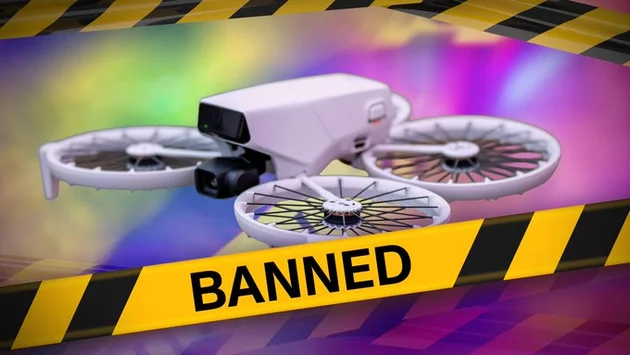
If you’ve been eyeing a new DJI drone for personal or professional use heading into 2026, time may be running out. The Federal Communications Communication (FCC) has officially added foreign-made drones—including those from Chinese tech giant DJI—to its “Covered List,” effectively banning their future import into the United States. The move, confirmed on December 23, 2025, targets devices and components deemed to pose “an unacceptable risk to the national security of the US,” shaking up the drone market just as the hobby and commercial sectors prepare for a new year.
DJI dominates the global drone market with an estimated 70% share, prized for its cutting-edge cameras, intuitive flight controls, and reliable performance. But that dominance now comes with a catch: under the FCC’s latest enforcement, any unmanned aircraft system (UAS) manufactured overseas—along with key parts like flight controllers, sensors, batteries, and data transmission modules—is blocked from entering U.S. borders. While the rule doesn’t outright ban ownership or use of existing DJI drones, it halts the flow of new units and replacement components, potentially driving up prices and limiting repair options.
The FCC’s decision follows months of mounting pressure from federal agencies concerned about data privacy and potential surveillance risks. Officials argue that DJI’s deep integration with cloud services and telemetry data transmission could allow foreign entities—particularly the Chinese government—access to sensitive U.S. infrastructure, airspace activity, or even law enforcement operations. Though DJI has repeatedly denied sharing user data with any government, the agency’s stance reflects broader U.S. policy tightening around Chinese tech, echoing earlier actions against Huawei and ZTE.
For hobbyists, the immediate impact may be limited—existing DJI drones remain legal to fly. But for commercial operators in real estate, agriculture, filmmaking, and public safety, the ban introduces real logistical headaches. Spare parts may become scarce, firmware updates could be restricted, and insurance providers might hesitate to cover aircraft using foreign-made systems. Some users are already scrambling to stock up on batteries, gimbals, and propellers before supply dries up, while others are exploring alternatives from American or allied manufacturers like Skydio or Autel Robotics.
American drone makers stand to benefit—if they can scale fast enough. Companies like Skydio have long positioned themselves as “secure, U.S.-designed” alternatives, and government contracts have already begun shifting in their favor. However, these domestic options often come at a premium and lack the mature ecosystem DJI has spent a decade building. For now, most consumer and mid-tier pro users face a tough choice: stick with a shrinking DJI inventory or adapt to less polished—but potentially more compliant—U.S.-friendly platforms.
Retailers and importers have a short window to clear existing inventory before the ban fully tightens. Industry insiders expect a surge in last-minute DJI purchases through early 2026, followed by rapid price inflation on the secondary market. If you’re considering a Mavic, Mini, or Inspire model, acting now could save you hundreds—or even thousands—down the road. Just be aware: future support, including software updates and warranty claims, may become uncertain as regulatory scrutiny intensifies.
This ban isn’t just about drones—it’s part of a sweeping U.S. strategy to decouple critical tech supply chains from geopolitical rivals. While national security concerns are legitimate, critics warn that blanket restrictions could stifle innovation and hurt small businesses that rely on affordable, reliable tools like DJI’s. As the lines blur between consumer gadget and strategic asset, one thing is clear: the skies over America are about to look very different in 2026.
DJI Drone Ban: What the FCC’s New Import Rule... 0 0 0 5 2
2 photos

𝗦𝗲𝗺𝗮𝘀𝗼𝗰𝗶𝗮𝗹 𝗶𝘀 𝘄𝗵𝗲𝗿𝗲 𝗽𝗲𝗼𝗽𝗹𝗲 𝗰𝗼𝗻𝗻𝗲𝗰𝘁, 𝗴𝗿𝗼𝘄, 𝗮𝗻𝗱 𝗳𝗶𝗻𝗱 𝗼𝗽𝗽𝗼𝗿𝘁𝘂𝗻𝗶𝘁𝗶𝗲𝘀.
From jobs and gigs to communities, events, and real conversations — we bring people and ideas together in one simple, meaningful space.




Comments