Alerts
Always receive notifications to stay updated on new posts & activities on your content and account on Social Network.

-
6 minutes, 21 seconds
India's diabetes burden is one of the most significant public health challenges the country faces. Over 100 million Indians are currently managing type 2 diabetes or pre-diabetic conditions — and this figure grows annually as urban sedentary lifestyles, refined food diets, and genetic predisposition combine to create a metabolic environment where blood sugar dysregulation is increasingly common.
Most conversations about managing diabetes through diet focus on the obvious interventions — reducing sugar, limiting sweets, cutting obvious carbohydrates. What receives less attention is the daily grain choice that produces far more blood sugar impact than the occasional sweet because it's eaten multiple times every day across every meal. The flour used for daily rotis is repeated more consistently than any other dietary input, which means its glycaemic profile has more cumulative effect on blood sugar management than sporadic dietary adjustments made elsewhere.
For the 100 million Indians managing blood sugar, and the larger population managing pre-diabetic conditions that haven't yet been formally diagnosed, the grain choices in the daily kitchen are one of the highest-leverage dietary decisions available.
Standard commercial wheat atta — the refined flour that most Indian households use as their primary daily flour — has a relatively high glycaemic index. The refining process removes the bran and germ layers that contain the fibre responsible for slowing starch digestion. What remains is primarily rapidly digestible starch that enters the bloodstream as glucose quickly, producing the blood sugar spike that, repeated across multiple roti meals per day, contributes to the blood sugar dysregulation that diabetes management requires controlling.
The problem compounds when this pattern repeats across every meal. A household eating standard refined wheat rotis at breakfast, lunch, and dinner is exposing the blood sugar management system to three separate rapid glucose spikes daily. Across a week, a month, a year, this pattern makes blood sugar management harder than it needs to be — not because of any single dramatic dietary excess, but because of a daily repeated pattern that creates a structural challenge for a system already under metabolic stress.
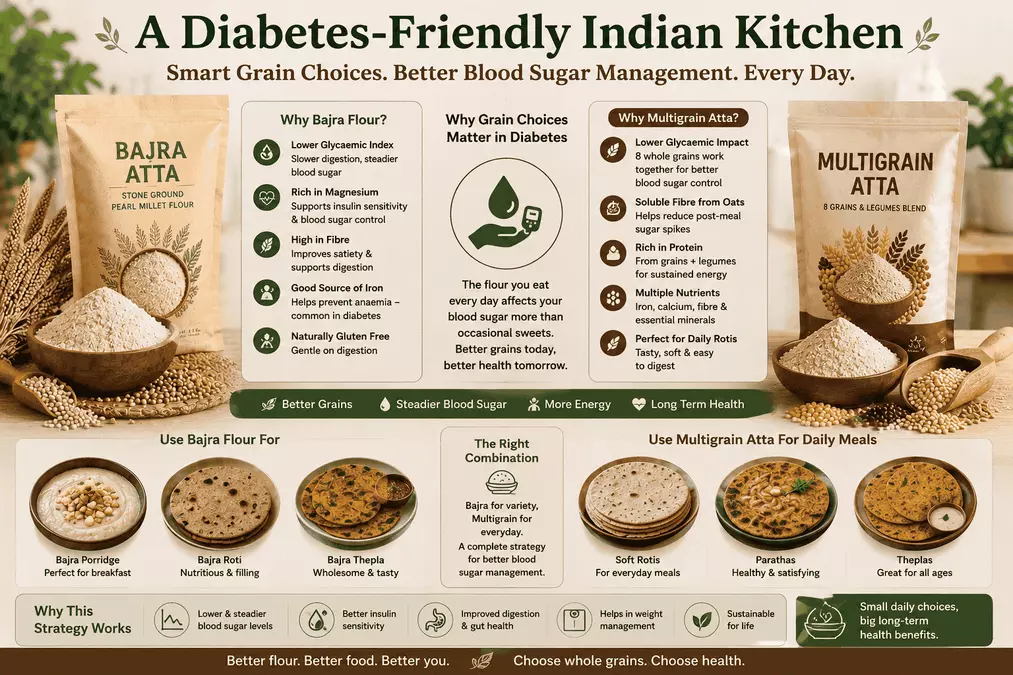
Pearl millet's glycaemic profile differs from refined wheat in ways that are directly relevant to blood sugar management. Bajra flour — ground from whole pearl millet grain with the bran intact — digests more slowly than refined wheat flour because the fibre that slows starch digestion is present rather than removed.
The result is a flatter blood sugar response curve after a bajra roti meal compared to an equivalent refined wheat roti meal. Blood glucose rises more gradually, reaches a lower peak, and falls more slowly — producing a more sustained energy release without the spike that triggers the rapid insulin response and subsequent blood sugar drop that manages diabetic conditions need to avoid.
Bajra also carries magnesium in meaningful quantities — a mineral that plays a role in insulin sensitivity. Research consistently shows associations between adequate dietary magnesium and improved insulin function, and bajra flour as a regular dietary source contributes to magnesium intake through a food format that requires no supplementation or specialised preparation.
The iron content in bajra flour is a secondary benefit worth noting for diabetic patients, who are at higher risk of anaemia — the chronic inflammation associated with poorly managed diabetes impairs iron absorption, and dietary iron from whole grain sources contributes to managing this risk.
For households where bajra flour is used occasionally but standard refined wheat flour handles most daily roti production, the blood sugar benefit of bajra is limited to the meals where it's specifically used. The challenge of making bajra flour the primary daily flour for all household members — including those without blood sugar concerns, and children who may resist unfamiliar textures — means that single-grain bajra use often remains partial rather than consistent.
A multigrain atta 10 kg pack as the household's primary daily flour addresses this challenge by incorporating bajra's blood sugar benefits — along with those of jowar, ragi, oats, and the other whole grains in the blend — into every roti made by the household, regardless of which family member's specific health needs are being served at any given meal.
The combined glycaemic effect of an eight-grain whole grain blend is lower than refined wheat flour and comparable to or better than single-grain bajra rotis for blood sugar management purposes, because multiple grain components are contributing to the slower digestion that produces the flatter glucose response. The soluble fibre from oats specifically — beta-glucan — has the strongest evidence base among dietary fibres for glycaemic management, adding a specific blood sugar benefit that pure bajra rotis don't provide.
Implementing a diabetes-friendly grain strategy through daily roti production requires two products rather than one — bajra flour for specific preparations where its pure grain character is both nutritionally and culinarily appropriate, and a multigrain blend as the daily staple that delivers consistent blood sugar-aware nutrition across all household roti meals.
The bajra flour preparation occasions that work best for households managing blood sugar include breakfast bajra porridge — a lower-glycaemic alternative to wheat or semolina-based breakfast preparations — and the occasional bajra roti or thepla where the single-grain flavour and texture are specifically desired.
The multigrain blend handles the daily roti production that constitutes the largest volume of daily grain consumption for most households — three to four rotis per person per meal, across two to three meals daily. Getting this daily volume into blood sugar-aware territory through the flour choice rather than through meal-by-meal dietary discipline is the highest-leverage intervention available in the diabetes-friendly kitchen.
The blood sugar benefit of a dietary change compounds over time — it's not a single meal's improvement but an accumulated effect of consistent daily patterns. A multigrain atta pack used consistently as the household's primary flour for three months produces a meaningfully different blood sugar pattern than the same flour used intermittently alongside standard refined wheat atta.
The 10 kg format supports this consistency by ensuring the blood sugar-aware flour is always the default available option rather than an alternative that occasionally runs out and gets replaced by refined atta while a replenishment order is pending.
Not all products marketed as multigrain or whole grain deliver the glycaemic benefit they imply. Blends using refined rather than whole grain forms of their ingredients retain the appearance of nutritional diversity without the actual fibre content that produces slower digestion. Bajra flour that has been overmilled loses the bran that carries both the fibre and the mineral content that makes the grain valuable.
10on10 foods processes its bajra flour and multigrain atta to the whole grain standard that preserves the nutritional properties relevant to blood sugar management — the bran layers intact, the grain character preserved, the fibre content delivering what the label implies.
Blood sugar management is a daily, repeated challenge — not a problem solved by occasional dietary interventions. The household that builds a consistent grain-based blood sugar management strategy through everyday flour choices is addressing the challenge at the level where daily repetition creates the most impact. Two grain products, used consistently, across every meal. That's the practical implementation — and it's achievable without any dramatic change to how the household eats.


8.1K articles

2.7K articles

1.5K articles

34 articles








Comment