Building America's Semiconductor Workforce: A New National Network
The U.S. National Science Foundation (NSF) and the U.S. Department of Commerce are expanding a national effort to build the semiconductor workforce. This next step strengthens how regions coordinate education and job training under the CHIPS & Science Act of 2022. The non-profit SEMI Foundation will now run the National Network for Microelectronics Education (NNME). This network is the federal government's main tool for meeting the growing need for skilled workers in the semiconductor and microelectronics industries.
What Are the New NNME Regional Nodes?
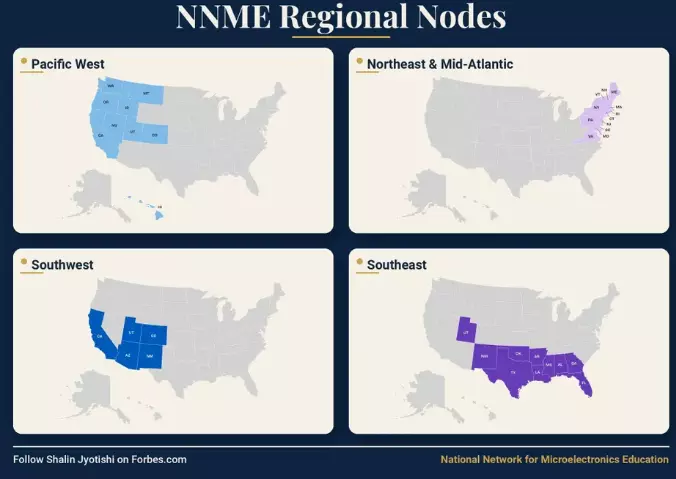
Last month, the SEMI Foundation launched the first four NNME Regional Nodes. These nodes are the backbone of the network. They turn the national semiconductor workforce strategy into real action at the local level. Their goal is to connect education, industry, and workforce development groups to build clear career paths in semiconductors.
The four inaugural nodes are:
- NNME Southwest – led by the Arizona Commerce Authority
- NNME Pacific Intermountain – led by Boise State University
- NNME Northeast – led by NY CREATES
- NNME South – led by the University of Texas at Austin
How the Network Will Strengthen the Semiconductor Talent Pipeline
The SEMI Foundation and the NNME will work with these regional nodes to:
- Boost awareness of semiconductor careers
- Build and test training programs that match industry needs
- Track workforce results like student readiness, job placement, and employer satisfaction
Together, the regional nodes connect more than 325 organizations. These include community colleges, universities, K-12 schools, STEM education partners, workforce boards, and major semiconductor employers like Intel, TSMC, and Micron.
Funding and Support for Each Node
Under the NNME structure, the NSF and SEMI Foundation expect to support each Regional Node with up to $20 million over five years. This funding will help build a strong, lasting pipeline of skilled workers.
A Closer Look: The Southwest Node
The Southwest node shows how this model works on the ground. Led by the Arizona Commerce Authority, it brings together 47 members across five states: Arizona, Colorado, Utah, New Mexico, and southern California. Its industry partners include Intel, TSMC, Amkor, Micron Technology, and many others.
Sandra Watson, President and CEO of the Arizona Commerce Authority, said, "Industry drives everything we do in Arizona, and that's especially true with the NNME Southwest Regional Node."
Arizona has attracted more than 70 semiconductor expansion projects since 2020, representing over $214 billion in investment. To meet the demand for skilled workers, the regional partners plan to:
- Accelerate industry-aligned stackable credentials
- Expand hands-on learning and cleanroom access
- Strengthen talent pipelines for K-12 students and rural communities
Innovative Tools: The SemiSphere Platform
One key tool in the Southwest node is SemiSphere, an educational content platform developed at the University of Arizona. It lets instructors and industry experts create and share teaching materials for students from middle school through graduate school. This helps make semiconductor instruction consistent across different regions.
NSF's Broader Strategy for Tech Workforce Development
The NNME is part of a larger effort by the NSF to improve regional coordination around workforce development. This includes advanced technology areas like artificial intelligence (AI). Earlier this year, the NSF launched the TechAccess: AI-Ready America initiative. It supports state-level AI readiness hubs and AI education efforts to help workers and small businesses adapt to AI's impact.
Erwin Gianchandani, head of the NSF's technology directorate, said, "America's leadership in semiconductors depends on our ability to develop our talent. The NNME represents an important investment in America's innovation capacity, talent readiness, and long-term competitiveness."
Why Workforce Intermediation Matters
These networks are built on a key insight: without careful coordination, federal research dollars and manufacturing incentives may not translate into real jobs. Successful implementation of policies like the CHIPS Act requires local institutions that can connect employers, educators, and the public workforce system. The NNME Regional Nodes and AI-Ready hubs are designed to build this local coordination muscle across the country.
Whether these networks flourish will shape how well the United States can align its workforce with the goals of the CHIPS & Science Act and future industrial policies.














Comment