Ashley Etienne Thinks We're Talking About Imposter Syndrome All Wrong
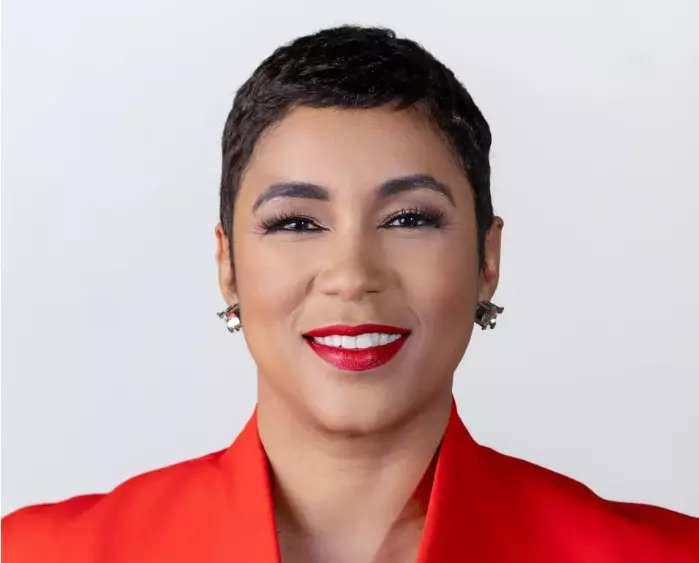
Ashley Etienne has been in some of the most high-pressure rooms in American politics. She ran communications for Speaker Nancy Pelosi. She served as Vice President Kamala Harris's communications director. She built and commanded the war room that drove the first impeachment of Donald Trump—a role she fought to claim by walking into the Speaker's office and making her case before anyone else could. She has since leveraged her expertise into a long-term spot as a contributing host on NBC's Meet The Press.
She knows something about belonging in rooms where the stakes are enormous and the margin for error is zero. Which is precisely why she has little patience for imposter syndrome.
“I don’t really understand it,” Etienne said in a recent interview. “I think it's really a major distraction for many young people.”
That’s not a dismissal of self-doubt as a real psychological experience. It’s something more pointed: a critique of how the workplace conversation around imposter syndrome has quietly redirected talented people—and disproportionately women and people of color—away from the one thing that actually builds confidence: preparation.
The Cottage Industry of Self-Doubt
Over the past decade, imposter syndrome has become one of the most talked-about concepts in professional development. The term—coined by psychologists Pauline Clance and Suzanne Imes in 1978—describes the persistent feeling of intellectual fraudulence experienced by high achievers who can't internalize their own success. Workshops address it. TED Talks dissect it. Entire coaching practices are built around it.
But critics have begun to question whether the framing itself is doing harm. In a widely cited 2021 Harvard Business Review piece, organizational scholars Ruchika Tulshyan and Jodi-Ann Burey argued that the concept was invented to describe the internal experiences of white women—and that applying it to women of color obscures a more important truth: the problem isn't in their heads. It's in the room.
Etienne’s reframe lands somewhere adjacent, but distinct. Her concern isn't that imposter syndrome pathologizes a systemic problem—though she'd likely agree with that too. Her concern is more tactical: that the energy spent managing feelings of fraudulence is energy stolen from genuine readiness.
“Don’t obsess about this notion of whether you should or shouldn’t be in the room,” she said. “If God opened the door, push your way through it. But spend that energy—rather than being in your head—investing in yourself, preparing for that room. Knowing who's in the room, who's going to say what, what your retort would be, what's your goal going into the conversation.”
Preparation as Power
Etienne’s own career trajectory is a case study in exactly that approach. When she first arrived in Washington, D.C., she had no connections, no political pedigree, and—by her own admission—no clear roadmap. She cold-wrote five members of Congress and chose to work for the one most likely to lose his Senate race, reasoning that turnover in his office would create faster opportunities to advance.
Within a year, she went from receptionist to communications director. “I was making six figures and had no idea what I was doing,” she said, “but I managed through it all.”
That early bet on strategic positioning over safe choices became a template she returned to throughout her career. She sought the hardest assignments, not the most prestigious titles. She studied the rooms she was entering—the players, the pressures, the likely moves—rather than auditing whether she deserved a seat in them.
“I wanted the hard assignments because I knew it was going to challenge me, stretch me, put me in the room with the best people,” she said. “I chased the challenge and not the title and not the money.”
The result, over three decades, was a kind of compound interest in credibility: the reputation as what colleagues called “Obama's bad news fixer” and “the queen of the war room” was built not on confidence performed, but on competence accumulated.
The Reframe in Practice
For younger professionals navigating an increasingly complex workplace, Etienne's prescription involves a concrete mental shift: redirect the anxious energy of self-questioning into specific, actionable preparation.
- Before a high-stakes meeting, research every person in the room.
- Before asking for a promotion, build an explicit case—name accomplishments, anticipate objections, know your counterargument.
- Before stepping into a leadership role, be honest with yourself about whether your foundation is genuinely ready for what the role demands.
“It's easier to be audacious when you're standing on a solid foundation,” Etienne said. “A lot of young people don't invest in their foundation—ensuring that you're prepared for the responsibility you're going to take on.”
She's careful not to conflate this with the “just work harder” advice that has drawn its own backlash in conversations about Black women and professional labor. The investment she's describing is strategic, not necessarily measured in hours. It might mean getting a graduate degree, or finding a mentor, or deliberately choosing a role that exposes you to new skill sets. “Some cases it doesn't require 80 hours of working,” she said. “Sometimes it does. It's about making investments in yourself, however you see fit.”
What the Room Actually Requires
The broader workplace implication of Etienne's argument is worth sitting with. If organizations are serious about inclusion, they have a role in this equation too—not just in opening doors, but in being transparent about what preparation actually looks like inside their specific rooms. Sponsorship, honest feedback, and access to institutional knowledge are not soft benefits. They are the difference between someone showing up prepared and someone showing up to guess.
For individuals, though, Etienne's message is clarifying in a way that much of the imposter syndrome discourse is not. The goal is not to feel confident. The goal is to be ready.
“If not me, then who?” she said, reflecting on the moment she claimed the impeachment war room. “And it should be no one. If not me.”
That question, she suggests, is a better use of mental energy than the ones imposter syndrome invites. Not: Do I deserve to be here? But: Am I prepared to handle what being here requires? And if not—what’s my next investment?














Comment