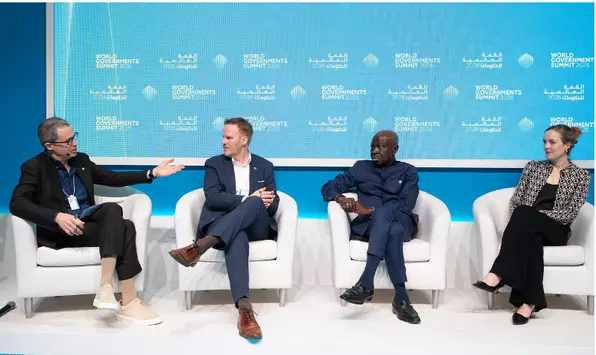
The AI workplace future is transforming how people work, learn, and build careers. At a global summit in Dubai, labour and leadership experts explored how artificial intelligence, shifting demographics, and economic uncertainty are redefining jobs. Many workers are asking whether roles will disappear, what skills will matter, and how organizations should prepare. The message was clear: fixed career paths are fading fast. Adaptability, continuous learning, and human judgment are becoming more valuable than job titles. Governments, employers, and professionals must rethink how work is structured.
Experts emphasized that predicting the labor market years ahead is becoming nearly impossible. Rapid technological shifts and economic changes are forcing institutions to rethink workforce planning. Instead of rigid long-term strategies, leaders are being urged to build flexible systems that evolve with change. Artificial intelligence is boosting productivity, but the benefits are not always reaching workers through wages or job stability. This growing imbalance is raising concerns about inequality. Investing in skills is no longer optional—it is a core survival strategy.
Artificial intelligence is especially effective in environments filled with repetitive tasks like research, documentation, and administrative work. Governments and large organizations stand to gain significantly by using AI to handle routine operations. But experts warned that automation should enhance human work, not replace decision-making. The goal is to keep people focused on complex, judgment-heavy tasks that machines cannot manage alone. Continuous retraining will be essential as tools evolve rapidly. Maintaining human agency will determine whether AI benefits society or deepens risk.
Fear, not technology, may be the biggest threat to future work. When people believe opportunities are shrinking, they stop investing in their own growth and resist experimentation. Leaders must communicate a realistic but hopeful vision that encourages action and skill development. Optimism helps organizations embrace change rather than avoid it. Regions that maintain confidence in the future often see stronger innovation and workforce readiness. Leadership today requires balancing caution with momentum.
As AI reshapes industries, traditional career identities tied to a single profession are becoming fragile. Experts argue that meaningful work should no longer be defined only by status or title. Fair pay, stability, and social protections must remain part of the conversation. Roles most vulnerable to automation often include repetitive tasks, which disproportionately affect certain groups of workers. Education systems focused only on credentials may struggle to keep pace. The future of work will center more on purpose, contribution, and adaptability.
Workplaces are already moving away from rigid job descriptions toward task-based models. AI tools allow individuals to deliver impact without following traditional management hierarchies. Career progression may no longer depend on climbing corporate ladders. Instead, employees will contribute through specialized skills, projects, and workflows. Culture, experimentation, and leadership support will shape success more than static titles. Organizations that redesign work around outcomes will adapt faster.
No one can predict which skills will dominate the next decade. What experts agree on is the need for environments that encourage learning and experimentation. Workers must continuously reskill as technologies evolve. Employers must create safe spaces where teams can test ideas and fail without fear. This approach builds resilience and prepares organizations for unexpected shifts. The ability to learn quickly may become the most valuable skill of all.
The future of work will not be defined by a single breakthrough or industry. It will be shaped by how individuals and institutions respond to ongoing change. Those who stay flexible, curious, and proactive will have the greatest advantage. Fixed roles, predictable paths, and lifetime careers are fading into history. In their place, a more dynamic and human-centered model is emerging. The AI workplace future is not just about technology—it is about how people evolve with it.


Array