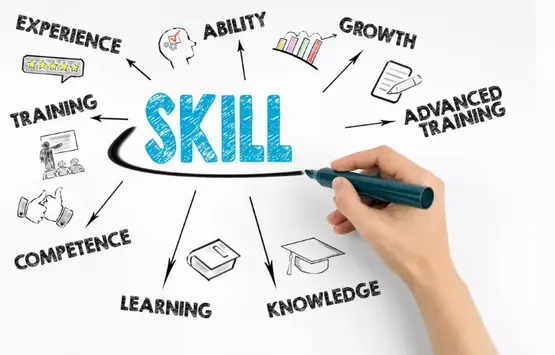
Skills have become one of the most searched and discussed topics in work, HR, and leadership, especially as AI reshapes jobs. People want to know what skills matter, which ones last, and how to build them faster. Yet despite the hype, the concept remains blurry and inconsistently defined. Traits, abilities, knowledge, and personality are often mixed together under the same label. This confusion makes workforce planning, hiring, and reskilling far harder than it needs to be. To clarify the picture, researchers have spent decades studying skills across psychology, education, and performance science. Their findings reveal a far more precise—and useful—way to think about skills in modern work.
At their core, skills are learned capacities to perform tasks efficiently and reliably. They show up in consistent results delivered with less effort over time. Speaking a language fluently, resolving conflict calmly, or writing clean code all reflect skill, not personality. What matters is not just correctness, but speed, judgment, and economy of action. Skills are visible in performance, not intentions or labels on a résumé. They improve through learning and practice rather than being fixed at birth. This distinction is crucial, because confusing skills with traits leads organizations to train the wrong things.
Practice is essential, but it is not the full story. People differ in their underlying abilities, which shape how quickly and deeply skills develop. Two individuals can receive identical training and still progress at very different speeds. Cognitive capacity, perceptual sensitivity, and coordination all influence learning efficiency. In simple terms, skills emerge from a mix of effort and potential. More potential reduces the effort needed, while less potential requires greater persistence. This is why one-size-fits-all upskilling programs often disappoint.
Personality traits do not determine whether someone can perform a task, but they strongly influence whether skills are developed and used. Conscientious people tend to practice more deliberately and apply feedback consistently. Open-minded individuals are more likely to acquire creative and analytical skills. Emotional stability affects how well skills hold up under pressure. Many so-called “soft skills” are actually personality traits expressed in the right context. Understanding this prevents organizations from overestimating how trainable certain behaviors really are.
There is no perfect measure of skills, but some methods are far more reliable than others. Self-reports and credentials are weak signals on their own. The strongest indicators come from observing real performance in realistic tasks. Work samples, simulations, and standardized assessments consistently outperform informal judgments. Psychometric tools can also estimate how easily skills may be acquired by measuring underlying abilities. The most accurate approach triangulates performance data, structured evaluation, and scientific measurement. Guesswork is not a strategy.
Curiosity acts as a multiplier for skill development. Curious people engage more deeply, persist longer, and explore beyond surface mastery. They ask better questions and actively seek feedback. This leads to faster learning and more flexible application of skills. Curiosity also strengthens metacognition, helping individuals recognize gaps and adjust strategies. Over time, this creates higher ceilings of mastery. In fast-changing roles, curiosity may be as valuable as competence itself.
Skill demand follows economic logic. Skills are valuable when they are both useful and scarce. Technology constantly reshapes this balance by automating tasks and expanding supply. History shows this pattern repeating across every major innovation wave. When tools embed expertise, previously rare skills lose value. What remains valuable are skills that are difficult to codify, slow to develop, or deeply contextual. AI is accelerating this cycle faster than ever.
No one can predict exactly which skills AI will replace. A better question is which skills will remain scarce and defensible. These tend to sit around automation, not inside it. Problem framing, judgment under uncertainty, and sense-making remain human-intensive. Leadership, accountability, and trust also resist full automation because responsibility still lies with people. The future favors those who combine technical literacy with context, ethics, and adaptability. As execution becomes cheaper, meaning-making becomes priceless.
Access our platform effortlessly on-the-go through our user-friendly mobile apps.








Comment