
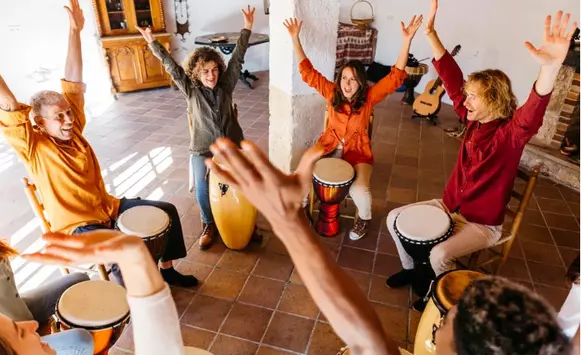
Leadership rhythm is the cadence through which you enter rooms, steady teams under pressure, and create meaning when everything feels chaotic—and it's deeply shaped by cultural identity long before your first professional role. Before anyone hears your ideas, they feel your leadership rhythm through the way you connect, decide, and regulate emotional energy. Research shows that cultural background influences how leaders are perceived, affecting assumptions about credibility, decisiveness, and influence in ways that directly impact team performance and trust.
When asked how Dominican Republic rhythms still shape my leadership approach, my answer came quickly: "I come with merengue and salsa in my veins." It sounds playful, but it reflects a deeper truth about how cultural rhythm doesn't just shape how we move through the world—it fundamentally shapes how we lead. I was raised in Dominican rhythm and rooted in Dominican-Puerto Rican cultural DNA, learning to lead with warmth, humor, connection, and the consistency that builds trust, especially when stakes are high and moods are heavy.
I study organizational rhythms professionally, examining how energy moves through teams, how leaders steady or destabilize it, how decisions flow, and how meaning emerges under pressure. But long before that became my work, it was my wiring. Of course, no culture is monolithic, but our early rhythms often leave indelible patterns that surface in how we show up as leaders. The way you were taught to show up for people, to read a room, to use humor to release tension, to build trust through consistency—these weren't lessons from a leadership book. They were cultural inheritance.
Identity doesn't just shape how you lead—it shapes how your leadership is interpreted by others. A growing body of research suggests that cultural background influences the lens through which leaders are viewed, shaping assumptions about their credibility, decisiveness, and influence in global workplaces. Evaluation extends beyond technical skills to encompass the cultural cues leaders bring into rooms and the interpretations teams make from them. In other words, identity is not just personal; it's structural, and it shapes the rhythm of leadership in measurable ways.
Leadership rhythms differ dramatically across cultures. Some cultures prize directness and decisive action, while others emphasize relational trust and consensus-building before moving forward. Some lead with speed and urgency, while others lead with deliberate flow and careful consideration. Some focus on control and hierarchy, while others focus on collaboration and shared ownership. None of these approaches are inherently better, but knowing your rhythm gives you power to use it intentionally rather than letting it operate unconsciously.
Today's leaders navigate what futurist Jamais Cascio coined as BANI—brittle, anxious, nonlinear, and incomprehensible conditions. Organizations face constant reorganizations, AI disruption, and teams stretched thin by chronic uncertainty. McKinsey Health Institute research highlights persistent challenges in employee wellbeing, with surveys of tens of thousands of workers worldwide showing high levels of burnout and low holistic health, signaling widespread stress and disconnection that leaders cannot ignore.
In moments like these, leaders can't rely on technical expertise alone. They need relational, cultural, and emotional tools that steady people when everything feels unstable. Research shows organizations now need emotional steadiness from leaders who regulate under pressure rather than react impulsively, cultural intelligence from those who understand different rhythms and adapt without losing themselves, sensemaking from leaders who help teams understand what's happening and what it means, and connection from those who build psychological safety and belonging, which multiple studies link to higher performance and lower burnout. Leadership rhythm, used deliberately, fuels all of these capabilities.
My cultural upbringing taught me that storytelling works not as a download of information but as an invitation to understanding. You bring people in, help them make sense of complexity, and move together toward clarity. Leaders who do this well—who can narrate meaning in real time—create steadier teams, especially during crisis. Organizational scholar Karl Weick's decades of research reinforces this: sensemaking is the backbone of steady leadership that enables teams to stay curious under pressure, experiment instead of retreat, and practice the kind of mindful organizing that turns uncertainty into clarity rather than chaos.
This is where cultural identity resurfaces in leadership rhythm. My upbringing taught me to read the room before trying to lead it, to use humor to release tension, to lean into curiosity to understand where people are coming from, to build trust through consistency, to connect before correcting, and to listen as much as I speak. These stabilizing skills show up in moments we rarely name: pausing long enough to read the room before responding, using humor to soften a tense meeting, asking one more curious question to understand what people aren't saying yet. Leaders who understand and use their cultural rhythm deliberately often build trust faster, reduce friction, and improve team clarity—all direct drivers of performance.
First, name your leadership rhythm and use it intentionally. Ask yourself what shaped the way you move, decide, or steady people—was it culture, family, language, geography, faith, migration, or music? Leaders who understand the origin of their rhythm lead with more authenticity and coherence. Second, build a shared leadership rhythm with your team through consistent rituals like daily kickoffs, weekly resets, moments of humor, and quick storytelling. Research shows teams with consistent rituals coordinate faster and recover quicker under stress because everyone knows the expected tempo.
Third, let joy be strategy—not performative cheer or toxic positivity, but real, grounded joy through micro-moments that relieve tension, deepen trust, and keep people human in high-stakes work. Take joy as an example—a quality often dismissed as soft or superficial. Studies on organizational rhythm and team performance show that joy functions as a stabilizer, reducing friction, strengthening trust, and expanding a team's capacity to problem-solve clearly under strain. Research summarized by UC Berkeley's Greater Good Science Center shows that positive emotions including joy broaden cognitive resources, strengthen collaboration, and improve problem-solving, all of which help teams recover from stress and burnout.
Fourth, use your rhythm to regulate the room because your leadership rhythm isn't just internal—it's contagious. Leaders set the emotional tempo for their teams. Before high-stakes moments, take thirty seconds to pause, breathe, and clarify the rhythm you want to bring: calm, curiosity, courage, or steadiness. A growing body of research indicates that leaders who effectively regulate their emotions enable teams to think more clearly, collaborate more effectively, and recover more quickly from stress, particularly in high-pressure moments where steadiness is crucial.
Culture shapes leadership, rhythm shapes presence, and identity shapes how we make sense of the world and how we help others make sense of it too. You don't need any specific cultural background to have leadership rhythm—everyone has one, whether they've named it yet or not. The question isn't whether you have a leadership rhythm; it's whether you're using it strategically or letting it operate unconsciously while you focus solely on technical skills and strategic frameworks.
In a world this volatile, your leadership rhythm isn't just part of your personal story—it's a strategic tool that determines how teams experience your leadership, how trust forms, how stress gets regulated, and how meaning emerges from chaos. So ask yourself: What is the rhythm you lead with? And who or what taught you to move that way? Understanding the answers transforms leadership from something you do into something you embody with intention, coherence, and the kind of cultural intelligence that steadies teams when everything else feels uncertain.

𝗦𝗲𝗺𝗮𝘀𝗼𝗰𝗶𝗮𝗹 𝗶𝘀 𝘄𝗵𝗲𝗿𝗲 𝗽𝗲𝗼𝗽𝗹𝗲 𝗰𝗼𝗻𝗻𝗲𝗰𝘁, 𝗴𝗿𝗼𝘄, 𝗮𝗻𝗱 𝗳𝗶𝗻𝗱 𝗼𝗽𝗽𝗼𝗿𝘁𝘂𝗻𝗶𝘁𝗶𝗲𝘀.
From jobs and gigs to communities, events, and real conversations — we bring people and ideas together in one simple, meaningful space.


Comments