Alerts

-
3 minutes, 46 seconds
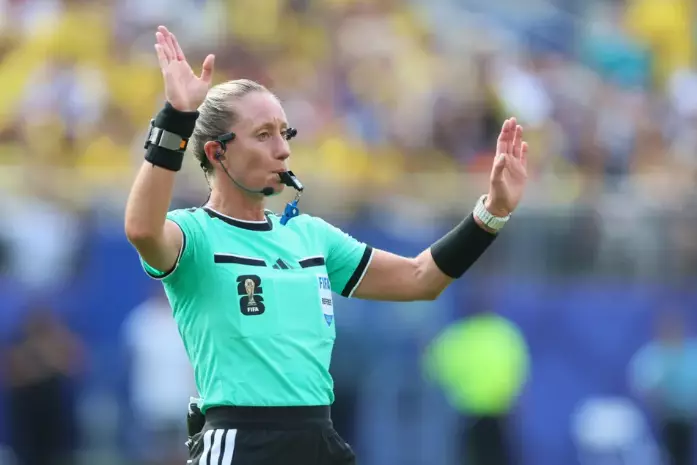
Women are now officiating at the men’s FIFA World Cup, but a major barrier remains: no woman has ever served as the center referee for a knockout match. While female referees have taken the field during group-stage games in both 2022 and 2026, FIFA has yet to appoint a woman to lead an elimination match. Research into why progress is slow reveals deep-rooted challenges, but the steps taken so far show real change is happening.
The numbers tell a clear story. For the 2026 World Cup, FIFA selected just six women as match officials—two referees, three assistant referees, and one video match official. That’s only 3.5% of the tournament’s 170 officials. Women remain a tiny minority on the field.
Yet female center referees have still only been assigned to group-stage matches. The referees for the 2026 final and third-place match will be announced this week.
It’s not surprising that women have struggled to break into the men’s World Cup. The players are men, the fans are mostly men (in the U.S., 71% of fans are men), the coaches are overwhelmingly men, and for decades, officials were all men. When women are given authority in what is seen as a “men’s game,” backlash often follows.
Researchers analyzed over 22,000 Twitter comments about female referees from the 2022 World Cup. Only 8% of comments were supportive. The rest were classified as sexist, exclusionary, or insulting. Examples include:
These comments aren’t just online noise. Researchers argue that constant ridicule and sexist treatment can discourage women from becoming or staying referees.
Previous research found that female referees in men’s soccer face a double standard. A questionable call by a man is seen as an individual error. The same call by a woman is blamed on her gender. As one official put it: “Every decision you make you’ve made because you’re female, not because you’re a referee.” Studies show women in male-dominated jobs are judged more harshly for mistakes than men.
Another barrier is the stereotype that women are less decisive than men. Being decisive is critical for a referee. Yet research finds no evidence that women are less capable of making quick decisions.
The slow progress isn’t unique to FIFA. Across professional sports, women are dramatically underrepresented among officials.
Interestingly, men do not face the same barriers in women’s sports. Men make up a significant portion of WNBA referees. But for the Women’s World Cup, FIFA chooses only female on-field referees.
Even though it’s slow, progress is real. Just four years ago, no woman had ever officiated a men’s World Cup match. Today, women are making calls on the field. That’s a big change. Research on women entering male-dominated professions shows that representation changes perceptions. The more fans see women officiating major matches, the less unusual it becomes.










Comment