
Alerts
-
4 minutes, 0 seconds
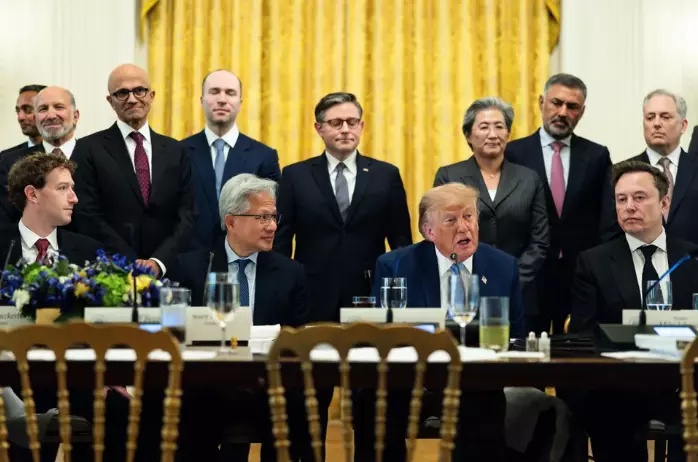
President Donald Trump convened many of the biggest names in artificial intelligence at the White House this week for a summit on the technology's future. The meeting took place amid warnings about potentially catastrophic risks from AI. But the guest list was overwhelmingly male: only two of the 31 people invited were women.
One of those two was White House Chief of Staff Susie Wiles. That left AMD CEO Lisa Su as the only woman from the AI industry in the room. The imbalance matters for reasons that go beyond representation, because research suggests a group's gender makeup can influence how it evaluates risk.
During the closed-door portion of the meeting, technology executives raised their risk concerns with the President. Participants later signed a voluntary safety agreement called the White House Accord on Super Intelligence, which President Trump described as "morally binding."
Six AI companies signed the accord: OpenAI, Anthropic, Google, Meta, xAI and Nvidia. Every executive who signed the document on behalf of a company was a man.
The gender imbalance could extend beyond this one meeting. President Trump said he is considering creating a roughly 10-person committee to "watch over the whole enterprise." He suggested the oversight committee might be formed from the attendees at the White House summit, which would carry the same gender imbalance into future oversight.
Women were clearly underrepresented at the summit, but they are also severely underrepresented in the oversight of the companies that promised to police their own AI safety practices in the agreement.
OpenAI has two women on its eleven-person board. Meta, Alphabet and Anthropic also have only two each. SpaceX has only one. Nvidia fares slightly better, with four women among its 11 directors.
To be fair, there are several high-level female AI industry leaders. Daniela Amodei is the cofounder and president of Anthropic. Mira Murati is the cofounder and CEO of Thinking Machines Lab and former CTO of OpenAI. Dina Powell McCormick is the president and vice-chairman of Meta. Fei-Fei Li is the cofounder and CEO of World Labs. Gwynne Shotwell is the president and COO of SpaceX.
Even so, there is still a severe lack of women in industry leadership. That imbalance takes on greater significance given the magnitude of the risks under consideration. One former Anthropic employee, Jacob Coxon, described the future AI risk on social media by writing, "The people building AI earnestly believe that it could kill us all by the end of the decade." Evan Hubinger, Anthropic's alignment science lead, responded, "We really do earnestly believe AI could kill all humans! I personally think it is >10% within the next decade."
Some of the industry's most prominent male leaders have also warned about catastrophic risks. Anthropic CEO Dario Amodei has estimated a 10% to 25% chance that things go catastrophically wrong, while Elon Musk has put the risk at 20%. Clearly, men are recognizing the danger, but gender may matter when assessing how much risk is acceptable.
With such dire risks on the table, gathering people with different perspectives on risk seems like an obvious step. And substantial research shows men and women often perceive risk differently. Some studies find that women are more risk-averse than men, while others find that the gender differences depend on the type of risk and what people have experienced when taking risks in the past.
In either case, women and men often see risks differently, which could matter when deciding how much AI risk is acceptable.
Gender may also affect what happens when groups make decisions about risks. In one 2025 study, researchers put participants in three-person groups containing different combinations of men and women. Male-dominated groups made riskier decisions than their members' individual preferences would have predicted.
In other words, men in male-dominated groups may make riskier decisions than they would have on their own. Groups with more women did not show the same "risky shift." Other studies similarly suggest that group gender makeup affects decision-making and willingness to take risks.
Overconfidence may compound the problem. Past research suggests that overconfidence may help explain men's greater willingness to take risks. With AI, someone taking greater risks because they are overconfident in their ability to control the danger could have serious consequences.
No one knows whether the people warning of catastrophic AI risk are too alarmist or not alarmed enough. What is known is that the consequences of getting it wrong could be enormous. If a small group gets to determine how much risk society should accept, the research suggests women should be part of those decisions. Plenty of female AI leaders and academics already have the expertise to participate in this oversight.









Comment