Alerts

-
13 minutes, 5 seconds
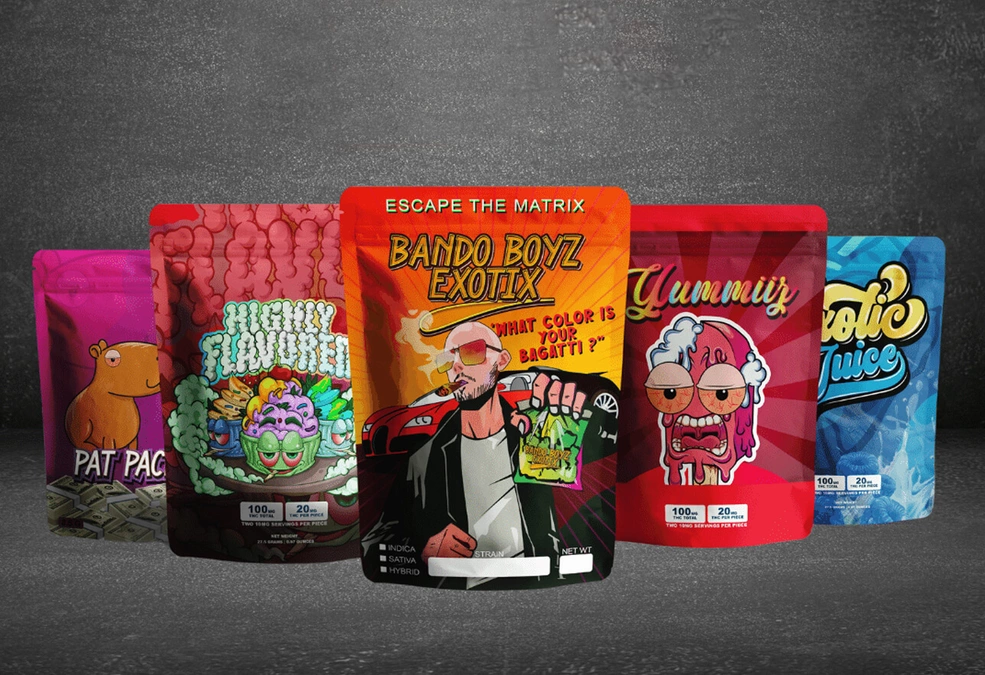
The custom Mylar bag market has expanded significantly in the past three years. Where buyers once had a handful of domestic suppliers to choose from, the combination of improved international logistics, digital print technology, and competitive pressure has produced a global market with hundreds of options at every price point.
More choice is generally a benefit for buyers. It also introduces more risk. The gap between a competitively priced Mylar bag that performs as specified and one that looks identical in a quote but performs materially differently in production is not always visible until the product is inside the bag and on its way to a customer.
This guide gives buyers whether you are a procurement professional or a business owner sourcing packaging for the first time, the framework to evaluate custom Mylar bag wholesale suppliers with confidence.
The term 'custom Mylar bags' covers a spectrum from minimally customised to fully bespoke, and the price difference across that spectrum is significant. Before requesting quotes, be clear about which level of customisation you actually need:
Custom size only a stock laminate, stock closure, in a non-standard dimension. Lowest cost, fastest lead time, available from most suppliers.
Custom print on a stock bag, your artwork applied to a supplier's standard bag size and specification using digital print. Low-to-moderate cost, typically 10–14 day lead time after artwork approval, MOQs of 100–500 units.
Fully custom specification, custom laminate construction, custom dimensions, custom closure type, custom finish, custom print via rotogravure. Highest quality and cost, 4–8 week lead time, MOQs typically 3,000+ units.
Buyers who ask for a quote for 'custom Mylar bags' without specifying which of these they need receive proposals that cannot be compared. Specify your requirements before you approach the market.
Ask every supplier to specify the exact laminate construction they are quoting. A genuine food-grade Mylar bag for long-term barrier applications uses a PET/AL/PE construction, polyethylene terephthalate outer layer, aluminium foil middle, and polyethylene food-contact inner layer.
Some suppliers substitute metallised polyester (VMPET) for the aluminium foil layer, which produces a visually similar but significantly lower-barrier result.
The right answer to 'what laminate are you quoting?' is a specific material designation, not 'high-quality Mylar' or 'premium foil bag.' If the supplier cannot specify the laminate construction, treat it as a warning sign.
For any bag that will contact food, supplements, or regulated consumables, the supplier must be able to provide compliance documentation, not just a verbal assurance. Request the Certificate of Conformance for food-contact compliance.
In the US, this references FDA 21 CFR standards. In the EU, EU Regulation 10/2011. In Canada, Food and Drug Regulations Part B.
A supplier who provides documentation proves they know what it is. A supplier who provides only assurances is leaving you to assume the compliance risk.
Ask specifically about the print method being used for your quote and the number of colours available. Digital print is technically unlimited in colour but may have constraints on specific metallics and spot colours.
Rotogravure is quoted per colour (each colour requires a separate cylinder), with metallic and fluorescent inks available as additional options.
For brands with Pantone-referenced brand colours, ask whether the supplier can hit your Pantone references on their substrate and confirm with a press proof before committing to a production run.
If you require a child-resistant closure, confirm that the supplier has tested their closure system against ASTM D3475 or the equivalent standard for your market. Ask for the test certificate.
Child-resistant closures that have not been independently tested cannot be relied upon for regulatory compliance in categories where CR packaging is mandated.
If you require a resealable zipper, ask how many open-close cycles the zipper is rated for. A zipper that fails after 50 cycles is not adequate for a product that consumers use daily for several weeks.
MOQ policies reveal a great deal about a supplier's operational model. High MOQs (5,000+ units) across all products suggest a business built for established brands at volume.
Low MOQs (100–500 units) on digital print suggest a supplier equipped to serve growing brands and frequent design updates.
Neither is inherently better; the right MOQ structure is the one that matches your current volume and update frequency. If your brand design is stable and your volume is predictable, higher-MOQ rotogravure production may deliver better unit economics.
If you update designs frequently or are still validating, low-MOQ digital print is more commercially appropriate.
Every supplier quotes a lead time. The more important question is: what is the supplier's on-time delivery rate against quoted lead times? Ask for data, or ask for references who can speak to delivery reliability.
A supplier who consistently delivers in five weeks is more valuable than one who quotes three weeks and delivers in six.
Ask also about the impact of design revisions on lead time. If you request a change after the pre-production sample review, how does that affect your delivery date? For brands working to meet deadlines, this is a critical operational variable.
Request the supplier's quality control documentation from a recent production run. This should include incoming material inspection records (verifying that the laminate received from their material supplier meets specification), in-process quality records (seal integrity testing during production), and outgoing inspection records (final check before shipment).
A supplier with systematic quality documentation produces consistently better results than one relying on operator experience alone. The documentation also gives you a basis for resolving quality disputes if something goes wrong.
Custom packaging production involves artwork approvals, pre-production samples, production milestone updates, and shipping coordination. The quality of your supplier's communication through this process directly affects your ability to manage your own production timeline.
Before placing a first order, test the supplier's responsiveness: send a detailed enquiry and evaluate the quality and turnaround of the response.
Ask how you will communicate during production: a dedicated account manager, shared inbox, or automated system. The answer tells you what your experience will be when you need a real-time update on a time-sensitive production.
Cannot specify laminate construction in material terms only describes bags as 'premium' or 'high-quality.'
Cannot provide food-contact compliance documentation for your market
Provides only digital renders rather than physical samples for review
Cannot provide references from buyers in comparable industries
Lead time quotes are significantly shorter than industry norms without a credible explanation
Has no documented quality control process
Requests full payment before pre-production sample approval
Custom Mylar bag quotes are only comparable when they are based on identical specifications. Use this checklist to verify before comparing:
Same laminate construction (PET/AL/PE vs VMPET; these are not equivalent)
Same bag dimensions (width, height, gusset specify all three)
Same mil thickness
Same closure type (and CR certification if applicable)
Same print method and number of colours
Same surface finish
Same quantity (unit pricing changes at volume thresholds)
A quote that comes in 20% lower than competitors may be quoting a different laminate, a thinner film, or a lower-capability print method. Ask the question explicitly: 'Is there anything in your quote that differs from this specification?'
A reputable supplier will tell you. A supplier who obscures specification differences to win a price comparison is not a supplier you want to discover this from after delivery.
The best packaging procurement outcomes come from supplier relationships, not individual transactions. A supplier who knows your business, your products, your volume patterns, your quality standards, and your design update frequency can serve you more effectively than one treating each order as a new engagement.
To build an effective long-term wholesale relationship:
Give your supplier visibility into your forward volume projections, which allows them to reserve capacity and material on your behalf
Consolidate SKUs where possible to increase your effective volume on any given specification
Communicate design changes as early as possible; last-minute changes are expensive for everyone
Provide quality feedback on every delivery, which gives the supplier data to improve and documents your standards
Pay on agreed terms, suppliers prioritise customers who are reliable commercial partners
For brands sourcing custom Mylar bags wholesale across multiple product lines, Alpha Global Packaging supports procurement planning with a full range of customisation options, including custom rigid boxes, Kraft packaging, and Mylar bags with the material breadth to consolidate multiple packaging categories with a single supplier relationship.
Custom Mylar bags wholesale is a category where doing the specification work upfront pays significant returns. Buyers who define their requirements clearly, qualify suppliers against objective criteria, and build long-term relationships with manufacturers they trust consistently outperform those who make procurement decisions on price alone.
The packaging inside which your product reaches your customer is a direct reflection of your brand. The supplier relationship behind that packaging determines whether it arrives consistently, on time, and exactly as specified. Both decisions deserve the level of attention this guide recommends.
Packaging requirements vary by product, industry, and region. Always consult with a packaging specialist to ensure compliance with applicable regulations for your product category.


8.4K articles

2.7K articles

1.6K articles

34 articles








Comment