
Alerts
-
6 minutes, 38 seconds
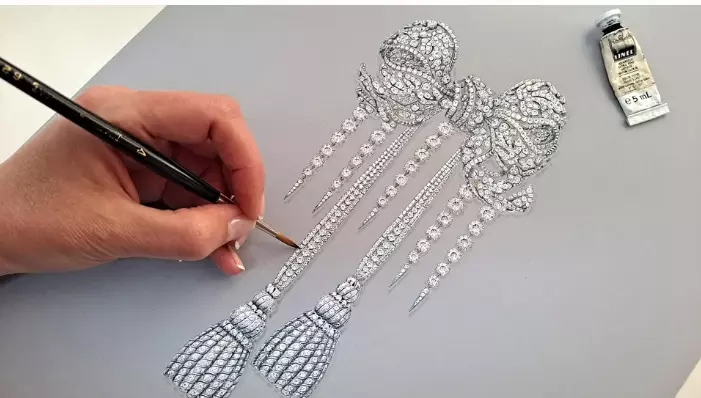
For anyone dreaming of a career in luxury design, becoming a jewelry gouache artist once represented one of the most prestigious creative paths in high jewelry. These artists create hand-painted renderings of jewelry using opaque watercolor techniques to bring gemstones and intricate designs to life before a piece is ever crafted. Yet despite its beauty and historical importance, the profession is slowly fading. Digital rendering tools, time pressures, and shifting industry priorities have pushed this once-essential craft to the margins of modern jewelry production.
For more than a century, jewelry gouache sat at the center of high jewelry creation, particularly in Paris’s famed Place Vendôme studios. Using delicate brushes and specialized pigments, artists produced hyper-realistic paintings that showcased how diamonds, emeralds, and other gemstones would appear in a finished piece. These artworks were not simply sketches—they were visual promises of luxury, crafted with extraordinary precision and patience. The technique, perfected in the 19th century, required deep knowledge of gemstones, light reflection, and color layering. In many prestigious maisons, these paintings were the first step in bringing a high-value jewel to life.
Despite its artistic significance, the jewelry gouache artist profession is increasingly at risk. The rise of CAD modeling and 3D rendering has dramatically changed how jewelry designs are presented to clients. Digital tools allow designers to generate images quickly and at lower cost, making traditional painting seem inefficient by comparison. Confidentiality rules in major jewelry houses also limit artists’ ability to publicly showcase their work, leaving many talented professionals largely invisible. Even museum exhibitions often focus on historical gouache paintings, reinforcing the perception that the craft belongs to the past rather than the future.
A small group of artists and educators are determined to keep the jewelry gouache craft alive. Among them are sisters Jeanne and Hélène Karpov, founders of Karpov Paris and an online learning platform dedicated entirely to teaching the technique. Through workshops, courses, and digital communities, they introduce new students to a discipline once learned almost exclusively inside elite jewelry houses. Their approach emphasizes the deep connection between observation and technique. According to the artists, mastery requires countless hours of practice and an eye trained to study hundreds of gemstones and finished jewelry pieces.
Even in a digital age, gouache renderings continue to play a powerful role in luxury jewelry sales. Designers working with rare gemstones and ultra-wealthy collectors often rely on these hand-painted images to communicate the emotional story behind a piece. A well-executed gouache can reveal depth, light, and brilliance in ways that digital images sometimes struggle to replicate. For clients considering million-dollar stones, the painting itself can become part of the luxury experience. In many cases, it’s the gouache artwork that ultimately convinces a buyer to move forward with an extraordinary commission.
Unlike many modern design tools, learning jewelry gouache painting offers no shortcuts. Students must spend years mastering brush control, color mixing, and gemstone realism. Beginners frequently struggle with techniques such as layering white pigment correctly so stones appear luminous rather than cloudy. Progress depends on patience and persistence, as early attempts rarely meet the high standards expected in luxury design. Over time, however, artists begin to understand how light, proportion, and color interact on paper. When that balance finally clicks, the result can transform a simple drawing into a captivating piece of art.
While digital tools have contributed to the craft’s decline, they may also help preserve it. Many designers now combine traditional gouache illustration with digital workflows. Hand-painted designs can be scanned and enhanced using software, allowing artists to share their work more easily with clients and collaborators. CAD specialists then refine the three-dimensional structure of the jewel while maintaining the visual richness of the original painting. This hybrid approach allows traditional artistry and modern technology to complement rather than compete with one another.
The future of the jewelry gouache artist career will likely depend on visibility, education, and support from the luxury industry. Without greater recognition from jewelry houses, museums, and design schools, the profession could become increasingly rare. Advocates believe public demonstrations, exhibitions, and educational programs could help inspire the next generation of artists. Yet the career also requires humility, as many gouache artists work behind the scenes without public credit for their creations. If the craft is to survive, it will need both passionate practitioners and institutions willing to celebrate the artistry behind high jewelry.










Comment