Alerts

-
3 minutes, 11 seconds
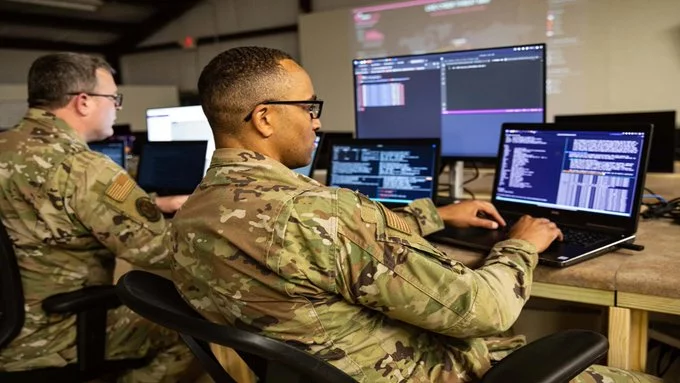
Army researchers are moving beyond theoretical exercises by training AI agents on real cyber tasks. Instead of simply feeding models static datasets, they employ reinforcement learning—a trial-and-error process where the agent receives feedback for its actions. This allows the systems to develop a practical understanding of both network defense and offensive operations within live, simulated environments. By interacting with realistic network topologies and traffic, the agents learn to identify vulnerabilities, execute countermeasures, and adapt to adversarial moves in a way that static analysis cannot achieve. The goal is to create autonomous agents capable of executing complex cyber maneuvers, learning optimal strategies from the consequences of their decisions in real time.
Despite the advanced learning capabilities of AI agents in cyber operations, the final decision to execute an action always rests with a human operator. This is not a technical limitation but a deliberate design choice. The AI can propose a course of action, simulate its outcomes, and even rank its confidence, but it cannot authorize a strike, a data exfiltration, or a system shutdown. That authority is held exclusively by a person who can assess the broader operational context, legal constraints, and ethical implications that the model may not fully grasp.
This human-in-the-loop structure ensures two essential outcomes: control and accountability. Control means that no autonomous action occurs without explicit approval, preventing unintended escalation or collateral damage. Accountability guarantees that a responsible individual can be identified for every decision, which is crucial for compliance and post-incident review. As the source emphasizes, this oversight is non-negotiable in real-world deployments, where errors carry significant consequences. The operator remains the final authority, using the AI as a powerful tool rather than an autonomous commander.
The training approach for AI agents in cyber operations relies on a dual-pronged strategy: simulated environments and real-world data. Simulated environments offer a safe, repeatable sandbox where agents can practice attack and defense techniques without causing actual harm. These virtual arenas allow for the rapid iteration of scenarios, from network intrusions to phishing attempts, enabling agents to learn from failures at scale. Complementing this, the integration of real-world data grounds the training in actual threat patterns and tactics, ensuring the AI learns from authentic adversarial behavior rather than purely theoretical models.
The combination of these tools and data sources is crucial for developing AI that can navigate the complex and unpredictable landscape of cybersecurity operations. This methodology prioritizes both breadth of experience and depth of practical knowledge.
Looking ahead, AI agents are poised to take on increasingly complex cyber operations, from autonomous threat hunting to rapid patch management. However, this trajectory underscores the ongoing need for human judgment. While AI excels at pattern recognition and speed, human operators remain essential for interpreting strategic intent, weighing ethical trade-offs, and making high-stakes decisions in ambiguous situations. The challenge lies in defining the optimal division of labor—ensuring humans stay in the loop without becoming bottlenecks.
Integration presents practical hurdles. Legacy security infrastructure is often not designed for AI-driven autonomy, requiring significant architectural changes. Data silos and inconsistent telemetry can starve AI models of the high-quality training data they need. Moreover, adversarial attacks on the AI systems themselves—such as prompt injection or data poisoning—introduce new vulnerabilities. Addressing these issues demands robust validation frameworks, continuous monitoring, and clear accountability protocols, ensuring that AI augments rather than undermines cyber defense.










Comment