Alerts

-
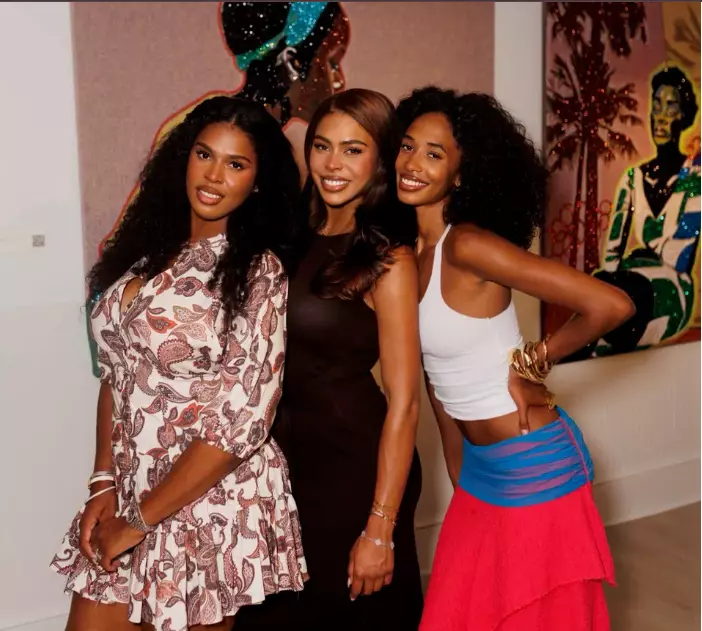
Two summers ago, a casual gathering at a kitchen table in a house on Martha’s Vineyard sparked a conversation that would evolve into a new art venture. It began with a simple, uncertain question from a recent art school graduate and quickly grew into something far larger than anyone at that table anticipated.
Mecca Pryor had brought a group of five friends up to Oak Bluffs, a summer tradition she has maintained for most Augusts. Among the group was Zoe Carson, a recent art school graduate who had a substantial body of work but no clear direction for it. Sitting at the table, Carson asked a question that many emerging artists face: “How do I put this out there?”
The answer came from Morgan Webster-Saunders, who gestured across the table and offered a surprisingly direct solution: “Show it to my mom.”
That suggestion led Carson’s work to Samantha Webster, a woman who had spent roughly seven years quietly building a collection with a focus on Black artists. Webster reviewed the work, found it compelling, and acted quickly. Before the weekend was over, she had purchased a piece.
The response was immediate and telling. Webster-Saunders turned to the room and voiced what would become the foundation of a new business: “We really need to do something.” Her sister, Taylor Webster, and Pryor were in full agreement.
That kitchen-table conversation has now materialized into something tangible. This month, the three of them staged “Anchors & Currents,” their first full exhibition, in a second-floor gallery located just a few streets away from the very kitchen where the idea was born.
The exhibition represents more than just a display of artwork. It is the culmination of an idea that started with a single artist’s question and a collector’s willingness to look. The space itself sits in close proximity to the original conversation, grounding the venture in the place where it all began.
What the trio figured out at that kitchen table has become the core of their entire operation. Their approach is not about selling art in the traditional sense. After attending Anchors & Currents, their official gallery event on the Vineyard, it becomes clear that they are offering something else entirely.
They are selling proximity. In the current market, proximity is the price.
This distinction matters. The venture is built on access, on the ability to connect people with art and artists in a way that feels personal and immediate. The gallery space, the setting, and the story behind the exhibition all contribute to an experience that goes beyond simply purchasing a piece to hang on a wall.
The path from that summer conversation to the opening of “Anchors & Currents” illustrates how a single question, met with a practical answer and a willingness to act, can grow into a full-fledged business. What began as one artist’s uncertainty has become a platform for connection, with the trio leveraging their collective instincts to create something new in the art world.
The sharpest illustration of this principle played out on opening weekend. Celebrity stylist Jason Bolden walked into the gallery, purchased one of Carson’s paintings, and shared exactly where it would hang: his kitchen, right next to his Amy Sherald.
Nothing about the artwork itself changed in that moment. What changed was its context—the company it now keeps and the signal that purchase sent to the broader art world. Pryor watched the effect land in real time: “That alone is going to take her work to a whole new level.”
The issue the three founders are working to solve carries a specific figure. According to the Burns Halperin Report, work by Black American artists—particularly those from the millennial and Gen Z generations—accounted for just 1.9% of auction sales value between 2008 and mid-2022. That translates to roughly $3.6 billion out of a staggering $187 billion total market. Museum acquisitions told a similarly sobering story, hovering at only 2.2%.
That statistic is often framed as a matter of taste or preference. studioQL’s founders, however, describe something far more mechanical at work. Carson’s success on the Vineyard came about because they commissioned her to paint two specific island scenes—“Inkwell Sunday” and “Meet Me at Shearer Cottage”—and then deliberately walked the finished works in front of buyers with deep generational ties to those exact locations.
“I don’t think they would have sold in that way,” Pryor said. “Zoe’s an Atlanta-based artist. She doesn’t have that same network in Martha’s Vineyard as we do.”
The Websters have a family case study that illustrates the difference between selling and being collected. Their great-grandmother, Jeanne Marie Greene, was a working painter who sold steadily throughout her career. She took commissions, showed in galleries, and sustained herself through her art. Yet, to the family’s knowledge, her work never entered a museum collection.
She sold. She was never collected.
Those are two fundamentally different economies, and only one of them compounds over time. A sale is a single transaction—a moment of exchange between artist and buyer. Being collected, by contrast, places work into institutional contexts that build reputation, increase value, and create lasting career momentum. The distinction matters because it determines whose careers accelerate and whose fade, regardless of the quality or consistency of the work itself.
The approach reads as a direct response to the traditional gallery model.
A conventional gallery typically takes a 50% commission. That standard split is rooted in a system, dating back to influential dealers like Leo Castelli, where the gallery assumes responsibility for production, shipping, insurance, and the lengthy process of introducing an artist to institutions. studioQL, however, charged between 20% and 40% on its first exhibition, allowing artists to keep 60% to 80% of the proceeds, while still covering shipping and logistics. The gallery also went a step further by flying several artists to the island and providing accommodation, operating on the belief that an artist presenting their own work is more compelling than a wall label.
The gallery signs no one. There is no representation agreement, no exclusivity clause, and not even a multi-year term. Instead, the arrangement is straightforward: two days on the island, followed by a commission on any sales that result.
"It's not like we're representing the artist every single day, all day," Pryor explained. The decision was intentional: "We want them to feel valued."
Morgan Webster articulated the financial logic clearly. An emerging artist "needs a larger cut in order to produce more work and be able to sustain life."
Pricing is established collaboratively, with benchmarks based on the collections an artist already belongs to, whether museum or private, and their educational background. Taylor Webster describes deliberately holding prices down to keep the work accessible for first-time buyers.
This strategy stands in contrast to a market where the 2026 Art Basel and UBS report indicated global sales had risen 4% to $59.6 billion, with a recovery "led by renewed activity at the high end," while contemporary dealer sales remained flat. The upper tier of the market experienced a resurgence, leaving the lower end to navigate its own path.
None of the three founders left their jobs to launch studioQL. Instead, they brought their professional expertise directly into the project.
Taylor Webster works as a public relations executive. Morgan Webster-Saunders is pursuing a PhD in artificial intelligence and came from a background in corporate operations; she built the website and managed the logistics. Pryor works in media. Her father, Eric G. Pryor, brings more than twenty years of experience as a museum professional, advising the artists on how work actually enters an institution.
“We were bringing skills from our occupations that we traditionally have to these artists,” Pryor said, “and they’re able to capitalize on them.”
The clearest proof that the network itself is the asset came when a luxury conglomerate paid for access to it. Moët Hennessy approached Pryor in September of last year, looking for a way to reach a Gen Z audience, a demographic all three founders happen to belong to. The brand brought studioQL into LVMH’s Art Basel program, where they built an immersive exhibition that visitors could paint alongside, treating it as a soft launch. Hennessy also backed “Anchors & Currents,” particularly the Hennessy Sound Lounge, which gave young and emerging DJs a platform, on the Vineyard.
This is the part that should interest anyone watching how younger workers build careers. Side hustle participation fell to 27% of U.S. adults in 2025, down from 36% the year before, according to Bankrate, with Gen Z still leading at 34%. The dominant millennial version of a second income was audience-facing: a personal brand, a newsletter, a storefront, something you had to be seen doing.
studioQL is the opposite shape. No founder is the product. The asset is the employer’s Rolodex and the operational competence a corporate job pays to develop, pointed at a market that undervalues the people they grew up around. The bench extends the pattern. Two of the weekend’s young curators came out of Stanford and Spelman; one of its hosts is deciding between venture capital and finance.
Access economies have a habit of reproducing the exclusion they were built to fix. If the qualifying credential for a studioQL show is knowing Pryor or one of the Websters, the artist outside that circle is still outside one, just a warmer one. Taking half the industry’s commission while paying all of the costs is generous at one exhibition a year. At ten, it is a math problem.
The founders are not pretending otherwise. Taylor Webster calls the whole thing unfinished by design.
“It’s not a finished idea, and I don’t want it to be,” she said. “Our anchors are the people, places, and experiences that made us who we are. The currents are everything still unfolding.”
Jeanne Marie Greene sold well for decades and got no further. Her great-granddaughters, alongside their lifelong friend, have the distribution she never did, and they are spending it on other people.

8.4K articles

1.6K articles

34 articles

28 articles













Comment