Alerts

-
6 minutes, 6 seconds
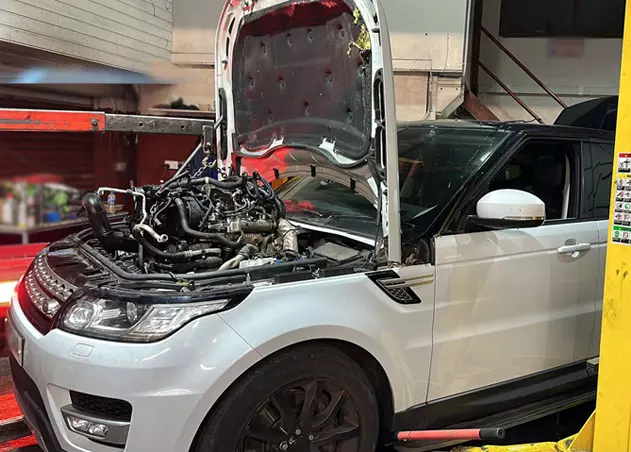
The Range Rover has occupied a singular position in the automotive world since its debut in 1970. It was not the first luxury vehicle, nor the first serious off-roader — but it was the first to convincingly be both simultaneously. At the centre of that achievement, in every generation and every variant, has been the engine. Range Rover powertrains have never been chosen merely to move the vehicle from one point to another. They have been selected, developed, and refined to deliver an experience — one of effortless authority, composed refinement, and the quiet confidence that comes from knowing the machine beneath you is capable of handling whatever lies ahead. This is the story of the engines that made the Range Rover what it is.
When Land Rover engineers placed the all-aluminium 3.5-litre V8 engine into the original Range Rover, they made a decision that would define the vehicle's character for decades. The engine itself had a fascinating history — originally designed by General Motors' Buick division in the United States, it was acquired by Rover in 1965 and progressively developed to suit British conditions and tastes.
What made this engine so well-suited to the Range Rover concept was its combination of qualities rarely found together at the time. Its aluminium construction made it unusually light for a V8, contributing to balanced weight distribution across the four-wheel-drive platform. Its power delivery was smooth and linear rather than peaky, providing the kind of relaxed, effortless torque that made both low-speed off-road work and sustained high-speed motorway driving feel equally natural. And its refinement — the near-silence of eight cylinders firing in an even cadence — brought a sense of composure to the driving experience that set the Range Rover apart from every other 4x4 on the market.
Through the 1980s and into the 1990s, the V8 was progressively developed to keep pace with rising expectations. Carburettors gave way to electronic fuel injection, bringing improved cold-start behaviour, more consistent power delivery across varying altitudes, and reduced fuel consumption at part throttle. Displacement grew from the original 3.5 litres to 3.9 litres in 1989, and later to 4.2 litres and 4.6 litres in the flagship models, with power outputs rising correspondingly.
The 4.6-litre naturally aspirated V8 fitted to the P38 Range Rover Engine produced around 225 horsepower — modest by contemporary standards but delivered with the smooth, wave-like torque characteristic that Range Rover owners had come to expect. By this point, the V8 had become inseparable from the Range Rover's identity. Its sound, its feel, and its particular brand of unhurried performance were as much a part of the Range Rover experience as its air suspension and leather upholstery.
For much of its early history, the Range Rover was a petrol-only proposition in many markets. The arrival of serious diesel power changed the vehicle's appeal fundamentally, particularly in Europe where fuel economy and long-distance torque output were primary concerns for luxury SUV buyers.
The BMW-sourced 3.0-litre TDV6, introduced in the L322 generation Range Rover, brought a new dimension to the lineup. With strong mid-range torque, impressive refinement for a diesel of its era, and significantly better fuel economy than the V8 petrol alternatives, it quickly became the preferred powertrain choice for a substantial portion of Range Rover buyers. Its six-cylinder configuration contributed to low vibration levels and an exhaust note that, while clearly diesel, was far removed from the agricultural clatter associated with earlier oil-burning engines.
The 4.4-litre TDV8 — a twin-turbocharged V8 diesel unit — took this philosophy further still. Producing torque outputs that rivalled dedicated towing vehicles while maintaining the composed, serene character expected of a Range Rover, the TDV8 became particularly popular among owners who required genuine towing capability without compromising on day-to-day refinement. It powered the Range Rover Sport TDV8 with particular distinction, matching the chassis dynamics of that more driver-focused vehicle with torque delivery of rare breadth and consistency.
If the TDV8 defined the Range Rover's working side, the supercharged petrol V8 defined its spectacular side. The 4.2-litre supercharged AJ-V8, developed in partnership with Jaguar, was a statement engine in every sense — producing over 390 horsepower and capable of propelling a vehicle weighing in excess of two and a half tonnes to 60 miles per hour in under six seconds.
Its successor, the 5.0-litre supercharged V8, raised the stakes further. Available in outputs ranging from 510 horsepower in standard supercharged specification to 565 horsepower in the SVAutobiography variant, this engine transformed the Range Rover's performance credentials entirely. The SVAutobiography could cover the 0-60 mph benchmark in approximately five seconds — figures that would have seemed implausible for a vehicle of this size and capability just a generation earlier. Yet the remarkable achievement was not the headline power output, but the manner in which it was delivered. The supercharged V8 remained cultured, quiet at a cruise, and devastatingly smooth under hard acceleration — entirely in keeping with the Range Rover's character.
The introduction of Jaguar Land Rovers in-house Ingenium engine family brought a new philosophy to Range Rover powertrains. Designed from the outset as a modular, scalable architecture, Ingenium engines prioritize efficiency, low emissions, and integration with electrified systems alongside the performance expected of a Range Rover.
The 3.0-litre inline-six Ingenium petrol engine — designated P400 in mild hybrid form — produces 400 horsepower with the assistance of a 48-volt integrated starter-generator that recovers energy under braking and provides additional torque during acceleration. The result is an engine that delivers supercharged V8 levels of performance with meaningfully reduced fuel consumption and CO2 emissions. Its inline-six configuration contributes exceptional smoothness, free from the inherent vibration characteristics of V-configuration engines.
The 3.0-litre Ingenium diesel continues the Range Rover's tradition of offering a refined, torque-rich alternative for economy-conscious buyers, meeting modern Euro 6d emissions standards while delivering the pulling power that Range Rover owners demand.
Range Rover's electrification story is no longer a future proposition — it is the present reality. The P400e plug-in hybrid system pairs a four-cylinder Ingenium petrol engine with a 105kW electric motor and a 38.2kWh battery pack, enabling over 60 miles of zero-emission electric driving on a full charge. For urban commuters who also require genuine long-distance and off-road capability, the P400e represents a genuinely compelling solution.
The fully electric Range Rover, developed on a dedicated electric-vehicle architecture, signals the brand's commitment to maintaining its leadership position as automotive propulsion undergoes its most profound transformation in a century. With instant torque, near-silent operation, and over-the-air software capability, the electric Range Rover carries the vehicle's core values into a new era with remarkable fidelity.
The Range Rover's engine history is not a catalogue of specifications — it is a chronicle of ambition. Each powertrain generation has been chosen or developed not merely to meet a technical benchmark, but to honour the vehicle's fundamental promise: that luxury and capability are not opposing forces, but complementary qualities that, with sufficient engineering commitment, can be delivered together in full measure. That promise has been kept, in every era, by the engine at the Range Rover's heart.





Comment