Alerts

-
2 minutes, 57 seconds
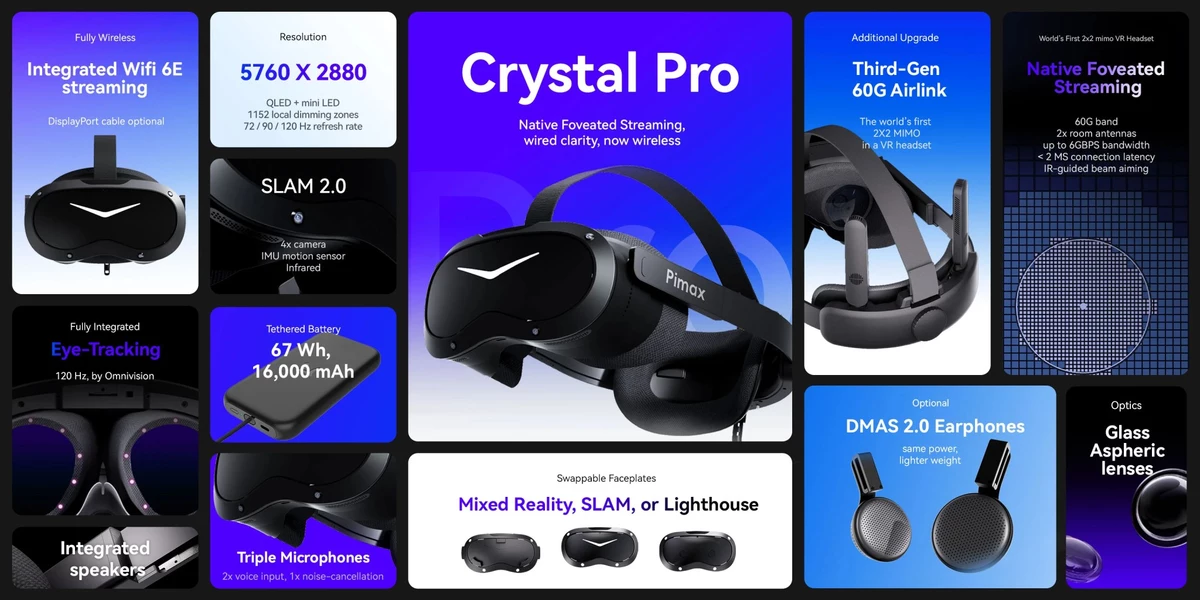
Pimax is trying to leapfrog the Steam Frame and Steam Machine. The company’s got a rep for optics among VR diehards, and it’s just announced the $1400 Crystal Pro. It’s a standalone headset with eye-tracking foveated streaming like the Steam Frame — now with uncompressed video over an optional (and pricy) 60GHz link.
That price and positioning put the Crystal Pro squarely in competition with Valve’s upcoming hardware. Where the Steam Frame leans on eye-tracking foveated streaming, Pimax pairs the same approach with uncompressed video delivered over its optional 60GHz link. The result, at least on paper, is a standalone headset that Pimax hopes will outpace both the Steam Frame and the Steam Machine.
The Crystal Pro's headline trick is eye-tracking foveated streaming, the same approach Valve is taking with the Steam Frame. Rather than rendering every pixel at full resolution, the headset tracks where you're looking and concentrates detail there, cutting the bandwidth and compute needed to stream PC VR content to a standalone device.
Where Pimax aims to leapfrog the competition is in how that stream arrives. The Crystal Pro supports uncompressed video over an optional 60GHz link, avoiding the compression artifacts that typically come with wireless PC VR. That link isn't cheap, though — Pimax is charging a pricy premium for the 60GHz add-on, so buyers will need to decide whether artifact-free wireless is worth the extra spend.
It's a notable escalation in the wireless VR arms race, and one that leans on Pimax's reputation for optics among VR diehards.
Pimax is not stopping at the headset itself. The Crystal Pro ships alongside a pair of gamepad wands that snap together, giving the controllers a dual-purpose design that can shift between separate hand tracking and a combined form. It is an unusual approach compared with the single-piece controllers most standalone headsets rely on, and it fits Pimax’s habit of pursuing hardware ideas its rivals leave on the drawing board.
Power comes from a tethered external battery rather than an internal cell. That means the headset stays lighter on your face, with the pack carried elsewhere and connected by a cable. The trade-off is obvious: you gain comfort and quick battery swaps, but you give up the untethered freedom that defines most standalone VR. For a headset pitched at enthusiasts, it is a deliberate compromise.
Together with the wands, the battery arrangement shows Pimax is willing to bend convention. Whether buyers accept the tether is another question, but the design choices are clearly aimed at the same crowd that already trusts the company’s optics.
Pimax isn’t stopping at headsets and controllers. The company is also launching a powerful mini-PC, and it looks like a taller Steam Machine clone. The compact desktop form factor echoes Valve’s living-room PC concept, but with a taller profile that sets it apart visually.
This move fits Pimax’s broader strategy of leapfrogging the Steam Frame and Steam Machine. Rather than competing on a single front, Pimax is building out an ecosystem: a standalone headset, snap-together gamepad wands, and now a small-form-factor computer to anchor the setup.
Details on specs and pricing for the mini-PC remain limited in the announcement, but its inclusion alongside the $1400 Crystal Pro signals that Pimax wants to own more of the VR and gaming hardware stack.










Comment