
Alerts
-
3 minutes, 21 seconds
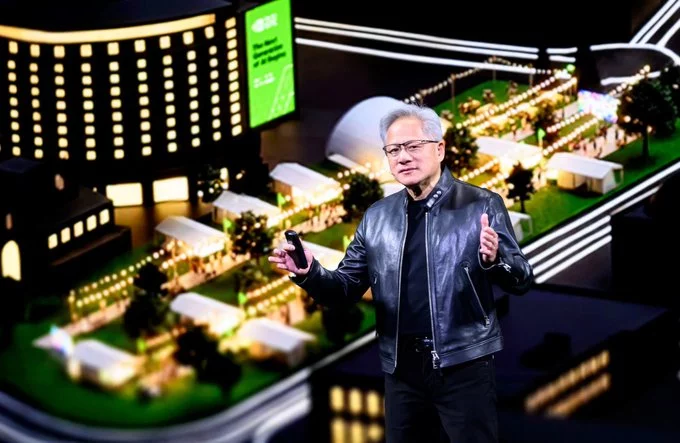
Nvidia has its finger in every pie, according to Jensen Huang. The chief executive's remark captures just how broadly the company's technology now spreads across the industry. From data centres training ever-larger AI models to the chips that power them, Nvidia sits at the centre of a vast and growing ecosystem.
That reach is not confined to a single market. The company's platforms touch cloud providers, enterprise customers, and researchers alike, each relying on its hardware and software to run demanding workloads. As Huang tells it, the breadth is deliberate: Nvidia aims to be present wherever accelerated computing is needed, rather than tethered to one narrow segment.
The comment also nods to the competitive landscape. Rivals and partners alike watch Nvidia's moves closely, because its position gives it unusual influence over pricing, supply, and the pace of innovation. For now, Huang's phrasing suggests he sees that sprawling footprint as a strength — one that keeps Nvidia embedded in nearly every corner of the AI boom.
Jensen Huang, Nvidia's chief executive, is not tempering expectations. Speaking about the company's outlook, he made clear that Nvidia sees another year of plenty in its future, suggesting demand for its chips and platforms shows no sign of fading.
The confidence reflects a business that has expanded well beyond its original roots in gaming graphics. Nvidia now supplies the hardware and software underpinning much of the artificial intelligence boom, and customers across cloud providers, enterprises, and governments continue to compete for capacity.
Huang's framing matters because it pushes back against the idea that the current surge is a short-lived spike. Instead, he positions the coming year as one of sustained opportunity rather than a peak followed by a decline.
For investors and partners alike, the message is straightforward: Nvidia expects to keep growing, and it intends to make the most of the demand in front of it. Whether that optimism holds will depend on execution — but Huang is betting on another strong year.
Analysts have raised a persistent worry about Nvidia's recent investments: that the company is funding its own customers, who then spend that money on Nvidia chips, flattering demand in a loop. Huang rejects the characterization outright.
He argues the investments are ordinary venture bets, not disguised orders. The companies Nvidia backs are building real products and need capital to scale, and Nvidia's stake is one of many sources of funding they draw on. If those businesses succeed, Nvidia benefits twice: as an investor and as a supplier. If they fail, the loss is bounded and small relative to Nvidia's balance sheet.
For Huang, the circularity critique also misunderstands the timeline. Investments and purchases are separate decisions made by separate teams, and no customer receives money on the condition that it comes back as chip revenue. He points to the breadth of Nvidia's customer base as further evidence that demand is not manufactured internally.
If Huang's account holds, Nvidia's position looks less like a single-product success story and more like an entrenched platform. He describes the company's technology as present across a wide range of industries, suggesting demand is not tied to one customer or one use case. That breadth matters because it cushions the company against a slowdown in any single market.
Huang also projects another year of plenty ahead, signalling that management sees no imminent cliff in demand. For investors, that forward-looking confidence is as important as any quarterly result.
His insistence that the company's deals are not circular addresses a persistent criticism: that Nvidia invests in customers who then buy its chips, inflating apparent demand. Huang rejects that characterisation. If he is right, the revenue reflects genuine end-market need rather than financial engineering.
Taken together, the claims point to a company that expects to keep growing, sells broadly, and says its books are clean.









Comment