Alerts

-
2 minutes, 24 seconds
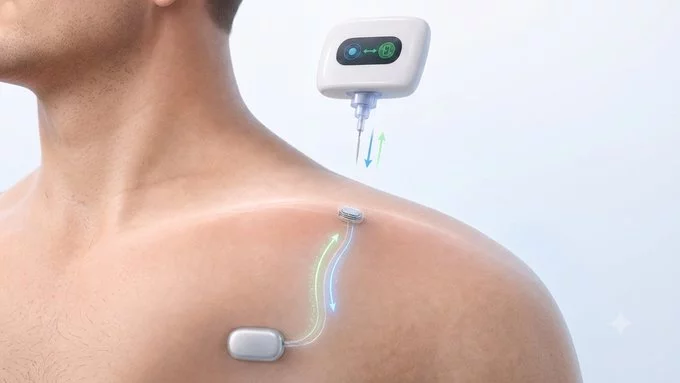
Imagine a USB plug for humans—a tiny power outlet hidden beneath your skin that can charge medical implants and transfer data at 16 Mbps. Scientists at the University of California, Irvine have created exactly that: the Implantable Bioelectronic Outlet (IBO). This breakthrough solves a major challenge in bioelectronics—how to power and communicate with devices like neural sensors and pacemakers without leaving a permanent opening that invites infection.
The IBO is a soft, spongy plastic port that sits just under the skin. When a doctor needs to charge a medical implant, retrieve data, or perform maintenance, they simply insert a fine needle through the skin into the outlet. The needle makes an electrical connection, delivering microwatts of power and transferring data at speeds up to 16 Mbps. Once the needle is removed, the skin heals, and the outlet stays sealed and hidden.
Current implantable devices have two main drawbacks: wireless charging coils are bulky and inefficient, and wired ports require a permanent opening in the skin, which can lead to infections. The IBO offers a middle ground—a hidden, accessible port that keeps the skin intact until needed. This is a game-changer for long-term implants like brain-computer interfaces, insulin pumps, and deep-brain stimulators.
Wireless charging for implants often requires large external coils or frequent recharging sessions. The IBO uses a thin needle to deliver power directly, which is more efficient and allows faster data transfer. Researchers say the outlet can be used repeatedly without damaging the skin or the implant.
The IBO is designed as a general access point for any bioelectronic device. It can work with:
While still in the research phase, the IBO could transform how doctors manage implanted devices. Instead of surgery to replace batteries, a simple needle insertion in a clinic could recharge and update the device. This reduces patient risk and recovery time. The next steps involve human trials and scaling the technology for commercial use.
UC Irvine's innovation brings us one step closer to a world where medical implants are as easy to maintain as your smartphone—without breaking the skin barrier. For now, this USB plug for humans remains a proof of concept, but its potential is enormous.









Comment