
Hyundai’s $7.6B EV Factory: Tariff-Proof Future & High-Tech Robots
-
3 minutes, 59 seconds
Hyundai’s $7.6B EV Factory: Tariff-Proof Future & High-Tech Robots
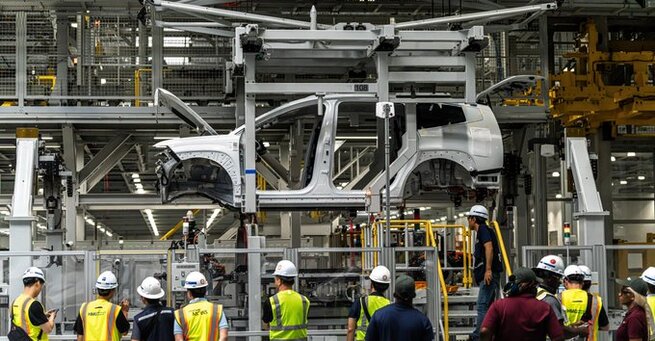
Looking for details on Hyundai’s new $7.6 billion EV factory in Georgia? You’re not alone. Many are asking how this massive facility impacts Hyundai’s position in the electric vehicle (EV) market, why it matters for U.S. manufacturing, and what it means for future EV buyers. Hyundai’s strategic $7.6 billion investment is a game-changer, creating a domestic stronghold for EV production amid rising global tariffs, political headwinds, and supply chain disruptions. Located in Georgia, this futuristic plant is already producing the flagship Hyundai Ioniq 9 SUV, marking a significant milestone in the company’s U.S. expansion strategy.
Hyundai’s EV Strategy Amid Tariffs and U.S. Policy Shifts
Hyundai’s Georgia EV plant—dubbed the Metaplant—is more than just a manufacturing hub; it’s a calculated response to growing protectionist trade policies and uncertainties around federal EV incentives. As tariffs on imported EVs threaten profits, Hyundai’s decision to build locally ensures tariff-free access to the lucrative U.S. market. By collaborating with battery giants LG Energy Solution and SK On, Hyundai is not only securing a stable battery supply but also reducing costs and boosting efficiency.
Automation, Robotics, and the Future of U.S. Manufacturing
Walking through the 7.5 million square foot Metaplant feels like stepping into a sci-fi future. Robotic arms work with surgical precision on Hyundai’s latest EVs, including the popular Ioniq 5 and Ioniq 9. This heavy automation not only increases productivity but also mitigates labor shortages—a challenge many automakers face as they scale EV production. The $4 billion battery plant within the complex underscores Hyundai’s commitment to domestic innovation and energy independence.
Domestic Battery Production: A Key to Lower Costs and Faster Delivery
Hyundai’s partnership with LG and SK On to build two massive battery plants ensures a steady supply of lithium-ion batteries, crucial for EV range and performance. This move shields Hyundai from volatile global supply chains and positions the brand as a reliable option for U.S. EV buyers.
Tariffs, Tax Credits, and the Future of EV Policy
With shifts in U.S. leadership and evolving trade policies, Hyundai’s local manufacturing capabilities provide a hedge against political risks. While federal EV tax credits and clean energy subsidies face an uncertain future, Hyundai’s proactive approach ensures it remains competitive even if incentives are scaled back or eliminated.
What This Means for EV Buyers and Hyundai’s U.S. Presence
For EV shoppers, this development means more reliable access to popular models like the Ioniq 5 and Ioniq 9, faster delivery times, and potentially lower prices. Hyundai’s U.S. expansion also promises more robust EV charging networks, enhanced after-sales service, and new job opportunities across the supply chain.



Contact Information





Suggested Writers
-

2.5K articles
-

1.3K articles
-

34 articles
-

28 articles



Comment