Humanoid Lightning Robot Breaks Half-Marathon Record
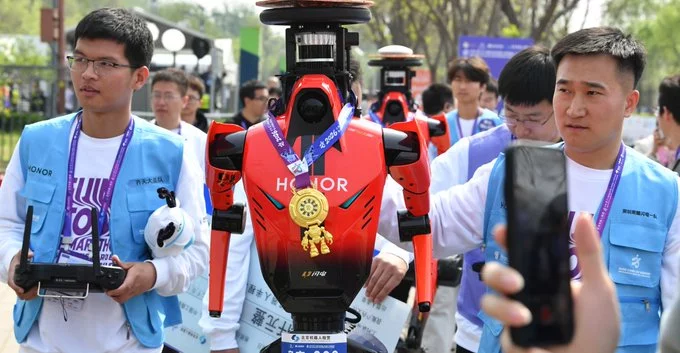
Humanoid “Lightning” robot has stunned the world by completing a half-marathon in under an hour, raising questions about the future of robotics and human competition. Four Lightning robots successfully finished the race, each demonstrating speed, endurance, and precision never seen before in humanoid machines. Curious readers are asking: how fast are these robots, and what does this mean for sports and technology? Early insights suggest this breakthrough could redefine both robotics engineering and athletic benchmarks.
Lightning Robot Half-Marathon Performance Shocks Experts
Lightning robots didn’t just participate—they dominated. Completing a half-marathon distance of 21 kilometers in under 60 minutes places them ahead of many elite human runners. Engineers designed these humanoid machines with advanced motion algorithms, enabling smooth strides and energy efficiency across long distances. Observers noted that the robots maintained consistent pacing without fatigue, a clear advantage over human athletes.
What surprised experts most was the coordination among the four robots. Each unit adapted in real-time to track conditions, terrain variations, and minor obstacles. This level of autonomy highlights how far artificial intelligence and robotics have progressed in recent years. The performance is already being described as a landmark moment in robotics history.
How the Lightning Robot Achieved Record Speed
Behind Lightning’s success lies a combination of cutting-edge hardware and intelligent software. Engineers equipped the robots with lightweight materials, high-efficiency actuators, and precision sensors that mimic human biomechanics. This allows for optimal stride length, balance, and speed control. Unlike earlier humanoid robots, Lightning can dynamically adjust its gait based on real-time data.
Equally important is the AI system powering these robots. Advanced predictive modeling helps Lightning anticipate changes in terrain and maintain stability. Machine learning algorithms continuously refine movement efficiency, reducing energy loss during long runs. This fusion of hardware and AI has created a robot capable of sustained high-speed performance over extended distances.
What This Means for the Future of Robotics and Sports
The Lightning robot’s half-marathon achievement signals a major shift in how robots interact with human environments. While robots have long excelled in controlled settings, this event demonstrates their ability to perform in dynamic, real-world scenarios. Such advancements could have implications beyond sports, including logistics, disaster response, and healthcare support.
For athletics, the development raises complex questions. Should robots compete alongside humans, or remain in separate categories? While the idea of robotic competitors may seem futuristic, events like this suggest it could become a reality sooner than expected. At the same time, these innovations could inspire new forms of competition that blend human and machine capabilities.
Lightning Robot Innovation Sparks Global Debate
Public reaction to the Lightning robot’s achievement has been mixed. Some celebrate the technological milestone, viewing it as proof of human ingenuity and progress. Others express concern about the implications for human athletes and the potential erosion of traditional sports values. The debate reflects broader discussions about artificial intelligence and automation in society.
Experts emphasize that robotics advancements are tools rather than replacements. The goal is not to overshadow human achievement, but to push the boundaries of what technology can accomplish. As innovation continues, maintaining a balance between progress and ethical considerations will be essential.
A Defining Moment for Humanoid Robotics
Lightning’s record-breaking half-marathon performance marks a turning point in the evolution of humanoid robots. What once seemed like science fiction is now a tangible reality, showcasing the incredible pace of technological development. The ability of robots to match—and even surpass—human endurance in certain scenarios highlights both opportunities and challenges ahead.
As researchers continue to refine these systems, the focus will likely shift toward collaboration rather than competition. Lightning has proven that robots can achieve extraordinary feats, but the bigger story lies in how this technology will be integrated into everyday life. One thing is certain: the future of robotics just accelerated dramatically.














Comment