
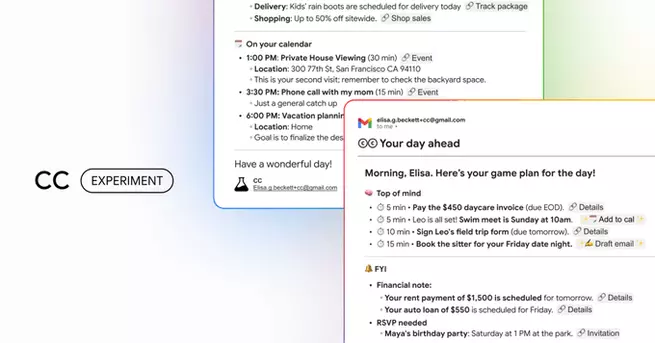
Google CC AI assistant is Google’s latest attempt to redefine how mornings begin, replacing endless scrolling with a single, personalized briefing. If you’re wondering what Google CC is, how it works, and whether it reads your emails and calendar, the short answer is yes—by design. The experimental AI agent pulls from your Gmail, Google Calendar, and Drive to summarize your day before it starts. Google says the goal is simple: give users one clear snapshot of what matters most, right when they wake up.
Each morning, Google CC AI assistant sends a concise “Your Day Ahead” email straight to your inbox. The briefing highlights upcoming meetings, deadlines, bills, and reminders, aiming to replace multiple app check-ins with one summary. Instead of bouncing between email threads and calendar alerts, users see everything in a single narrative. Google positions this as a productivity boost, especially for people juggling busy schedules. The briefing is designed to be skimmable on mobile, aligning with how most users start their day. Over time, CC adapts its summaries based on what you engage with. The idea is less noise, more signal.
Google CC AI assistant connects directly to core Google services to understand your routines and priorities. Gmail helps it surface important emails, while Calendar provides context about meetings and events. Google Drive adds documents and files that may be relevant to your day. According to Google, CC doesn’t just scan data—it learns patterns, such as which meetings matter most to you. Users can also teach CC explicitly by replying to its briefings or emailing it instructions. This feedback loop is central to how CC improves over time. Google frames this as personalization with user control, though privacy questions remain.
Beyond summaries, Google CC AI assistant can help users act faster. The agent can suggest email drafts, generate calendar links, or flag tasks that need immediate attention. This turns CC from a passive briefing tool into an active assistant. For example, if a meeting requires preparation, CC may highlight relevant documents or suggest a follow-up email. Google says these features are meant to reduce friction in the early hours of the day. Instead of reacting to notifications, users can start proactively. It’s a subtle shift, but one that could reshape daily workflows.
Google CC AI assistant is launching in early access for paid subscribers aged 18 and over in the US and Canada. Interested users can join a waitlist, though Google hasn’t shared how long it will remain open. There’s also no confirmed timeline for a wider global rollout. This limited release suggests Google is testing real-world usage before scaling. Feedback from early users will likely shape how CC evolves. As with many Google experiments, broader availability will depend on adoption and trust. For now, CC remains a controlled preview.
Under the hood, Google CC AI assistant runs on Google’s Gemini AI model. Gemini enables CC to combine personal data with information from the wider web, creating more contextual summaries. Google says this allows CC to understand not just what’s scheduled, but why it matters. Personalization increases as Gemini learns preferences over time. Users can also store specific memories, helping CC tailor future briefings. This reflects Google’s broader push to embed Gemini across its products. CC is another step toward AI becoming the default interface.
Google CC AI assistant enters a growing field of personalized AI briefings. Its closest comparison is OpenAI’s ChatGPT Pulse, which also delivers daily summaries. However, CC’s deep integration with Gmail, Calendar, and Drive gives Google a unique advantage. Instead of relying on prompts, CC operates continuously in the background. That tight ecosystem integration could make CC feel more seamless for existing Google users. At the same time, it raises questions about dependence on a single platform. The competition signals a broader shift toward AI-curated daily experiences.
Google CC AI assistant reflects a larger strategy to change how people consume information. Rather than opening multiple apps, Google wants users to trust one AI-generated overview. This could reduce screen fatigue while increasing reliance on Google’s ecosystem. For Google, CC also reinforces its role as a daily habit, not just a search engine. If successful, CC may redefine productivity mornings for millions of users. Whether people embrace an AI-curated start to the day remains to be seen. What’s clear is that Google wants to be the first voice you hear every morning.

𝗦𝗲𝗺𝗮𝘀𝗼𝗰𝗶𝗮𝗹 𝗶𝘀 𝘄𝗵𝗲𝗿𝗲 𝗽𝗲𝗼𝗽𝗹𝗲 𝗰𝗼𝗻𝗻𝗲𝗰𝘁, 𝗴𝗿𝗼𝘄, 𝗮𝗻𝗱 𝗳𝗶𝗻𝗱 𝗼𝗽𝗽𝗼𝗿𝘁𝘂𝗻𝗶𝘁𝗶𝗲𝘀.
From jobs and gigs to communities, events, and real conversations — we bring people and ideas together in one simple, meaningful space.



Comments