
Alerts
-
4 minutes, 26 seconds
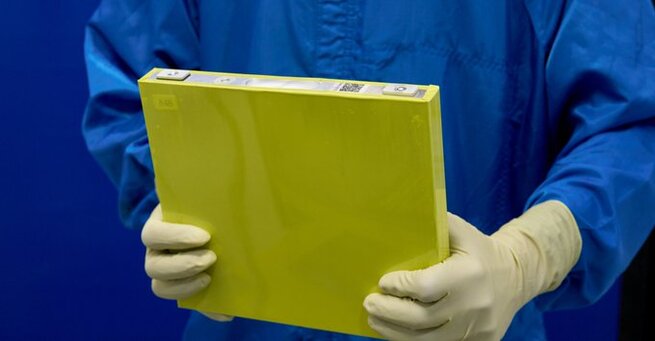
As global EV momentum slows, General Motors is betting big on breakthrough battery chemistry. Inside the lab where GM is cooking up new EV batteries to beat China, scientists are racing to reinvent energy storage — and reclaim America’s lead in electric innovation.
Deep in GM’s growing battery labs outside Detroit, engineers are stress-testing lithium-ion cells against every imaginable condition — desert heat, arctic cold, and tropical humidity. Each test mimics the real-world extremes that EVs endure over a decade on the road.
During an exclusive tour of these secretive labs, researchers can be seen examining cell chemistries at the atomic level using advanced electron microscopes. Others take on large-scale experiments, culminating with the “Megashaker” — a massive hydraulic test chamber designed to replicate the rigors of 10 years and 250,000 miles of driving in just six months.
Suspended midair by a crane, GM’s enormous 2,900-pound battery packs — like those powering the Cadillac Escalade IQ — are shaken violently to test structural durability and safety. Each simulation is a controlled storm of vibration, heat, and pressure meant to reveal weaknesses before they ever reach the road.
GM’s ability to compress a decade of wear into months gives it a major edge. The company aims to perfect new materials faster than competitors and cut the time to market for next-generation electric vehicles.
The push inside the lab where GM is cooking up new EV batteries to beat China isn’t just about performance — it’s about global dominance. China currently leads in battery production and raw material processing. GM’s mission is to develop domestic alternatives that reduce dependence on Chinese supply chains and slash costs for American consumers.
With China’s CATL and BYD setting the pace in affordable lithium-iron-phosphate (LFP) batteries, GM’s researchers are experimenting with new chemistries — potentially high-energy manganese or solid-state cells — that promise longer range, faster charging, and greater safety.
The EV industry’s recent slowdown has hit U.S. automakers hard. Consumers remain cautious due to high prices, limited infrastructure, and policy uncertainty. GM, once seen as a leader with its Ultium battery platform, now faces pressure to deliver a breakthrough that reignites enthusiasm and boosts sales.
In response, GM is betting that innovation — not imitation — will win the race. Its lab’s work could enable more affordable EVs, from compact Chevrolets to electric trucks, while ensuring that the supply chain remains closer to home.
If GM succeeds, the impact will ripple far beyond Detroit. New chemistries could drive down costs, extend range, and make EVs truly mainstream. It’s a high-tech arms race where energy density, durability, and scalability decide who leads the next era of mobility.
In the end, the lab where GM is cooking up new EV batteries to beat China represents more than research — it’s America’s bid to reclaim its electric future.










Comment