
Alerts
-
5 minutes, 49 seconds
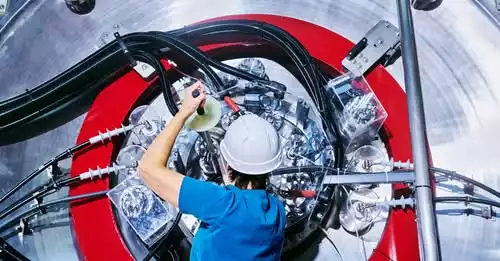
Don’t expect electricity from Trump Media’s newly announced nuclear fusion power plant anytime soon—certainly not before 2031, and possibly never. The parent company of Truth Social just revealed a merger with TAE Technologies, aiming to break ground on a utility-scale fusion reactor as early as 2026. But even optimistic insiders admit this timeline is wildly ambitious. With AI data centers guzzling unprecedented power, companies are desperate for clean, limitless energy. Fusion fits the dream—but reality lags far behind the hype.
Nuclear fusion mimics the sun’s core, fusing light atoms like hydrogen to release massive energy without long-lived radioactive waste or carbon emissions. Unlike today’s fission reactors, fusion promises near-limitless, safe, clean power. Yet after nearly a century of research, no experiment has produced net energy gain at a commercial scale. TAE’s prototype, “Norm,” is advanced—but it’s still a research device, not a power plant. Engineering hurdles like plasma containment, material durability, and heat conversion remain enormous. Even with billions in private funding, physics doesn’t bend to press releases.
The explosion of AI has created an electricity emergency. A single large data center can now use as much power as a small city, and tech giants are scrambling for sustainable sources. Microsoft, Google, and Amazon have all inked deals with fusion startups, hoping these futuristic reactors will one day power their AI ambitions. Trump Media’s sudden pivot into fusion may seem odd—but in 2025, aligning with cutting-edge energy tech boosts investor appeal, regardless of political branding. The real question isn’t why they’re jumping in, but whether they’ll survive the decades-long wait for payoff.
It’s ironic: a company tied to a former president who dismissed climate change as a “con job” is now betting on one of clean energy’s most promising technologies. But business often trumps ideology. By merging with TAE, Trump Media gains access to a $12B+ private fusion market and a narrative of innovation. Still, skepticism is warranted. TAE has raised over $1.2 billion since its founding in 1998 yet has no grid-connected reactor. Regulatory approvals, supply chain bottlenecks, and unproven engineering could easily delay the 2031 target—or derail it entirely.
TAE claims its first commercial plant could generate electricity by 2031—a timeline that makes many fusion scientists raise an eyebrow. For context, ITER, the world’s largest international fusion project, won’t begin full-power experiments until the late 2030s. Private firms like Commonwealth Fusion Systems and Helion target the 2028–2030 window, but none have demonstrated net energy production yet. TAE’s approach, which uses particle accelerators and hydrogen-boron fuel, is elegant but untested at scale. Betting on 2031 is less a prediction and more a fundraising tactic.
Even if fusion succeeds in the 2030s, it won’t solve today’s AI energy crunch. Data centers are being built now, running on natural gas and renewables. Communities from Virginia to Ireland are pushing back against new facilities due to water and power strain. Fusion might eventually ease long-term demand, but it’s no near-term fix. Relying on it as a “future savior” could distract from deploying proven clean energy—like wind, solar, and grid-scale batteries—right now.
Trump Media’s fusion play is a headline-grabbing move in a high-stakes energy race. But headlines don’t power servers. While the merger signals growing confidence in fusion’s potential, the science, engineering, and regulation required mean commercial power is still years—if not decades—away. For AI companies racing to scale, fusion remains a hopeful footnote, not a solution. Until then, the world will keep burning fossil fuels, not stardust.










Comment