Alerts

-
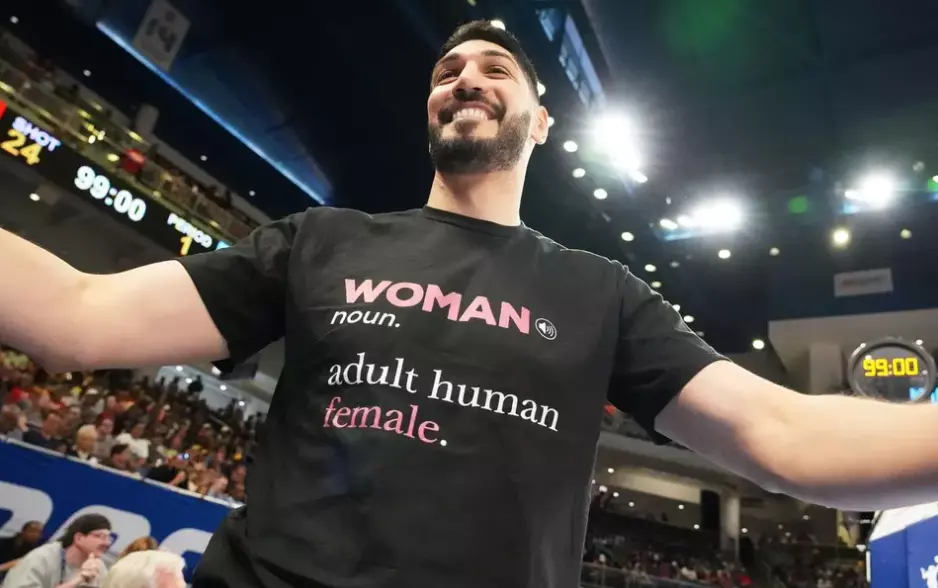
Two former NBA players have publicly stated their intention to declare for the 2027 WNBA draft, a move that could force the league to clarify its eligibility rules. Enes Kanter Freedom and Royce White both made separate announcements, citing their gender identity as the basis for their eligibility.
Kanter Freedom, who previously played for the Portland Trail Blazers and the Boston Celtics, made his announcement on social media. He argued that if self-identification is the sole criterion for eligibility, he meets every requirement necessary to compete in the WNBA.
White, a former NBA first-round draft pick, stated his case in an interview with Fox News. He said, “I'm transgender. I'm a woman. I identify as sometimes identifying as a woman for purpose of basketball, professional basketball, so I'll be declaring for the WNBA Draft in 2027 as well.”
In a subsequent social media post, Kanter Freedom claimed he had spoken with eight male players from the NBA, the G League, and European leagues who expressed interest in entering the WNBA draft. He highlighted a significant salary disparity between the leagues to explain the potential motivation.
“The NBA G-League pays players $45,000 a year, while the WNBA top players earn $1.4 Million. Those ‘men’ could earn an extra $1,355,000 a year by just identifying as women,” he wrote. The discussion escalated at a WNBA game last Sunday when Kanter Freedom was ejected following a confrontation with a player over the issue.
The WNBA’s current collective bargaining agreement states that only women are eligible to play in the league. However, the agreement does not provide a specific definition for the term “women.” This lack of clarity is central to the debate, as the league has not yet publicly responded to the players’ announcements with a formal interpretation of its rules.
To date, no openly transgender woman has ever participated in a WNBA game. The announcements by Freedom and White may compel the league to formally define its eligibility criteria for the first time.
The WNBA is not the first organization to confront this issue. Other women’s professional sports leagues have already grappled with the question of who is eligible to compete. Importantly, these leagues have not converged on a single, uniform policy.
Instead, different sports have adopted significantly different definitions of eligibility. This patchwork of approaches illustrates that there is currently no general consensus across women’s sports regarding the standards for participation, leaving the WNBA to determine its own path forward without a unified industry precedent.
The Women’s Tennis Association (WTA) has a history of adjusting its eligibility criteria for transgender women, moving from hormone-level requirements to a genetic test. The organization’s initial approach, implemented in 2018, allowed transgender women to compete provided their testosterone levels remained below 10 nmol/L for a period of twelve months. This threshold was significantly tightened in 2024, when the WTA mandated that transgender women maintain testosterone levels under 2.5 nmol/L for the preceding 24 months.
The policy took a decisive turn in July 2026, when the WTA revised its rules to require all female competitors to undergo an SRY gene test. The SRY gene is typically located on the Y chromosome, which is present in most individuals assigned male at birth. Consequently, transgender women, who generally possess this gene, would be deemed ineligible to participate under the new regulations. The WTA did, however, carve out exceptions for women with Complete Androgen Insensitivity Syndrome (CAIS) and certain other conditions. These individuals may carry the SRY gene but did not experience male puberty, making them eligible to compete.
It is important to note that women’s professional tennis has not always excluded transgender athletes. In the 1970s, Renée Richards, a transgender woman, was initially barred from the 1976 U.S. Open. Following a landmark court challenge, the WTA was compelled to reverse its policy. Richards subsequently competed in several U.S. Open women’s tournaments between 1977 and 1981. Now 92 years old, Richards remains a vocal supporter of trans rights. However, she described her own lawsuit as “selfish” in an interview with CNN. Today, she expresses opposition to allowing trans women and girls to participate in women’s sports, a stance that contrasts with her historic legal victory.
The Ladies Professional Golf Association (LPGA) takes a different approach in its competition policy, which centers on sex assigned at birth and the experience of male puberty. Under these guidelines, all players assigned female at birth are eligible to compete. For transgender women assigned male at birth, eligibility hinges on two key factors: they must have transitioned before the onset of puberty and must have maintained low testosterone levels since that time.
To date, no openly transgender women have competed on the LPGA Tour. Bobbi Lancaster made an attempt to qualify in 2014 but did not earn a tour card.
In contrast to the WTA and LPGA, the National Women’s Soccer League (NWSL) currently operates without a formal policy regarding transgender eligibility. The league had previously introduced a rule in 2021 that permitted trans women athletes to compete if their testosterone levels were below 10 nmol/L. However, this policy was abandoned just one year later, in 2022.
At present, there are no players who identify as transgender women in the NWSL. Despite the absence of a policy and current players, the league is closely monitoring the evolving landscape. NWSL Commissioner Jessica Berman told reporters that she is observing how other organizations handle the issue, explaining, “we’re continuing to monitor all of the real-time developments across adjacent or directly relevant institutions that are either making statements or making policy changes in that regard.”
The International Olympic Committee’s (IOC) definition of female eligibility has shifted considerably over the years, reflecting broader societal and scientific debates. A pivotal moment came in 2021 when Laurel Hubbard, a transgender weightlifter from New Zealand, was permitted to compete in the women’s category. Her participation was allowed under the IOC guidelines in effect at the time, which stipulated that transgender athletes could compete as women provided their testosterone levels remained below a specified threshold for a minimum of twelve months.
Meanwhile, World Athletics, the governing body for track and field, enforced a different and notably more complex set of regulations that same year. These rules were not uniform across all disciplines; they varied depending on the specific event. In a striking example of this complexity, two runners who met the eligibility criteria for shorter sprint distances were simultaneously barred from competing as women in longer-distance races, despite being the same athletes.
By 2024, the IOC adopted a more decentralized approach, deciding that each individual sport’s governing body should be responsible for crafting its own eligibility rules for women’s competitions. This move granted federations greater autonomy but also led to a fragmented landscape of regulations. Looking ahead, the most recent IOC rules, set to take effect in 2026, will mandate an SRY gene test for all female competitors. Under these forthcoming regulations, transgender women will be ineligible to participate in the 2028 Olympic Games.
The contrasting approaches taken by different sports bodies highlight a fundamental reality: there is no universally accepted answer to the question of who qualifies to compete in women’s sports. This leaves the WNBA at a critical crossroads. The league must determine whether to establish more explicit eligibility guidelines, and if it chooses to do so, it must decide which specific framework to adopt from the many available options.
This decision is particularly fraught for the WNBA, given its long-standing identity. For decades, the league has cultivated a reputation as a progressive and LGBTQ-friendly organization, championing values of inclusion and acceptance. Implementing rules that would exclude certain athletes carries the risk of alienating a significant portion of its fan base and potentially conflicting with the core principles espoused by the league and its players. The emotional weight of this issue was on display recently when Chicago Sky player Natasha Cloud addressed her followers on social media following an altercation with Kanter Freedom. In her post, she stated, “To every trans kid/person, You are apart of MY community & tribe. You belong. You’re loved. You’re seen. You’re perfect as you are. & you will always be protected by me.”
However, a contrasting viewpoint exists within the league’s own ranks. Indiana Fever guard Sophie Cunningham has been outspoken in her opposition to transgender women participating in women’s sports. In comments shared with ESPN, Cunningham expressed a desire to “protect young girls who shouldn’t have to go against biological men.” It was Cunningham’s public remarks that served as a catalyst, igniting the current widespread debate regarding transgender participation in the WNBA.
Since its founding in 1997, the WNBA has operated successfully without a comprehensive, detailed eligibility policy. For the time being, the league has indicated that there are “no immediate eligibility matters affecting the league.” Nevertheless, Commissioner Cathy Engelbert has confirmed that the matter is under active review, and she has stated that ongoing discussions with team representatives and the players’ union will continue to shape the league’s future approach.










Comment