Fitbit AI Health Coach Is Now Available on iPhone
Fitbit AI health coach is finally available on iPhone, expanding beyond Android months after its initial debut. iOS users in the U.S. can now access the Gemini-powered AI inside the Fitbit app, while users in the UK, Canada, Australia, New Zealand, and Singapore can use it on both iOS and Android. The feature remains in public preview and still requires a Fitbit Premium subscription. For many Apple users who rely on Fitbit wearables, this rollout answers one big question: yes, the AI coach now works on iPhone — but not for everyone just yet.
This marks a major milestone in Fitbit’s AI strategy and signals a deeper push into personalized, conversational health technology.
Where the Fitbit AI Health Coach Is Available
The Fitbit AI health coach public preview is currently rolling out in phases. In the United States, iPhone users can now join Android users in testing the feature. Meanwhile, users in select countries — including the UK, Canada, Australia, New Zealand, and Singapore — can access it on both platforms.
Availability may not be instant for all eligible users. Fitbit says the rollout will happen gradually over several days. That means even if you meet the requirements, you might need to wait a short time before the AI coach appears in your app.
This staggered launch approach is common for AI features, especially those powered by advanced large language models that require real-time processing and optimization.
How the Gemini-Powered AI Health Coach Works
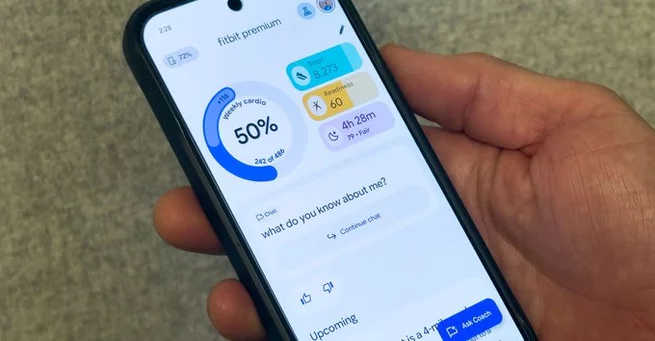
At the center of this update is a conversational interface powered by Gemini AI. Instead of static charts and pre-set recommendations, users can now interact with the app in a more natural way. You can ask about your sleep patterns, recent workouts, heart rate trends, or recovery metrics — and get responses that interpret your personal data.
The AI analyzes your latest results and can suggest tailored workout routines based on your goals, available equipment, and training preferences. For example, if you tell it you want to build strength at home with limited gear, it can create a customized plan that fits your setup.
This shift transforms the Fitbit app from a passive tracker into an interactive coach — one that adapts based on your real-time data and evolving fitness goals.
Fitbit Premium Subscription Still Required
Access to the Fitbit AI health coach is not free. An active Fitbit Premium subscription is mandatory to unlock the feature. Users must also sign into the Fitbit app using a Google account.
This requirement positions the AI coach as a value-added service rather than a standard feature. Fitbit Premium already includes advanced insights, readiness scores, guided workouts, and detailed health reports. The AI coach builds on those capabilities by making them easier to understand and more actionable.
For users considering the subscription, the key question becomes whether AI-driven personalization justifies the added cost.
Supported Devices for Fitbit AI Health Coach
Not every Fitbit device is eligible for the AI health coach. The feature currently supports 14 devices, including several Fitbit wearables and the Pixel Watch.
Users must own one of these supported devices for the AI coach to function properly. Since the system relies heavily on collected health data — such as heart rate, activity levels, and sleep metrics — compatible hardware is essential.
If your device isn’t supported, the AI feature won’t activate, even with a Premium subscription.
Why This iPhone Rollout Matters
When Fitbit first introduced the AI health coach in October, it was limited to Android users in the United States. That decision raised eyebrows, especially since a large portion of Fitbit users rely on iPhones.
By expanding to iOS, Fitbit significantly broadens its reach. It also reduces friction for users who previously felt excluded from early AI features. For many iPhone owners, this update represents long-awaited feature parity.
More importantly, it signals that AI-driven personalization is becoming central to wearable health ecosystems, not just a side experiment.
What This Means for the Future of AI in Fitness
The launch of the Fitbit AI health coach on iPhone reflects a broader trend in consumer tech: the move toward intelligent, data-driven coaching. Rather than simply tracking steps or calories, modern health platforms aim to interpret data and guide decisions.
Conversational AI interfaces may soon become the norm in fitness apps. Instead of scrolling through dashboards, users can ask questions like, “Why was my sleep score lower this week?” or “How can I improve my recovery?” and receive context-aware answers.
As AI models become more advanced, we can expect deeper integrations — potentially including predictive health insights, adaptive training plans, and real-time habit coaching.
Should iPhone Users Try the Fitbit AI Health Coach?
If you already subscribe to Fitbit Premium and own a supported device, trying the AI health coach is an easy decision. The feature is included in your plan and could offer more intuitive insights into your health data.
If you’re not subscribed, the decision depends on how much value you place on personalized coaching. Users who want guided structure and tailored feedback may find it worthwhile. Casual users who primarily track steps and basic metrics may not feel the same urgency.
Either way, the expansion to iPhone removes one major barrier. Fitbit’s AI health coach is no longer limited to Android — and that alone changes the competitive landscape.
As AI continues reshaping wearable technology, this rollout feels less like a minor update and more like the beginning of a smarter, more conversational fitness era.





Array