
-
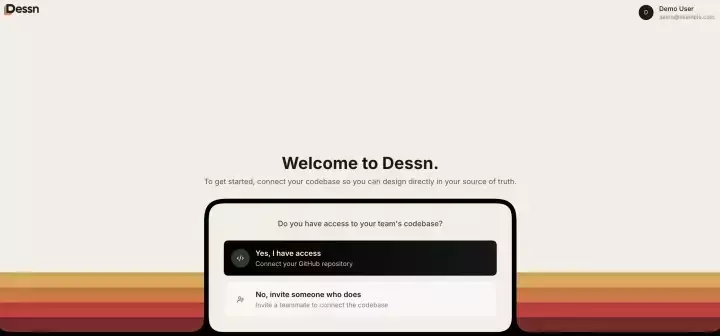
In a major development for the evolving world of AI-powered product design, Dessn has raised $6 million to expand its production-focused design platform. The funding signals growing investor confidence in tools that go beyond traditional design software and directly connect to real working codebases. For teams asking what Dessn is, how it works, and why it matters, the answer is simple: it is a design tool built for real production environments, not just mockups.
Unlike conventional design tools that separate designers from live systems, Dessn is designed to operate directly on a company's existing codebase in the cloud. This approach allows teams to iterate faster, reduce friction between design and engineering, and explore product changes in real time. In an era where AI is accelerating software creation, Dessn positions itself as a bridge between design creativity and production reality.
Dessn is an AI-powered design platform built to help teams work directly with production code rather than isolated design files. The startup focuses on enabling designers and product teams to make changes that immediately reflect in real systems. This eliminates much of the traditional handoff between design and development.
The company behind the platform has built its technology around a simple but ambitious idea: modern software development is becoming increasingly automated, so design must evolve into a more direct part of production. With $6 million in new funding, the company is aiming to scale this vision further and improve how teams collaborate across design and engineering workflows.
The $6 million funding round reflects growing momentum in AI-driven product development tools. The investment was led by Connect Ventures, with participation from Betaworks and N49P, all of which have a history of backing early-stage software infrastructure and design innovation.
Over the last few years, AI design tools have shifted from simple prototyping assistants to full-scale product development environments. Teams no longer just want to visualize ideas; they want to build working versions instantly. Dessn is part of this wave of transformation. Instead of focusing only on design mockups, it integrates with live systems so teams can experiment directly in production-like environments.
One of the most notable aspects of Dessn is its ability to run entire codebases in the cloud without complex local setup. This removes one of the biggest barriers between design and engineering collaboration: environment configuration.
This production-first philosophy is one of the key differentiators that sets Dessn apart from more traditional design tools.
Early adoption of Dessn includes teams across multiple industries. Companies in healthcare, fintech, and AI voice technology are already using the platform to speed up internal product development. Some of the early users include organizations such as Color, Wispr, and Mercury.
At the core of Dessn's strategy is a belief that software development is entering a new era where code becomes increasingly commoditized. As AI tools make it easier to generate functional applications, differentiation will come from design quality and user experience rather than raw coding ability.
Most traditional design tools are built around static workflows. Designers create screens, pass them to developers, and wait for implementation. Even newer AI tools often focus on generating prototypes rather than interacting with live systems.
While Dessn currently operates without external integrations, the roadmap includes expanding connectivity with communication and productivity tools. Planned integrations include team messaging platforms and meeting transcription tools that can feed design ideas directly into the system.
The goal is to allow real-time collaboration between discussions, meetings, and product design changes. However, the company has also made it clear that it will not integrate with certain competing design ecosystems, as it wants to maintain its focus on production-first workflows.

2.6K articles

1.4K articles

34 articles

28 articles













Comment