Alerts

-
6 minutes, 58 seconds
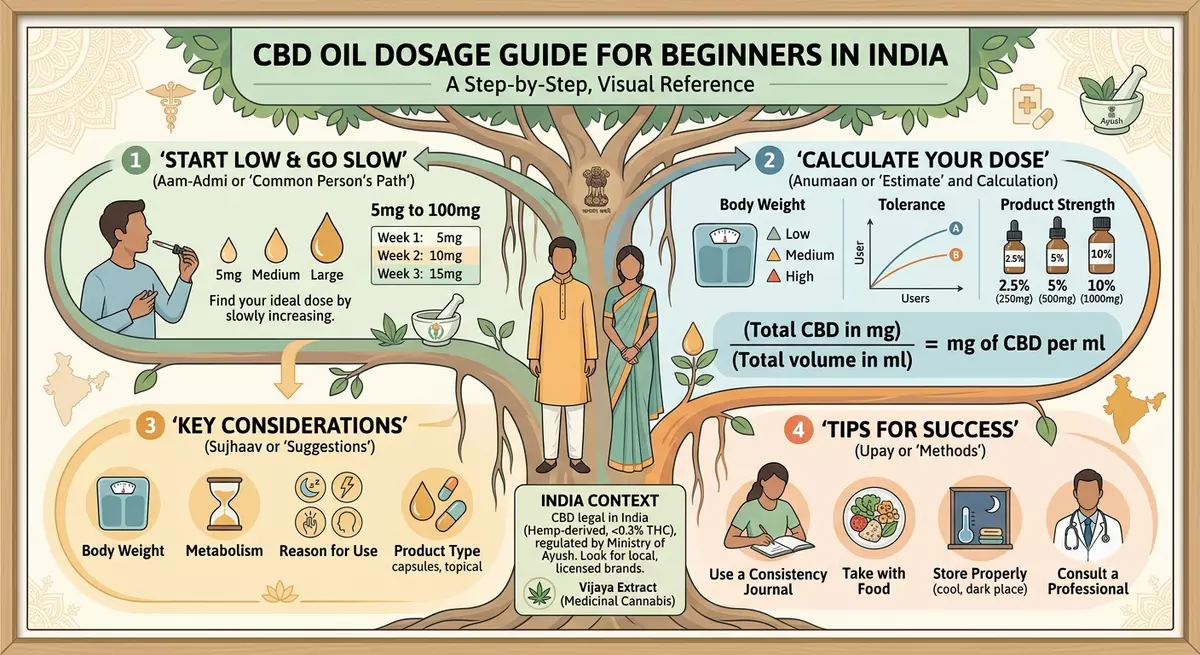
CBD oil can seem simple at first, just place a few drops under the tongue, but the right starting amount depends on the product’s strength, your health, other medicines you take, and how your body responds. For beginners, the safest principle is not “take more for faster results.” Start low, change slowly, and track your response.
This guide is general education, not a personal prescription. CBD can affect the liver and interact with medicines, especially sedatives and drugs processed by the liver, so speak with a qualified clinician before using it if you take regular medication, are pregnant or breastfeeding, have liver disease, or are considering CBD for a diagnosed condition.
Before working out a dose, confirm what the bottle actually contains. CBD products can differ substantially in their CBD concentration, ingredient quality, and THC content.
Look for:
Do not assume that “hemp oil” means high-CBD oil. Hemp seed oil is a food oil and is not automatically equivalent to a CBD extract. FSSAI’s hemp-seed rules also limit CBD in foods made from hemp seed products and prohibit CBD health claims on such food labels.
The number on the front of the bottle usually refers to the total CBD in the entire bottle, not the dose in one drop.
Beginner tip: A lower-strength bottle can make it easier to make small changes without accidentally taking a large amount.
There is no universally proven over-the-counter CBD dose for stress, sleep, pain, or general wellness. Research has used widely different doses for different medical contexts, and a product bought for wellness should not be treated like an approved medicine.
A practical, cautious approach is:
The aim is to find your minimum effective dose, not the highest amount you can tolerate.
Most CBD oils are taken sublingually: place the measured oil under the tongue, hold it briefly, then swallow. This may give a more predictable onset than immediately swallowing it, though absorption can still vary by person and by product.
A simple routine for beginners:
These are starting frameworks, not medical dosing instructions.
| Goal | Conservative starting point | What to observe |
| General wellness | 5 mg once daily | Alertness, digestion, sleep changes |
| Occasional stress | 5 mg once daily | Calmness versus unwanted tiredness |
| Sleep support | 5 mg in the evening | Time to fall asleep, next-day grogginess |
| Discomfort after activity | 5 mg once daily | Symptom pattern and ability to function |
Avoid beginning with high doses simply because another person reports taking more. CBD response varies due to body size, metabolism, diet, other medicines, the formulation, and the reason for use.
If symptoms are persistent, severe, or worsening, such as chronic pain, panic symptoms, insomnia, seizures, or inflammatory disease, self-experimentation should not replace medical assessment.
A short record makes CBD use safer and more useful. Otherwise, it is easy to increase the dose without knowing whether it actually helped.
Track:
After one week, review the pattern. If there is no benefit at a cautious dose, do not keep escalating indefinitely. Discuss the product and your goal with a clinician instead.
CBD is not risk-free because it can change how some medicines are metabolized. The U.S. FDA notes potential liver injury and drug interactions, including interactions that may increase side effects or reduce the effectiveness of other medicines.
Get medical advice before using CBD if you take:
Stop using CBD and seek medical advice promptly if you develop severe fatigue, persistent nausea or vomiting, dark urine, yellowing of the eyes or skin, unusual bruising, rash, or a significant change in mood or behaviour.
India’s legal framework is not accurately summarized by blanket statements such as “all CBD is legal” or “all hemp products are illegal.” Under the NDPS Act, the statutory definition of ganja includes the flowering or fruiting tops of the cannabis plant, while seeds and leaves are excluded when not accompanied by those tops.
That distinction does not automatically make every product marketed as CBD oil lawful, medically appropriate, or suitable for interstate transport. Product source, formulation, THC content, manufacturing route, local enforcement, and how it is sold all matter. Avoid relying solely on social-media marketing or a vague “legal in India” claim.
Choose products with:
For a beginner in India, the most responsible CBD strategy is simple: verify the product, calculate the actual CBD amount in milligrams, begin with a low measured dose such as 5 mg, keep a symptom journal, and increase only gradually if appropriate. Treat CBD as an optional wellness product, not a shortcut or cure, and involve a healthcare professional whenever medicines, liver concerns, pregnancy, or a serious medical condition are part of the picture.


8.3K articles

2.7K articles

1.6K articles

34 articles








Comment