
-
5 minutes, 14 seconds
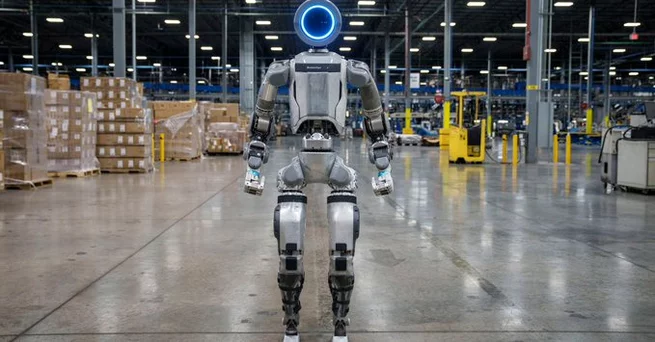
Boston Dynamics Atlas is officially moving from tech demos to real factory floors, answering one of the most searched questions from CES 2026: when will humanoid robots actually do industrial work? The company and parent firm Hyundai say Atlas robots will begin building cars at Hyundai plants in 2028. Production is expected to reach 30,000 humanoid robots per year, starting with Hyundai’s massive Metaplant in Savannah, Georgia. Atlas is fully electric, battery-powered, and designed to operate safely alongside humans. The announcement positions Atlas as a direct rival to Tesla’s Optimus robot. It also marks one of the clearest timelines yet for large-scale humanoid robot deployment. For automakers, this could redefine how cars are built over the next decade.
Boston Dynamics Atlas stands out because it was engineered specifically for real-world industrial environments, not just controlled labs. The latest version revealed at CES features joints that rotate 360 degrees, a compact humanoid frame, and a distinctive glowing face display. Unlike earlier hydraulic versions, Atlas is now fully electric, improving efficiency and maintenance. The production-ready model is designed to be water-resistant and capable of operating in temperatures ranging from -4°F to 104°F. These specs matter in automotive plants where conditions vary widely. Hyundai says these upgrades make Atlas suitable for continuous factory shifts. That durability gives Atlas a practical edge over many experimental humanoid robots.
Hyundai plans to introduce Atlas robots gradually, beginning with tasks that already have strong safety and quality data. Early use cases include parts sequencing and logistics work inside factories. By 2030, the automaker expects Atlas to handle repetitive motions, heavy lifting, and more complex assembly tasks. Executives describe this as a phased approach rather than an overnight automation takeover. Atlas will initially work alongside human employees instead of replacing entire teams. Hyundai frames this as a productivity boost rather than a workforce reduction. Still, the expansion timeline signals a major shift in how factory labor is structured.
The announcement has reignited concerns about job displacement, a topic dominating search interest around humanoid robots. Hyundai insists Atlas will support human workers, especially in physically demanding or injury-prone roles. The company emphasizes “harmonious collaboration” between people and machines. However, large-scale production of 30,000 robots annually suggests long-term workforce changes are inevitable. Labor experts warn that even gradual automation can reshape job categories over time. Retraining and upskilling programs may become critical as robots take on more physical tasks. For now, Hyundai is focusing its messaging on safety, efficiency, and shared workloads.
Hyundai unveiled Atlas during a high-energy CES 2026 keynote that mixed spectacle with strategy. The event opened with Spot robots performing a choreographed K-pop dance, drawing attention before Atlas took center stage. A remotely piloted Atlas prototype demonstrated its mobility live on stage. Hyundai also displayed a static production model that reflects what factories will actually receive. While the live demo grabbed headlines, the real story was the firm production timeline. Unlike many CES concepts, Atlas has a clear path to mass deployment. That credibility separates this announcement from typical tech show hype.
Boston Dynamics Atlas represents a turning point for humanoid robotics in manufacturing. This is no longer about experimental robots doing stunts, but about machines built for daily industrial work. Hyundai’s commitment signals confidence that humanoid robots can deliver measurable returns. If successful, Atlas could influence how other automakers approach automation. It may also accelerate competition among Tesla, Figure AI, and other robotics players. As 2028 approaches, attention will shift from promises to performance. For now, Atlas has firmly stepped into the future of car manufacturing.

2.5K articles

1.4K articles

34 articles

28 articles














Comment