Alerts

-
7 minutes, 3 seconds
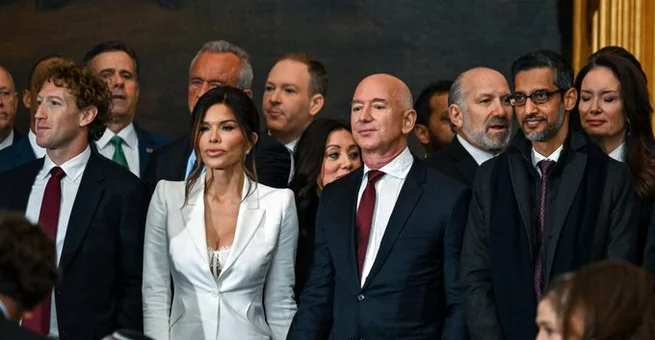
Searchers asking “Did Trump actually rein in Big Tech?” or “Why are tech CEOs suddenly close to Trump?” are landing on a surprising answer: the promised populist squeeze on Silicon Valley didn’t really materialize. A year ago, MAGA populists celebrated the image of tech leaders orbiting Trump as proof the “oligarchs” had been broken. Now, the dynamic looks reversed—Big Tech appears to have learned how to work the administration’s incentives, stall or redirect threats, and reshape the agenda in its favor.
Right before the inauguration, the photo-ops were intoxicating for the populist wing: top tech executives showing up, cutting checks, taking meetings, and signaling they could play ball. Influencers like Steve Bannon framed it as a turning point—years of grievances over moderation, media coverage, and “censorship” suddenly replaced by a show of corporate deference. The message to the base was simple: Trump had the leverage, and the companies would fall in line.
But photo-ops are cheap. Policy is where power shows.
A year later, the bigger story isn’t who sat where—it’s what didn’t happen. The high-drama ideas MAGA populists wanted most—big structural breakups, hard-edged tech punishments, forced outcomes on major platform fights—ran into the Washington reality Big Tech understands better than almost anyone: time, process, and internal faction warfare.
Big companies don’t always need to “win” outright. Often, they just need to slow things down until priorities shift, allies change seats, or the White House gets bored and moves on. In a political environment where attention is currency, delay can be the victory.
One of the clearest signals of the shift: the administration’s posture around TikTok has looked less like a decisive populist crusade and more like a muddle—especially as Trump’s own political incentives collide with the platform’s reach. A forced “American acquisition” storyline that once seemed like a populist trophy hasn’t delivered the clean outcome many expected, and that ambiguity benefits the status quo.
When a fight turns into a long negotiation with no finish line, the biggest players—those with lawyers, lobbyists, and stamina—tend to do best.
While culture-war fights grab headlines, the quieter contest over AI rules is where the stakes are exploding. In Nguyen’s account, tech-aligned power brokers pushed hard to shape the AI agenda—especially by discouraging a patchwork of state-level regulations that could box companies in. That’s a hugely material win for major AI players, because it keeps the compliance map simpler and preserves room to scale fast.
This is where Big Tech’s advantage shows: it can translate technical complexity into political leverage. If lawmakers feel lost, the best-organized industry voice often becomes the default “expert.”
Another major reason populists lost leverage? The people around Trump changed. Nguyen and other Verge reporting describe a world where Trumpworld figures increasingly function as tech lobbyists—sometimes explicitly, sometimes through influence networks that blur politics, business, and personal loyalty. That ecosystem rewards those who can offer access, money, media amplification, and “wins” Trump can claim quickly.
In that kind of system, Big Tech doesn’t need to convince everyone. It just needs to convince the right nodes.
A big subtext here is Trump’s habit of letting internal rivals fight—then backing whichever side feels most useful in the moment. MAGA populists expected a straight line from grievance to crackdown. Instead, Big Tech learned to operate inside the churn: flatter where it matters, negotiate where it counts, and keep opponents busy battling each other.
That doesn’t mean the populists got nothing. It means their grip on tech policy weakened, while the industry’s ability to steer outcomes strengthened.
If you’re watching this from the outside, it can feel like whiplash: how do the same CEOs go from villains to valued guests without a public ideological conversion? The answer is that Washington incentives beat online narratives. Big Tech is built to run long campaigns—funding, staffing, messaging, legal strategy, and relationship management—while populist movements often burn hottest on spectacle and short-term dominance.
A year in, the scoreboard looks less like a revolution and more like a familiar pattern: the institutions and industries that can endure the longest usually shape the final rules.










Comment