Alerts

-
5 minutes, 27 seconds
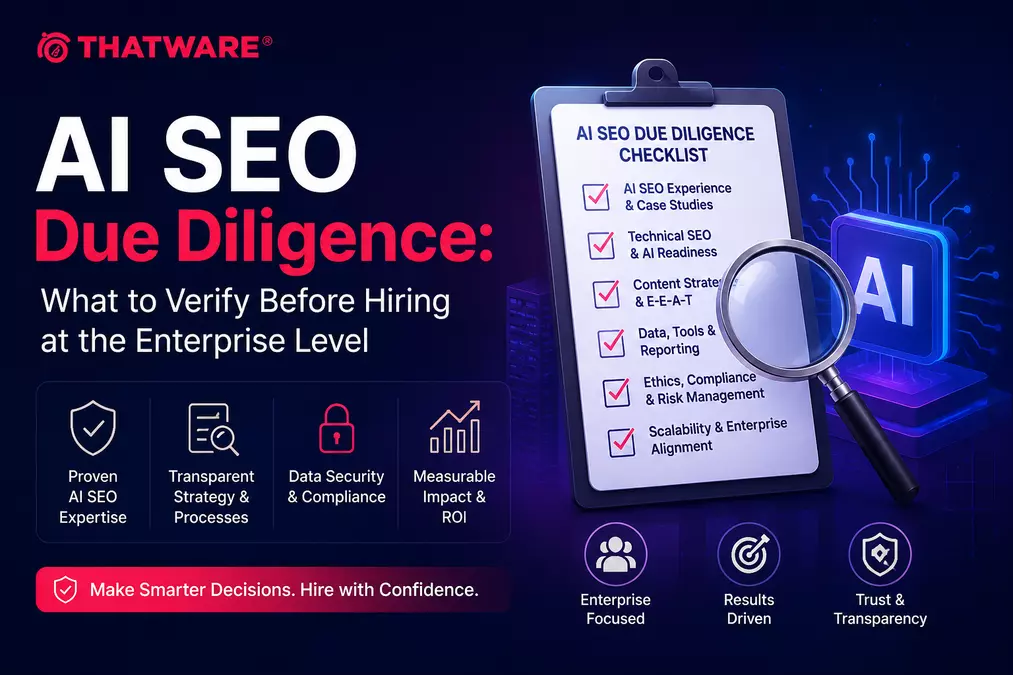
Enterprise SEO decisions are rarely simple. They involve multiple stakeholders, long approval cycles, and budgets that carry real pressure. When AI enters the equation, the evaluation becomes even more complicated because almost every agency today claims to be “AI-driven,” yet very few can clearly explain what that actually means in practice.
This is where careful due diligence becomes critical. At enterprise level, the wrong SEO partner does not just waste budget. It slows down growth, distorts reporting, and creates long-term visibility gaps that are difficult to recover from.
For many teams currently evaluating providers, the goal is often to hire the best AI SEO agency for enterprise. But before that decision is made, it is important to understand what separates real capability from surface-level positioning.
Before reviewing agencies or running procurement cycles, internal clarity is essential. Many enterprise SEO failures do not come from poor execution but from unclear expectations on the client side.
Teams should be aligned on what success actually means. For some organizations, it is pipeline growth. For others, it is brand visibility or expansion into new markets. Without defining this upfront, even the strongest agency will struggle to deliver meaningful results.
Ownership is another overlooked factor. SEO often sits between marketing, content, product, and growth teams. If no single group owns the strategy, execution becomes fragmented.
Content production capacity also matters. Agencies can build strategy, but execution depends on collaboration. The stronger the internal alignment, the stronger the outcomes.
A major mistake enterprise buyers make is confusing tool usage with methodology.
Many agencies now say they use AI, but that often means nothing more than faster content generation or automated reporting. That is not an AI-native approach.
A real AI SEO methodology focuses on how search systems interpret meaning, not just how content is produced. This includes semantic architecture, entity relationships, structured data design, and optimization for AI-generated search results.
A strong agency should clearly explain how it improves visibility in AI Overviews and large language model outputs. If the answer is limited to “AI content creation,” it is a warning sign.
Enterprise brands also require deep knowledge graph optimization. Large organizations often have multiple brands, regions, executives, and product layers. Each of these must be correctly mapped so that AI systems understand the full entity structure.
Without this, even high-quality content struggles to gain consistent visibility.
Enterprise SEO is not just strategy. It is operational execution at scale.
Agencies working at this level need structured workflows, dedicated teams, and strong project management systems. Without this, complexity quickly leads to breakdowns.
A practical evaluation approach is to ask about current enterprise clients, team structure, and reporting systems. It is also useful to understand how they manage multilingual or multi-market campaigns.
In many cases, agencies will self-select out of enterprise discussions when they realize the scale requirements. That honesty is valuable.
Traditional SEO reporting is no longer enough.
Keyword rankings and organic traffic still matter, but they do not fully reflect how modern search behaves. A significant portion of visibility now happens inside AI-generated summaries where clicks are not always tracked in the same way.
A mature agency should report on AI visibility signals such as citation frequency in AI Overviews, brand mentions in generative responses, and share of voice across AI search environments.
They should also connect visibility directly to business outcomes like pipeline contribution or revenue impact.
If reporting is still focused only on surface-level metrics, it is not enterprise-ready.
Enterprise brands operate in environments where context matters.
Finance, healthcare, SaaS, legal, and other regulated industries require a clear understanding of compliance rules, trust signals, and content restrictions. This is where many agencies fail, because they apply generic SEO frameworks across all industries.
Strong agencies demonstrate real subject matter understanding. They know how E-E-A-T principles apply in regulated sectors. They understand competitive constraints and how authority is built differently across industries.
Case studies in similar industries are not optional. They are essential proof of capability.
Enterprise engagements should never be structured around activity alone.
A strong contract includes measurable milestones, clear KPIs, and review cycles that assess performance against business outcomes. It should also allow flexibility if results consistently miss expectations.
Agencies that are confident in their systems usually welcome this level of accountability. Those that resist it often rely more on process volume than actual outcomes.
The contract should reflect partnership, not dependency.
In enterprise SEO, the pitch team is not always the delivery team.
It is common for senior strategists to lead sales conversations, while day-to-day execution is handled by junior staff. This gap can significantly impact quality if not addressed early.
It is important to meet the actual people who will manage the account. Their experience, stability, and understanding of enterprise environments matter more than polished presentations.
High turnover in account teams is often a warning sign of deeper structural issues within an agency.
Enterprise SEO is a long-term investment. The impact of choosing the right or wrong partner compounds over time.
The strongest results come from agencies that combine technical depth, AI-era understanding, and operational maturity. These are not easy to evaluate quickly, which is why structured due diligence is essential.
Some of the most capable top AI SEO agencies today have rebuilt their entire methodology around how AI systems interpret search, not just how traditional rankings are achieved. Identifying these agencies requires careful evaluation beyond surface-level claims.
A helpful reference point for structured evaluation is an enterprise AI SEO agency due diligence checklist before signing, which outlines key verification steps used by enterprise teams during procurement cycles.
The enterprise SEO landscape is changing quickly, and AI has accelerated that shift. What used to be a relatively straightforward procurement decision is now a technical and strategic evaluation process.
The agencies that succeed in this space are not the ones with the loudest claims, but the ones with clear methodology, transparent reporting, and real infrastructure to support scale.
ThatWare continues to operate in this space by focusing on structured AI-driven SEO systems, enterprise-grade execution, and transparent methodology that aligns with how modern search actually works. In a market filled with noise, that level of clarity is what enterprise teams should be looking for when making long-term decisions.

8.4K articles

2.7K articles

1.6K articles

34 articles








Comment