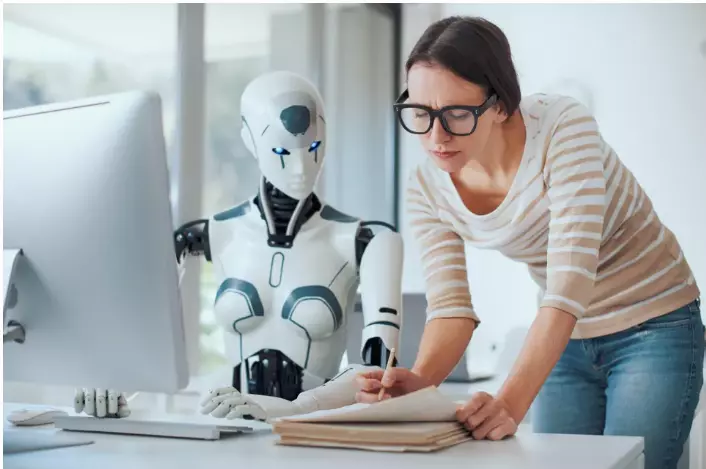
The AI teammate mindset is quickly becoming a defining skill in modern workplaces. As artificial intelligence tools become embedded in daily workflows, experts say employees must start thinking of AI as a collaborator rather than a threat. Workers who learn to partner with AI may gain a major productivity advantage, while those who resist the shift risk falling behind colleagues who know how to use the technology strategically. With AI adoption accelerating across industries, embracing the AI teammate mindset could soon be essential for career growth.
Just a few years ago, artificial intelligence triggered widespread fear among workers worried about job loss and automation. Today, that anxiety is slowly evolving into cautious optimism. Workplace experts now say the narrative is shifting from “AI replacing humans” to “AI working alongside humans.” Instead of acting as a distant tool, AI is increasingly integrated directly into daily tasks, from research and writing to decision-making support. By the end of 2026, analysts predict AI will be present in nearly every professional workflow. As this shift accelerates, the idea of AI functioning like a workplace teammate is gaining traction.
Major technology companies and software platforms are investing heavily in the concept of AI-powered collaboration. Businesses are developing tools designed to operate as digital assistants capable of supporting entire teams. The goal is not to eliminate human roles but to enhance productivity and problem-solving. In many organizations, AI already helps summarize meetings, generate reports, and analyze large data sets. Leaders see these capabilities as an opportunity to transform how work gets done. For employees, the key question is no longer whether AI will be used—but how effectively they can work alongside it.
Despite growing enthusiasm among executives, many workers still hesitate to fully embrace AI as a coworker. Research from Slingshot’s Digital Work Trends Report shows that 41% of C-suite leaders see AI as an emerging member of the team. Employees, however, view it differently. Over half of workers describe AI primarily as a tool rather than a collaborator, and only a small percentage consider it a true teammate. Even younger employees—often viewed as the most tech-savvy—express concern that AI could eventually replace human roles. This divide highlights the cultural adjustment still happening inside organizations.
Another workplace dynamic is widening the gap between leaders and employees. According to recent research from Checkr, 64% of managers feel pressure to adopt AI in order to remain competitive. In contrast, fewer than 40% of employees report feeling the same urgency. More than half of managers also believe AI skills are becoming an unspoken job requirement. That perception suggests the future workforce may increasingly reward employees who develop AI fluency early. Workers who delay learning these tools could find themselves at a disadvantage as expectations evolve.
Interestingly, recent graduates appear to be ahead of senior professionals in AI readiness. A study from SHL found that 38% of entry-level graduates demonstrate strong AI-related workplace competencies, compared with just 23% of leaders. Younger professionals also outperform experienced workers in critical thinking within AI contexts and advocating for AI adoption. This shift is prompting organizations to rethink talent strategies. Many leaders now see early-career employees as valuable drivers of digital transformation within their teams.
Experts say the best way to adopt the AI teammate mindset is to begin experimenting with AI tools now. Workers don’t need to become specialists overnight, but hands-on experience builds confidence quickly. Using AI to draft content, organize research, or analyze information can reveal practical ways the technology improves efficiency. Over time, employees can move beyond simple productivity tasks and explore how AI supports strategic thinking and decision-making. Transparency also matters. Sharing AI discoveries with colleagues helps teams learn together and accelerates innovation across the organization.
For professionals hesitant about AI, the biggest threat may not be automation itself. Instead, it could be competing with coworkers who know how to use AI effectively. Employees who treat AI like a junior collaborator—guiding it, refining its output, and applying human judgment—can dramatically increase their productivity. Those who resist the technology may struggle to keep pace with teams that integrate it seamlessly into their work. In a rapidly evolving job market, adaptability often determines long-term success.
Ultimately, the rise of the AI teammate mindset reflects a broader transformation in how work happens. Artificial intelligence will likely eliminate repetitive tasks and streamline complex processes, but human creativity, judgment, and leadership remain essential. The professionals who thrive will be those who see AI as a partner rather than an adversary. By embracing this mindset early, employees can position themselves at the center of the next wave of workplace innovation—rather than watching it happen from the sidelines.





Comment