If you’ve ever wondered whether decisions are rational or emotional, new research suggests the answer is clear: every decision has an emotional component. From business strategy to sports tactics, feelings often shape outcomes more than we admit. Fresh data on emotional intelligence and decision-making shows that higher EQ is linked to more disciplined processes and more accurate predictions. In an era where AI handles tasks but humans still make the calls, understanding this connection may be one of the most valuable leadership advantages you can build.
The Hockey Study That Challenged Logic
In 2018, a paper nicknamed “Pulling the Goalie” shook the sports world. Researchers found that hockey coaches often wait until two minutes remain to pull the goalie when trailing. Statistically, that timing is too late. Data showed teams down by one goal should consider pulling the goalie with six minutes left, and teams down by two goals with up to twelve minutes remaining.
So why don’t coaches follow the math? Emotion. Specifically, fear of losing badly and facing backlash from fans, players, or owners. The study revealed that tradition wasn’t rooted in logic but in emotional risk aversion. It’s a powerful reminder that even elite professionals are influenced by how losses feel, not just how probabilities calculate.
Every Decision Has an Emotional Component
This dynamic isn’t limited to sports strategy. Research shows that people who enjoy their college experience are more likely to donate later. Stock markets shift alongside global weather patterns. Even baseball pitchers are more likely to hit batters on hot days. Emotions quietly shape behavior in ways most decision-makers never consciously notice.
Importantly, emotion isn’t the enemy of sound judgment. Anxiety can prompt preparation before a speech or careful planning before launching a product. Fear can protect us from reckless moves. The real risk comes from ignoring emotions altogether. When leaders pretend feelings aren’t present, those feelings often drive the decision behind the scenes.
Emotional Intelligence and Decision-Making: The Four Core Skills
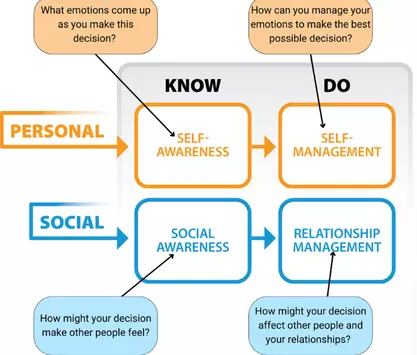
Emotional intelligence (EQ) refers to the ability to recognize, understand, and manage emotions—both your own and others’. It’s commonly broken into four core skills: self-awareness, self-management, social awareness, and relationship management. Each plays a distinct role in decision-making quality.
Self-awareness helps leaders identify the emotional drivers behind a choice. Self-management ensures those emotions don’t hijack the outcome. Social awareness helps leaders anticipate how decisions will affect others. Relationship management allows them to maintain trust even when making difficult calls. Together, these skills transform reactive choices into deliberate ones.
Mapping EQ Skills to Better Decisions
When mapped directly onto decision-making, the overlap becomes clear. Recognizing your fear, excitement, or frustration is the first step in preventing impulsive action. Managing those feelings allows you to pause, reflect, and apply a process instead of reacting automatically. Considering how others might respond builds empathy into strategy.
Strong relationships also improve decisions. Leaders with trusted networks can test assumptions and gather perspective before committing. That feedback loop reduces blind spots. In many cases, what looks like “good instincts” is actually disciplined emotional regulation combined with thoughtful input.
New Research on Emotional Intelligence and Decision-Making
A recent analysis of 1,393 professionals who completed an EQ assessment found a consistent pattern. Higher emotional intelligence was moderately correlated with using a structured decision-making process. It was even more strongly associated with reporting that decisions turned out as expected.
In practical terms, individuals who said they “almost always” used a process scored roughly six points higher in EQ than those who rarely did. The same gap appeared when participants evaluated how accurately their decisions matched expected outcomes. Among the four EQ skills, social awareness was most linked to using a process, while self-management was most connected to positive results. While the findings are self-reported and don’t prove causation, the signal is difficult to ignore.
Why Emotional Intelligence Matters in the AI Era
As automation reshapes the workplace, emotional intelligence and decision-making are consistently ranked among the most critical future skills. Reports from organizations like the World Economic Forum and McKinsey & Company repeatedly highlight both capabilities as essential for navigating technological change. When AI handles analysis, humans remain responsible for judgment.
Ethical oversight, stakeholder trust, creative thinking, and relationship-building cannot be outsourced to algorithms. Leaders must ensure AI is applied responsibly and strategically. That requires emotional awareness, empathy, and disciplined thinking. As roles evolve, the ability to manage emotions and make thoughtful decisions will separate adaptable organizations from reactive ones.
The Bottom Line: You Can’t Remove Emotion—But You Can Master It
The takeaway isn’t that emotion undermines logic. It’s that emotion and logic are inseparable. Ignoring feelings doesn’t eliminate their influence; it simply makes that influence invisible. Emotional intelligence gives leaders the tools to recognize, regulate, and channel those forces productively.
In high-stakes moments—whether pulling a goalie, approving a budget, or navigating change—the best decisions rarely come from pure instinct. They come from disciplined processes shaped by emotional insight. And in a world where change is constant, mastering emotional intelligence may be the most strategic move of all.














Comment