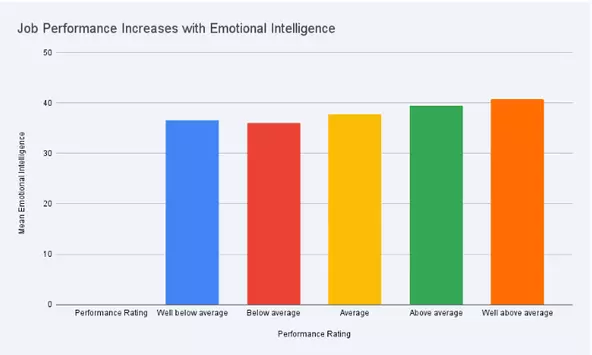
Emotional intelligence is often dismissed as a “soft skill,” especially by technical or high-stakes teams, but new data suggests that assumption is costly. Leaders frequently ask whether EQ really impacts job performance or salary in measurable ways. The short answer is yes, and the numbers are hard to ignore. Analysis of nearly 1,500 professionals shows a clear link between emotional intelligence, stronger performance ratings, and higher pay tiers. These findings help explain why organizations are rethinking how they define “real” skills. As workforce planning intensifies, EQ is moving from optional to essential.
The data reveals that emotional intelligence is strongly correlated with job performance across roles and industries. For every incremental increase in EQ score, self-rated performance rises in a meaningful way. A 10% improvement in emotional intelligence typically translates into a noticeable jump on a five-point performance scale. In practical terms, that shift is often enough to move someone from average to above average. A 20% EQ improvement pushes professionals more than halfway into the next performance tier. This suggests EQ doesn’t just support performance; it actively accelerates it.
The salary findings tell a similarly compelling story. Emotional intelligence scores consistently aligned with higher pay bands in the dataset. A 10% increase in EQ predicted movement into the next salary tier by roughly a quarter step. Since each pay band represents a significant income jump, even modest EQ gains matter. A 20% EQ increase correlated with an additional $15,000–$20,000 in annual earnings. Over a 30-year career, that difference approaches half a million dollars.
Emotional intelligence is built on four core skills: self-awareness, self-management, social awareness, and relationship management. While all four correlated with better outcomes, relationship management stood out as the strongest predictor of performance and salary. Professionals skilled at managing conflict, delivering feedback, and building trust consistently landed in higher performance and pay tiers. Self-management and social awareness followed closely behind. Self-awareness still mattered, but its impact was slightly smaller on its own. Together, these skills compound, with relationship management delivering the highest return.
Relationship management doesn’t exist in isolation. To give effective feedback, for example, a person must recognize their own discomfort, regulate their emotions, and read the room accurately. That requires self-awareness, self-management, and social awareness working together. When these skills align, interactions become clearer, calmer, and more productive. This explains why relationship-focused behaviors are so powerful in real-world settings. They turn emotional intelligence into visible, measurable impact.
One reason emotional intelligence delivers such strong returns is that it’s highly trainable. Unlike IQ or personality traits, EQ improves with deliberate practice and feedback. Research shared by Travis Bradberry shows that leaders who engaged fully in EQ coaching, microlearning, and goal tracking all improved bottom-line performance. Partial participation still produced gains, while no follow-through delivered minimal results. The takeaway is simple: effort matters. When organizations invest properly, EQ skills improve and results follow.
Strong emotional intelligence programs share common ingredients. Daniel Goleman’s research highlights motivated participants, sufficient training time, and ongoing reinforcement as critical factors. Social support through coaching or peer accountability increases consistency and habit formation. Leadership modeling also plays a decisive role in sustaining behavior change. When senior leaders visibly practice emotional intelligence, it signals that these skills are valued. Culture, not just content, determines success.
Emotional intelligence isn’t about being nicer at work; it’s about performing better and earning more over time. The data makes it clear that EQ influences both how well people do their jobs and how much they’re paid for it. For individuals, improving emotional intelligence is a career investment with compounding returns. For organizations, it’s a lever for productivity, retention, and leadership readiness. The next time EQ is labeled a “soft skill,” the numbers tell a much harder truth.


Copyright © 2026


Comment