What are operational relationships and why are they becoming one of the most searched leadership concepts in 2025? As companies grow more matrixed, distributed, and cross-functional, more leaders are discovering that the middle layer holds the key to organizational execution. Middle managers aren’t just “running the middle.” They are leading the operational relationships that connect culture, strategy, and front-line delivery—turning high-level plans into coordinated action across teams, functions, and geographies.
Why Operational Leaders Sit at the Center of Execution
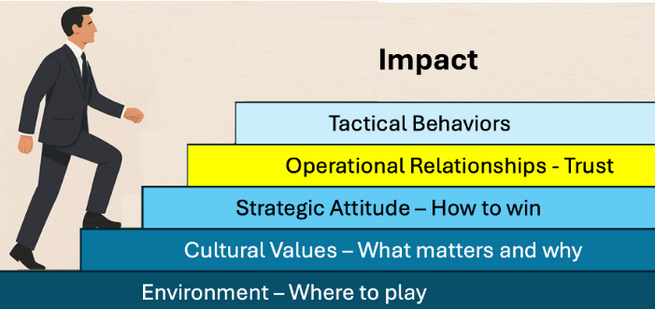
In the BRAVE nesting of leadership—where cultural leaders set values, strategic leaders define attitude, operational leaders steward relationships, and tactical leaders drive behaviors—the middle holds everything together. Operational leaders make strategy real by translating the “how we win” into the “how we work together” every day. Their job is alignment: ensuring that marketing collaborates with sales, finance supports product, and headquarters stays in rhythm with the field. When operational management is strong, teams move in step. When it falters, silos and friction quietly take over.
What Great Operational Relationship Leadership Looks Like
Top-performing middle managers function like chief relationship officers. They build trust upward with executives, downward with teams, and sideways with peers—knowing that execution depends on shared context, not just task lists. Consider a leader coordinating a major launch: she brings marketing, supply chain, finance and product into a shared planning rhythm; clarifies dependencies and decision rights; communicates trade-offs early; and elevates risks with solutions, not blame. This kind of leadership produces fewer surprises, faster problem-solving, and higher engagement because people feel connected to a common mission.
How Operational Leadership Breaks Down
Failures in operational relationships rarely begin with conflict. Instead, they surface as missed deadlines, rework, and preventable churn. Most breakdowns fall into three patterns. The Siloed Translator focuses narrowly on “my metrics,” attending cross-functional meetings only to report—not align. The Overloaded Firefighter promises too much to too many and delivers chaos despite good intentions. And the Passive Conduit relays messages without context, challenge, or synthesis, allowing confusion and informal power structures to fill the gaps. Each failure mode weakens trust and slows the entire organization.
How Middle Managers Can Lead Operational Relationships Better
To step up, middle managers can start by reframing their role—from owning work to owning relationships. Instead of asking, “What is my team delivering?” the real question becomes: “Which critical interfaces am I strengthening this week?” Leading with trust matters just as much. That means clarifying intent, stating constraints openly, renegotiating commitments early, and following through consistently. And integration matters: offering senior leaders early warnings with options, while helping teams connect strategy to concrete decisions across functions.
Why This Matters Now More Than Ever
Today’s organizations operate through handoffs, virtual collaboration, and project teams that rarely share the same boss or building. Work moves through time zones, tools, and teams that must rely on each other without always knowing one another. In this environment, operational relationships aren’t just helpful—they’re the glue binding strategy, culture, and daily execution. Without that glue, even the strongest strategies remain theoretical, never reaching the front line where results are created.
The Leadership Question Every Middle Manager Must Answer
At a time when execution is increasingly cross-functional and interdependent, middle managers face a defining question: Are you simply managing tasks inside your lane, or are you leading the relationships that bring strategy to life? The answer determines whether an organization achieves alignment or drifts into disconnected effort—whether its culture stays aspirational or becomes lived experience.
Middle managers who master operational relationships don’t just “run the middle.” They enable coordinated excellence—and that impact ripples across the entire enterprise.














Comment