
Alerts
-
4 minutes, 3 seconds
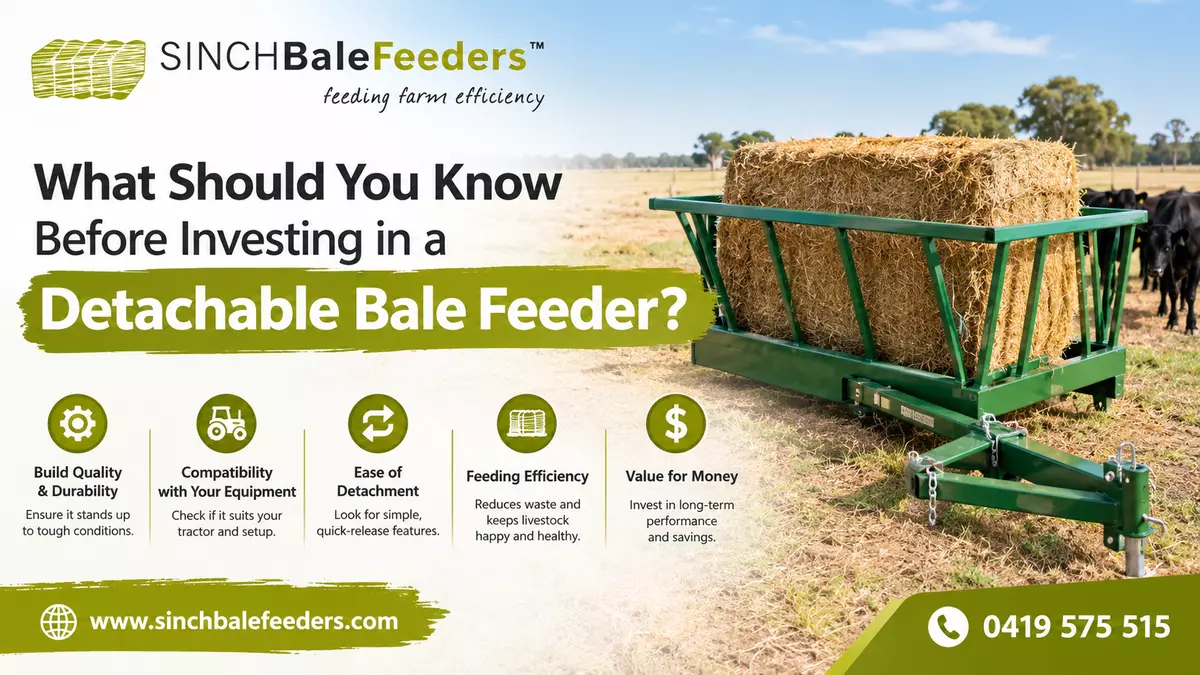
Choosing feeding equipment is an important decision for livestock operations that regularly handle large quantities of hay or silage. A detachable system is designed to provide flexibility by allowing the feeding unit to be mounted on a suitable platform, truck, or trailer and removed when it is needed for another task. Before investing in a livestock hay feeder, farmers should understand how the equipment fits into their existing feeding routine, machinery fleet, and available infrastructure.
The type and size of bales used on a farm should be one of the first considerations. Large square bales require equipment capable of supporting their weight and dimensions throughout loading, movement, and feed-out. A square bale feeder should be selected according to the bale specifications used by the operation rather than based solely on its overall capacity.
Consider:
Bale dimensions and average weight.
Number of bales required per feeding cycle.
Frequency of feeding.
Available loading equipment.
Distance between storage and feeding areas.
Matching the feeder to the farm's bale type helps ensure that the equipment integrates properly into daily operations.
One of the main reasons farmers consider a detachable system is flexibility. Unlike a permanently installed feeder, a detachable unit can be removed from its supporting platform when feeding work is finished. This allows the truck, trailer, or other platform to be used for different agricultural tasks.
For a farm using one vehicle for transportation, material handling, and feeding, a detachable livestock hay feeder may help make better use of existing equipment. However, farmers should check how the unit attaches and detaches and whether the supporting platform is suitable for the feeder's dimensions and operating requirements.
Hydraulic power is another important factor when evaluating bale feeding equipment. A hydraulic system drives the feeding mechanism and needs to be compatible with the power source being used.
Before purchasing, review:
Hydraulic pressure and flow requirements.
Available hydraulic connections.
Control arrangements.
Power source compatibility.
Accessibility for maintenance.
A square bale feeder that depends on hydraulic operation should be matched carefully with the hydraulic system of the intended truck, tractor, or other power unit.
The location where hay or silage is distributed can influence the type of feeder required. Some operations feed livestock in fixed areas, while others move between paddocks or grazing locations.
A detachable system can be useful when feeding locations change because the equipment can be configured for mobile operation. Farmers should consider road access, paddock conditions, terrain, turning space, and the distance between bale storage areas and feeding locations.
Feeding large quantities of hay can involve repeated loading, positioning, handling, and distribution tasks. Mechanical feeding equipment can reduce the amount of manual work involved in these activities.
When evaluating a livestock hay feeder, consider how many workers are currently involved in feeding and which tasks consume the most time. A suitable mechanical system may help consolidate several steps into a more organized feeding process.
Agricultural equipment operates in demanding environments where dust, moisture, forage residue, and heavy loads can contribute to wear. Maintenance requirements should therefore be considered before purchasing a feeder.
Look for practical features such as:
Accessible grease points.
Durable drive components.
Straightforward hydraulic connections.
Replaceable wear components.
Easy access to areas requiring inspection.
A well-maintained square bale feeder can support consistent operation while helping operators identify potential issues before they interrupt feeding schedules.
A detachable feeder only provides its intended flexibility when it works properly with the equipment already available on the farm. Measure the platform, check mounting requirements, and confirm that the supporting vehicle can safely accommodate the feeder and loaded bales.
Farmers should also consider whether the platform will remain useful for other jobs after the feeder is removed. This is one of the key advantages of a detachable configuration.
The right feeding equipment should fit both current and anticipated farm requirements. Consider possible changes in livestock numbers, bale volumes, feeding locations, and machinery availability.
Rather than focusing only on the initial purchase, evaluate the feeder based on its expected role within the entire farm operation. A flexible livestock hay feeder may provide greater practical value when it complements existing equipment and feeding practices.
Investing in a detachable bale feeder requires more than comparing equipment capacity. Bale dimensions, hydraulic compatibility, mounting requirements, feeding locations, labor needs, maintenance, and existing machinery all influence whether a particular system is suitable.
By evaluating these factors in advance, farmers can choose a square bale feeder that fits their operation and supports a more organized approach to hay feeding. The goal is to select equipment that works with the farm rather than requiring the entire feeding system to be redesigned around the machine.



Comment