
Alerts
-
3 minutes, 12 seconds
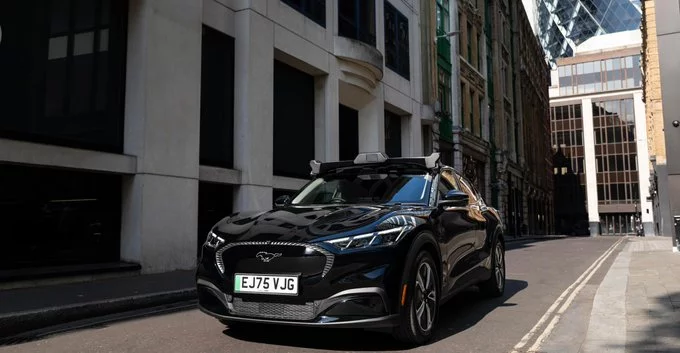
Uber has become the first company to launch robotaxis in London, beating rival Waymo to the punch in one of the world’s most demanding urban environments. The ride-hailing giant’s autonomous vehicles are now picking up passengers in the British capital, marking a significant strategic victory over Alphabet’s self-driving unit, which had been widely expected to enter the London market first.
According to the company, the initial rollout will operate in a defined area of the city, with a fleet of vehicles based on a modified electric SUV. Unlike some competitors, Uber’s approach does not rely on lidar or a geofence; instead, the system uses a combination of cameras and advanced AI to navigate London’s complex, narrow streets and unpredictable traffic. This technical choice is designed to allow the service to be scaled more easily beyond the launch zone.
For now, the robotaxis will not be completely driverless. Uber has confirmed that human safety drivers will be present in all vehicles during the initial phase, sitting behind the wheel to intervene if necessary. This cautious approach is aimed at building regulatory confidence and gathering real-world data before moving to a fully autonomous operation. The company says the service will gradually expand its coverage and passenger capacity based on performance and safety metrics.
In a notable departure from many competing autonomous vehicle programs, the robotaxis operating in London do not rely on lidar sensors for navigation. Instead, the vehicles are equipped with a suite of cameras and radar, a design philosophy that prioritizes a vision-based approach to perception. This decision eliminates the high cost and mechanical complexity often associated with spinning laser units.
Furthermore, the service is not confined to a geofenced area. Unlike other pilots that restrict operations to a pre-mapped, limited district, these vehicles are designed to handle the full complexity of London’s dense urban streets. The absence of a geofence means the system must rely on robust, real-time mapping and decision-making to manage unexpected roadworks, parked vehicles, and pedestrians. This broader operational domain is a significant technical challenge, as the software must generalize across varied road layouts and traffic conditions without the safety net of a strictly bounded and heavily pre-scanned zone. The reliance on camera data and the lack of a territorial boundary underscore a fundamentally different engineering bet on the path to full autonomy, one that will be closely watched as the initial rollout progresses.
Despite the vehicle’s advanced autonomous capabilities, the initial launch will not be fully driverless. Uber has confirmed that a human safety driver will remain behind the wheel in every robotaxi during the early phase of the London rollout. This approach mirrors the cautious strategy adopted by other autonomous vehicle operators, allowing the technology to be monitored and refined in real-world conditions before any consideration of removing the human fallback.
The presence of a safety driver serves multiple critical purposes. Primarily, it provides an immediate layer of intervention should the autonomous system encounter an unexpected scenario or edge case that its programming cannot handle. This is especially important in a dense, complex urban environment like London, with its narrow streets, heavy pedestrian traffic, and unique road markings. Furthermore, the data collected from these supervised trips is invaluable, helping engineers identify weaknesses and improve the driving algorithms.
Uber has stated that this is a temporary measure, designed to build confidence and gather sufficient operational data. The company has not provided a specific timeline for when the safety drivers will be removed, emphasizing that the transition will be driven by demonstrated safety performance rather than a fixed schedule. For now, passengers will be riding with a trained operator present, ready to take control at a moment’s notice.










Comment