Alerts

-
5 minutes, 2 seconds
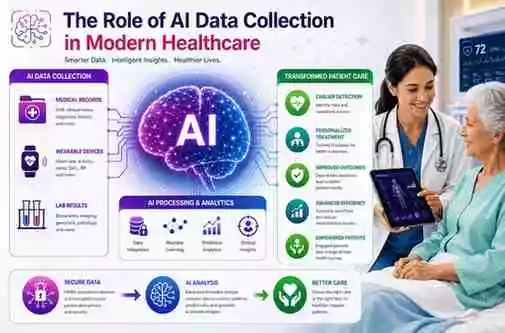
Artificial intelligence is transforming industries across the United States, from healthcare and finance to retail, automotive, and customer service. However, even the most advanced AI model depends on one critical resource: high-quality data. Without relevant, diverse, and accurately collected data, AI systems may struggle to deliver reliable results.
This is where an AI Data Collection company plays an important role. These companies help organizations gather, structure, and prepare the data required to train and improve machine learning and artificial intelligence models. By using professional AI Data Collection Services, businesses can obtain scalable datasets designed around their specific AI requirements.
AI models learn patterns from large volumes of data. The quality of this training data directly affects how accurately an AI system performs in real-world situations.
Poor-quality, incomplete, outdated, or biased data can create problems such as inaccurate predictions, inconsistent outputs, and poor model performance. For this reason, businesses need a reliable process for collecting data from appropriate sources.
An AI Data Collection company can help businesses develop datasets based on specific project requirements. Depending on the AI application, collected data may include images, videos, audio recordings, text, documents, or other forms of digital information.
For example, an autonomous vehicle project may require road images and driving videos, while a conversational AI system may need large volumes of speech and text data.
AI systems often need to work across different environments, users, languages, accents, and scenarios. Diverse datasets help businesses develop models that can perform effectively across a broader range of real-world conditions.
Professional AI Data Collection Services can help organizations define collection requirements that account for geographic, demographic, environmental, and contextual diversity.
An AI Data Collection company typically manages multiple stages of the data collection process. The exact workflow depends on the project's goals, data type, industry, and technical requirements.
The process usually begins by understanding what an AI model needs to learn. Data requirements may include file formats, volume, resolution, language, location, demographic characteristics, and specific scenarios.
Clear requirements help ensure that the collected dataset is relevant to the intended machine learning application.
Professional AI Data Collection Services can support multiple data formats, including:
By combining different collection methods, businesses can develop datasets that better reflect the conditions their AI systems will encounter.
Collecting large quantities of data is not enough. The dataset must also meet defined quality standards.
An AI Data Collection company may implement quality-control procedures to identify incomplete files, duplicates, unusable recordings, incorrect formats, and other issues. Validation helps businesses reduce unnecessary data-cleaning work later in the AI development pipeline.
Outsourcing data collection can provide several practical advantages for organizations developing AI applications.
AI projects can require thousands or even millions of data samples. Building an internal collection operation at this scale can require significant time, technology, and personnel.
Professional AI Data Collection Services can help organizations scale data gathering according to project requirements while maintaining defined collection standards.
Data collection can become a time-consuming part of an AI project. Working with an experienced provider allows internal AI teams to focus more heavily on model development, testing, and deployment.
A structured collection workflow can help reduce delays caused by insufficient or inconsistent training data.
Different AI applications require different data strategies. A healthcare AI model may require specialized medical datasets, while a computer vision system may require carefully selected images and videos.
An experienced AI Data Collection company can help organizations develop collection approaches suited to their particular AI use case.
Consistent collection methods make datasets easier to process and use in machine learning workflows. Standardized requirements can help maintain consistency across file formats, recording conditions, metadata, and other dataset attributes.
AI data collection is relevant across many industries in the U.S.
Healthcare organizations can use specialized datasets to develop AI applications for medical imaging, patient-support technologies, and healthcare analytics. Data collection must follow applicable privacy and compliance requirements.
Automotive companies use image and video datasets to support computer vision systems, advanced driver-assistance technologies, and autonomous driving research.
Retailers can collect product images, customer interaction data, and other information to support recommendation engines, visual search, inventory systems, and personalized experiences.
Financial institutions can use structured datasets to develop AI solutions for fraud detection, document processing, customer service, and risk analysis.
Selecting a suitable provider requires more than comparing data volume or pricing. Businesses should consider experience, scalability, data quality processes, security practices, and the provider's ability to support project-specific requirements.
Ask how the provider collects, validates, reviews, and manages datasets. Clear quality-control processes can help reduce problems during model training.
A provider should be able to support both initial pilot projects and larger production requirements as the AI application grows.
Organizations handling sensitive information should evaluate data security procedures, privacy practices, access controls, and relevant regulatory requirements before selecting an AI Data Collection company.
High-quality data is the foundation of successful artificial intelligence. As AI adoption continues to expand across U.S. industries, businesses need reliable ways to collect relevant, diverse, and scalable datasets.
An experienced AI Data Collection company can support this process by helping organizations define requirements, gather different types of data, validate datasets, and scale collection according to project needs. With professional AI Data Collection Services, companies can build stronger data pipelines and provide their AI teams with the information needed to develop and improve modern AI applications.





Comment